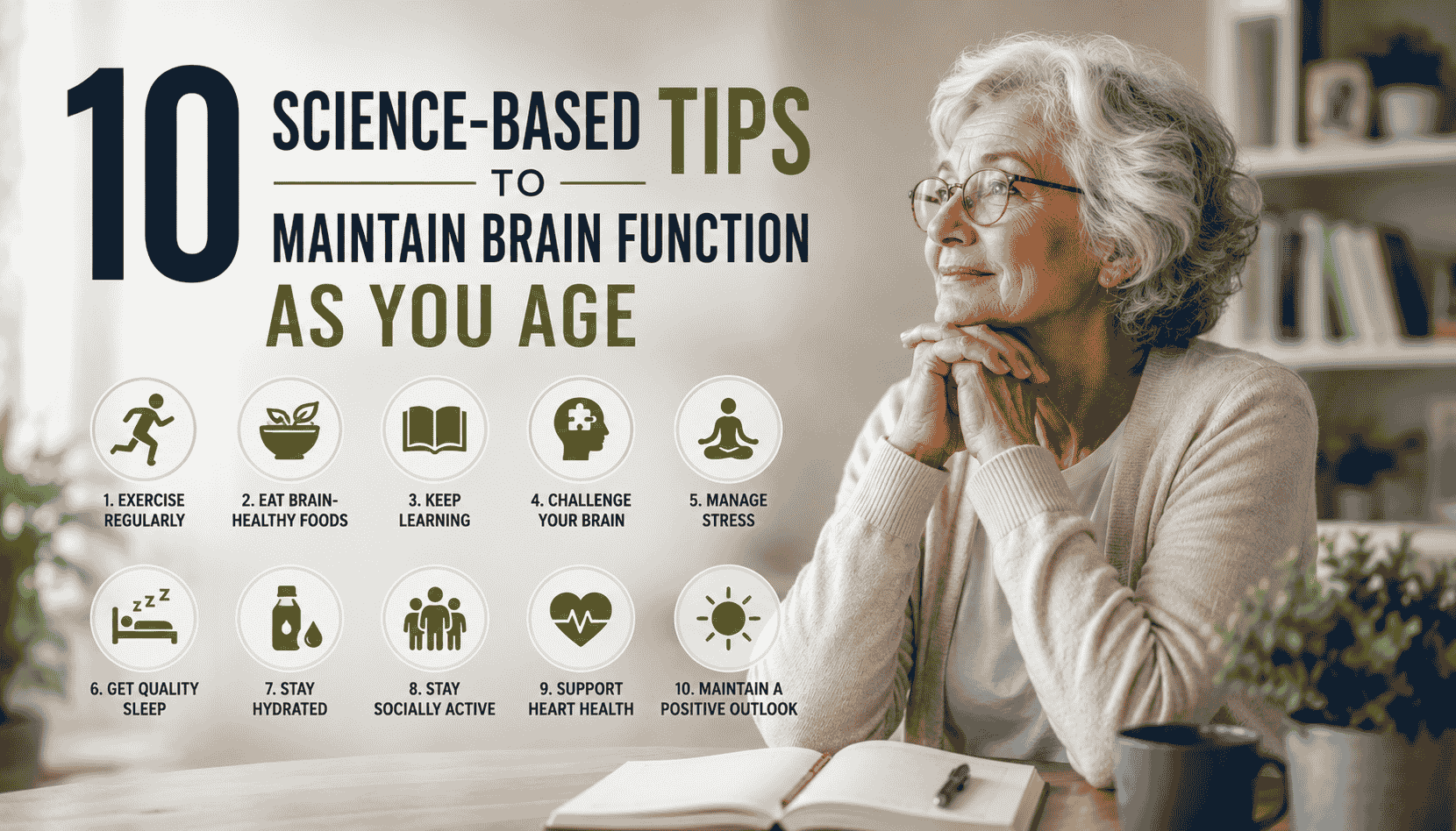
10 Science-Based Tips to Maintain Brain Function as You Age
Many people are curious about practical ways to maintain memory, thinking, focus, and general cognitive health as they age and how to keep their brains engaged.
The good news is that a number of lifestyle choices are linked to better brain aging. sustaining general brain health can be aided by regular exercise, enough sleep, a healthy diet, social interaction, education, controlling cardiovascular risk factors, and sustaining mental activity.
There isn’t a single meal, pill, puzzle, or “brain exercise” that can prevent dementia or memory loss, though. Numerous factors, such as age, genetics, medical conditions, lifestyle, and environment, have an impact on brain health.
The good news is that your brain can benefit from many of the same activities that support your heart and general health.
Let’s examine doable strategies to promote healthy aging and keep your brain engaged.
Why Age-Related Brain Health Is Important
Memory, attention, movement, emotions, communication, decision-making, and a host of other processes are all controlled by your brain.
Normal aging can lead to some alterations in memory and processing speed. For instance, you could need more time to remember details, take longer to learn something new, or occasionally forget a name.
However, substantial or quickly deteriorating changes in memory, thinking, personality, or the capacity to carry out daily tasks shouldn’t be written off as typical aging. These symptoms should be explored with a healthcare provider because there are numerous potential reasons.
In order to maintain cognitive health, the National Institute on Aging advises emphasizing good lifestyle choices and controlling medical disorders.
Ten Strategies to Maintain Brain Activity as You Age
1. Work Out Your Body
Maintaining an active lifestyle is one of the best strategies to promote general brain health.
Exercise promotes cardiovascular health and improves blood flow throughout the body. Taking care of your cardiovascular system is crucial to taking care of your brain since the brain depends on a healthy blood flow.
Among the beneficial activities are:
Cycling and Walking
Dancing, swimming, and gardening
Trekking
Strength training
Sports for recreation
The U.S. Centers for Disease Control and Prevention advise individuals to engage in muscle-strengthening activities at least twice a week in addition to at least 150 minutes of moderate-intensity physical activity each week.
You don’t have to accomplish that goal right away. If you’re not doing anything right now, start small and work your way up.
Easy concept:
Walk for 20 to 30 minutes most days of the week.
2. Continue to Learn New Things
Being challenged is good for your brain.
It takes focus, memory, problem-solving skills, and adaptability to learn something new.
Think about learning:
A novel language
An instrument of music
Taking pictures
Methods of cooking
Painting
Computer proficiency
Growing a garden
A novel academic topic
A fresh pastime
Selecting genuinely difficult and engaging activities is crucial.
Learning something new is a different kind of mental challenge than just repeating an activity you already know very well.
Mentally stimulating hobbies may be linked to improved cognitive health, according to the National Institute on Aging, though researchers are still figuring out which activities offer the biggest long-term benefits.
3. Read Frequently
One easy approach to keep your mind active is to read.
Your brain processes terminology, ideas, connections, and information while you read.
It’s not necessary for you to read complex academic literature.
Try:
Novels
Biographies
Science articles and history books
Newspapers
Nonfiction Periodicals Educational websites
Selecting content that piques your interest and stimulates thought is crucial.
Increase the activity of your reading
When you’ve completed a chapter, consider:
What were the key concepts?
What did I discover?
Can I give someone else an explanation?
As a result, reading passively becomes a more engaged learning activity.
4. Try New Activities to Test Your Brain
Playing games like card games, chess, crosswords, puzzles, and strategy games can be fun methods to test your brain.
However, don’t expect that playing brain-training games will stop dementia from happening.
There is conflicting evidence regarding commercial cognitive training programs, and the advantages might be greatest for the particular abilities being performed.
Combining many types of mental stimulation is a better tactic.
For instance:
Monday: A crossword puzzle
Tuesday: Acquire a fresh recipe
Read a book on Wednesday.
Thursday: Work on your linguistic skills
Play chess on Friday.
Saturday: Acquire a new ability
Sunday: Engage in artistic endeavors
Your routine remains engaging when it is varied.
5. Maintain Social Networks
Your brain is not an isolated entity.
A key component of healthy aging can be human connection.
Conversation, emotional support, mental stimulation, and a sense of belonging can all be obtained through regular social interaction.
Try:
Getting together with pals
Making calls to relatives
Participating in a community organization
Offering assistance
Enrolling in a course
Engaging in cultural or religious activities
Taking part in a walking group
Playing games with other people
Maintaining social engagement is one way to enhance cognitive health, according to the National Institute on Aging.
Start small if you’re feeling lonely. A simple phone conversation might be a significant step.
6. Make Restful Sleep a Priority
Sleep is more than just a period of time when your brain “switches off.”
Memory, learning, mood, and general health are all significantly impacted by sleep.
It can be more difficult to focus, retain knowledge, and control emotions during the day if you don’t get enough sleep.
Although everyone has different sleep demands, the CDC advises people to get at least seven hours of sleep every nite.
To encourage more restful sleep:
Maintain a regular sleep routine.
Make your bedroom cozy.
Before going to bed, cut down on pointless distractions.
Steer clear of too much caffeine late in the day.
Establish a calming evening ritual.
If your everyday life is being negatively impacted by ongoing sleep issues, consult a medical professional.
7. Consume Brain-Friendly Foods
No single “miracle food” can keep the brain youthful.
Instead, concentrate on eating a generally healthy diet.
Typical foods seen in dietary patterns that support brain health include:
Vegetables
Fruits
Whole grains
Legumes and beans
Seeds and nuts
Fish
Sources of lean protein
Unsaturated fats that are healthy
Due to its emphasis on fruits, vegetables, whole grains, legumes, nuts, and other nutrient-dense foods, the Mediterranean-style and MIND-style eating patterns have drawn a lot of study interest.
Maintaining general health and cognitive function requires consuming a balanced, healthful diet, according to the National Institute on Aging.
Rather than concentrating on a single “superfood”
Consider your overall eating habits.
Just as one subpar meal won’t undo a healthy eating pattern, a handful of berries won’t make up for an otherwise awful diet.
8. Guard Your Heart to Guard Your Brain
Brain and heart health are intimately related.
Blood vessels can be impacted by conditions like high blood pressure, diabetes, high cholesterol, and cardiovascular disease, which may raise the risk of cognitive issues.
Because of this, controlling cardiovascular risk factors is crucial to aging the brain healthily.
Collaborate with your healthcare provider to track and treat ailments like:
Elevated blood pressure
Diabetes
Elevated cholesterol
Heart conditions
Being overweight
Don’t stop taking prescription drugs or alter your course of therapy without first talking to your doctor.
9. Refrain from Smoking and Limit Alcohol Use
Smoking causes blood vessel damage and is linked to a number of health issues, such as stroke and cardiovascular disease.
At any age, quitting smoking has positive health effects.
Another crucial factor is alcohol. Overindulgence in alcohol can have detrimental effects on the brain and general health.
If you use alcohol, talk to a healthcare provider about what is suitable for your situation, especially if you take medication or have medical concerns.
10. Keep Your Head Safe
Reducing avoidable injuries is another aspect of brain health.
When engaging in activities where head injuries could occur, wear the proper protective gear.
For instance:
When cycling, wear a helmet that fits properly.
Observe safety precautions when participating in sports.
When driving, buckle up.
Minimize the risk of falls at home.
Wear the proper safety gear at work.
Prevention is important because severe or recurrent traumatic brain injuries can have long-term effects.
Older Adults’ Brain Exercises
Try combining several mental tasks if you’re looking for ways to keep your brain busy.
Activities for Memory
Learn a brief poem by heart.
Find out people's names.
Before you check your shopping list, remember it.
Develop your ability to recall instructions.
Activities for Solving Problems
Crosswords, Sudoku, chess, and logic puzzles
Games of strategy
Artistic Pursuits
Painting, writing, photography, music, crafts, and cookingActivities for Learning
Classes in languages
Online classes
Lectures for education
Innovative technology
Instruments for music
Social Exercises
Book clubs
Volunteering
Community-based organizations
Exercise in groups
Activities for the family
Activities that you appreciate and are ready to stick with are the finest.
Is It Possible to Stop Memory Loss as You Get Older?
Although there is no surefire way to stop dementia or age-related cognitive loss, this is a crucial question.
Physical inactivity, smoking, excessive alcohol use, hypertension, diabetes, obesity, hearing loss, depression, social isolation, and other modifiable lifestyle and health variables have all been linked to an increased risk of dementia, according to research.
According to the 2024 Lancet Commission study, a significant percentage of dementia cases at the population level may be avoided or postponed by addressing a number of modifiable risk factors across the life course.
This does not imply that altering one’s lifestyle will prevent dementia.
Age, genetics, and other variables are also important.
However, adopting healthy habits can still have a significant positive impact on your general health.
Indications to Consult a Physician
Normal aging can cause occasional forgetfulness.
Nonetheless, some alterations call for medical care.
Consult a medical expert if you or a loved one has experienced:
Memory issues that make day-to-day living difficult
Growing challenges with money or prescription management
Getting lost in well-known locations
Considerable shifts in judgment
Having trouble finishing routine tasks
Significant behavioral or personality changes
Growing communication challenges
Quick or alarming shifts in perspective
Don’t try to diagnose yourself using information from the internet.
A medical expert can assist in choosing the right assessment.
Frequently Asked Questions
Which type of exercise is better for maintaining brain health?
There isn’t a single exercise that everyone agrees is “best.” Aerobic exercises including walking, cycling, swimming, dancing, and others can improve general and cardiovascular health. Broader benefits can be obtained by combining aerobic exercise with strength and balance training.
Which meals are ideal for maintaining brain health?
A balanced diet full of fruits, vegetables, whole grains, legumes, nuts, and other nutrient-dense foods is preferable than a single food.
Do puzzles help people avoid dementia?
There is insufficient data to conclude that doing puzzles by itself can prevent dementia, but they can offer pleasurable mental activity. It is more suitable to have a more comprehensive strategy that includes learning, social interaction, physical activity, proper nutrition, sleep, and the treatment of medical disorders.
How can I maintain a sharp memory?
Maintain social relationships, consume a healthy diet, control cardiovascular risk factors, stay physically active, get enough sleep, keep studying, and keep your mind active.
Does the brain benefit from acquiring a new skill?
Acquiring difficult new abilities can be a beneficial component of an active lifestyle and offer mental stimulation. Instead than just repeating well-known tasks, select activities that need focus, practice, and learning.
Is it typical to become forgetful as you age?
Normal aging can cause some modest alterations, but serious memory issues that interfere with day-to-day functioning should be assessed by a medical practitioner.
Concluding Remarks
It doesn’t need costly pills, complex programs, or hours of brain games to learn how to keep your brain active as you age.
Developing a lifestyle that promotes your general health is the most sensible strategy.
Continue to be physically active. Continue your education. Go through it. Keep up your social ties. Make sure you get enough rest. Consume a healthy diet. Control diabetes, blood pressure, cholesterol, and other medical issues. Don’t smoke, don’t drink too much alcohol, and keep your head safe.
Above all, make your life engaging.
Engage in mental challenges, physical activity, social interaction, and lifelong learning.
Stopping the clock is not the goal of healthy brain aging. It’s about creating the ideal environment for your body and brain to be active and healthy throughout your life.