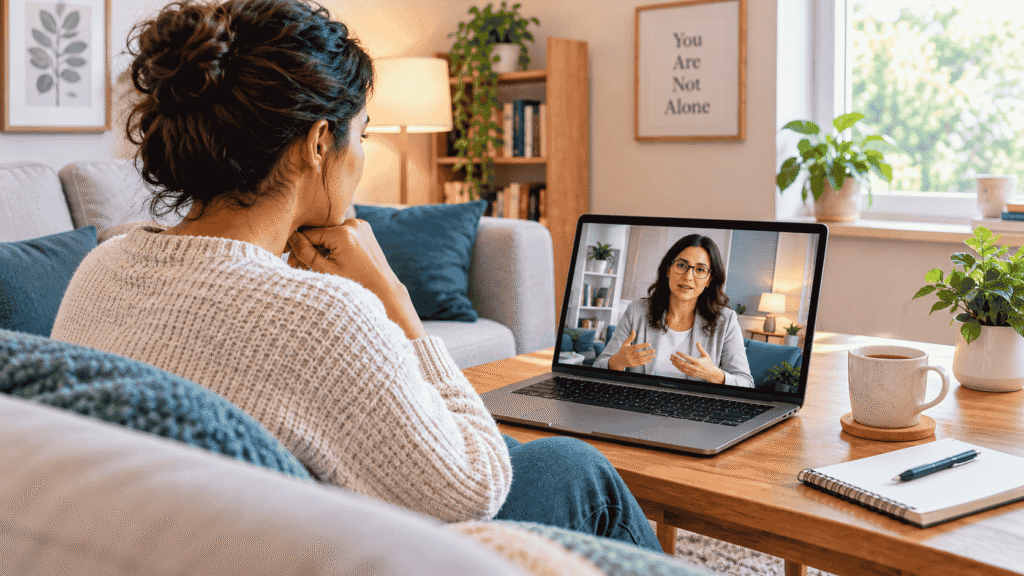

Best Online Therapy Options for Anxiety
Online therapy has become a more convenient approach to get mental health help. Instead of visiting a
clinic, consumers can speak with a certified mental health professional via video calls, phone sessions,
or, depending on the service, encrypted texting.
However, selecting an online treatment service should be more than just picking the cheapest or most
popular platform. The therapist’s credentials, therapy style, privacy safeguards, availability, cost, and fit
for your symptoms are all important.
What is Online Therapy?
Online therapy, often known as teletherapy, virtual therapy, or telepsychology, is psychological
counseling provided remotely using digital communication technologies.
Depending on the provider, sessions may occur through:
Video calls.
Telephone calls.
Secure texting or messaging.
Online Therapy Programs
Individual counseling.
Options for therapy include couples, family, and group sessions.
The National Institute of Mental Health states that virtual mental health treatments can include
evaluation, diagnosis, treatment planning, psychotherapy, medication-related care, and continuous
support, depending on the provider and scenario.
Can Online Therapy Help Treat Anxiety, Stress, and Depression?
Yes. According to research and recommendations from major mental health organizations, teletherapy
can be an effective treatment option for a variety of mental health issues.
According to the American Psychological Association, teletherapy provided by video or telephone can
produce results comparable to traditional in-person psychotherapy for a variety of conditions, including
anxiety and depression.
Online treatment may be especially beneficial for those who:
- Have trouble traveling to a therapist’s office.
- Prefer having therapy at home.
- Have a hectic job or family schedule.
- Live away from mental health doctors.
- Feel uneasy attending a typical clinic.
Want more flexible appointment options?
A evaluation of internet-based psychological therapies revealed that they helped with anxiety, stress,
and depression, albeit the efficacy varies by program and individual.
1. Video Therapy with a Licensed Therapist.
Best for: People looking for a typical therapy experience.
Video therapy enables you to communicate with a therapist in real time using a secure video platform.
It can be an effective treatment for anxiety, depression, marital problems, work stress, and other issues
that benefit from frequent consultations with a mental health specialist.
Advantages include:
Face-to-face interactions
Real-time communication.
Ability to develop a therapeutic connection
Access from home.
Frequently comparable in structure to conventional treatment.
If you prefer human connection and want to engage with a therapist visually, video sessions might be a
great place to start.
2. Online Cognitive-Behavioral Therapy (CBT)
Ideal for: Anxiety, sadness, anxiety, negative thinking, and stress-related issues.
Cognitive behavioral therapy is one of the most popular evidence-based psychotherapy techniques. CBT
assists people in identifying problematic thinking patterns and behaviors and developing healthy coping
strategies.
According to the National Institute of Mental Health, CBT is an evidence-based therapy for depression
that can help patients question and alter harmful ideas and behaviors.
Online CBT may include:
Video sessions with therapists
Structured exercises.
Thought records
Homework Assignments
Behavioral techniques
Progress tracking
Someone looking for online treatment for anxiety and depression may want to seek a program that
provides licensed CBT therapists.
3. Telephone Therapy
Best for: Those who do not wish to utilize video.
Some people find video calls unpleasant or distracting. Telephone treatment is a simpler alternative.
Research suggests that telephone-delivered psychological therapies might be an effective strategy to
enhance access to mental health care.
Telephone treatment can also be beneficial for:
Internet connection is unstable.
You like privacy without cameras.
You are uncomfortable with the video.
You want a simple communication mechanism.
4. Therapists favor online programs.
Ideal for: People looking for structured treatment under expert supervision.
Some online programs incorporate digital classes, exercises, assessments, and therapeutic discussions.
These technologies provide more structure than typical messaging while yet allowing therapy to be
provided remotely.
According to studies, properly evaluated internet-based therapies can considerably improve symptoms
of depression, anxiety, and stress.
5. Online Counseling for Stress and Life Issues
Best for: People dealing with professional stress, marital issues, grieving, burnout, or big life changes.
Not everyone seeking treatment has a diagnosed mental health condition. People often require expert
assistance while dealing with challenging circumstances.
Psychotherapy can help people deal with chronic stress, marital problems, loss, family issues, and other
unpleasant situations.
A certified counselor or therapist can assist you in identifying stress triggers and developing effective
coping and problem-solving skills.
How to Select the Best Online Therapy
Consider the following points before joining an online therapy platform.
1. Check the Therapist’s Credentials.
Search for a licensed and qualified mental health provider.
The APA advises verifying the provider’s licensure and the service’s ability to verify both the provider’s
and the client’s identities.
Depending on your demands, you could encounter:
Psychologists
Licensed professional counselors.
Clinical social workers
Psychiatrists
Other competent mental health specialists
2. Consider the Treatment Approach.
Different therapies are developed to meet different requirements.
Here are some common approaches:
Cognitive Behavioral Therapy (CBT).
Interpersonal psychotherapy (IPT)
Psychodynamic psychotherapy
Supportive treatment.
Exposure-based treatments for certain anxiety disorders
Mindfulness-based methods
CBT and interpersonal therapy are particularly identified by the NIMH as evidence-based therapies for
depression.
3. Consider Privacy and Security.
Mental health talks might reveal very intimate information.
Before you use a service, check:
How is your information protected?
Whether communications are encrypted
Who has access to your information?
How is your data stored?
Which privacy policies apply.
When choosing telepsychology services, the American Psychological Association suggests taking privacy
and security into consideration.
4. Compare costs.
Online treatment fees vary greatly.
Your entire cost might depend on:
Therapist qualifications:
Session duration
The frequency of appointments
Location
Insurance Coverage
Subscription Structure
Video vs. messaging services
Do not automatically select the cheapest option. A cheaper price does not always imply greater value if
the service does not deliver the level of professional help you require.
5. Check availability.
Consider whether appointments are available when you really need them.
A competent online therapist should work nicely with your schedule. Consistency is key since treatment
frequently entails regular sessions and continuous effort.
6. Look for a Therapist Who Understands Your Problem.
A therapist who specializes in anxiety disorders may be beneficial to someone having panic attacks.
Someone suffering from depression may seek the help of a specialist who specializes in depressive
illnesses.
Inquire with possible therapists about their experience with your specific difficulties and the therapy
approaches they utilize. The NIMH suggests seeking for a clinician with experience addressing your
symptoms.
Online Therapy vs. In-Person Therapy
Online therapy isn’t necessarily better than traditional therapy. For many people, the biggest advantage
is accessibility and convenience.
| Feature | Online Therapy | In-Person Therapy |
| Travel required | Usually no | Yes |
| Home access | Yes | No |
| Video sessions | Usually available | Not applicable |
| Telephone option | Often available | Sometimes |
| Privacy at home | Depends on environment | Usually controlled by clinic |
| Therapist choice | May provide broader options | Depends on local availability |
| Convenience | High for many people | Can require more planning |
Research summarized by the APA indicates that teletherapy can produce outcomes comparable to
traditional psychotherapy for several conditions.
Still, the best format depends on the individual.
When Online Therapy Might Not Be Enough.
Online treatment is not suitable for many situations.
Someone undergoing a serious mental health crisis, imminent danger, or suicidal ideation may require
immediate professional or emergency assistance rather than a typical online therapy appointment.
If you or someone else is in urgent danger, call your local emergency services or visit the nearest
emergency department. In the United States, dial or text 988 to reach the Suicide & Crisis Lifeline.
For significant or rapidly increasing symptoms, a doctor, psychiatrist, psychologist, or other competent
healthcare professional can assist in determining the right level of care.
How to get the most out of online therapy
Once you’ve chosen a therapist, a few behaviors might help you get the most out of your sessions.
Prepare Before Your Session.
Write down:
What’s been bothering you
Important symptoms.
Major stresses.
Questions you’d want to ask
Changes from your last session
Find a private space.
Use a quiet spot where others cannot readily hear your chat.
Be Honest with Your Therapist.
Therapy works best when you can talk frankly about your ideas, feelings, symptoms, and worries.
Give Treatment Time.
Improvement may not occur after a single session. Therapy frequently necessitates ongoing
engagement and practice in between meetings.
Discuss Progress.
Inform your therapist if you believe that treatment is not working for you. They may change the
treatment plan, recommend a different form of therapy, or request more expert examination.
Frequently Asked Questions
Is internet therapy helpful for anxiety?
Yes. Evidence suggests that teletherapy can be useful for anxiety, especially when administered by
competent clinicians using suitable therapeutic procedures.
What is the most effective online therapy for depression?
There isn’t a single best choice. Look for a skilled therapist who has expertise with depression and
evidence-based treatments like cognitive behavioral therapy or interpersonal therapy.
Can internet therapy assist with stress?
Yes. Therapy can help people recognize stressors, learn coping skills, enhance problem-solving abilities,
and treat underlying emotional issues.
Is video treatment superior to text therapy?
Not necessarily. Video and telephone treatment offer more evidence for treating numerous diseases
than some types of text-only intervention. The best solution depends on your symptoms and treatment
requirements.
How can I determine whether an internet therapist is qualified?
Check the therapist’s professional qualifications, licensure, experience, treatment style, and the
platform’s privacy policy. The APA suggests ensuring that internet providers are properly licensed and
certified.
Can internet treatment replace medication?
Not always. Treatment is determined by the individual’s medical condition and circumstances.
Depression, for example, can be treated with psychotherapy, medication, or both. A knowledgeable
healthcare expert can assist in determining the most appropriate treatment strategy.
Final Thoughts
The best online therapy for anxiety, stress, and depression is one that offers skilled professional care,
employs an appropriate treatment strategy, respects your privacy, fits your schedule and budget, and
caters to your specific requirements.
For many people, video therapy with a qualified expert is an easy way to get started. Online CBT and
therapist-supported programs can also be beneficial, especially for anxiety and depression. However,
internet therapy should not be considered a general substitute for in-person or emergency mental
health treatment.
Most significantly, obtaining expert help is a great start. You do not have to wait until your symptoms
become overpowering before consulting with a trained mental health specialist.