How Social Media is damaging Your Mental Health
Social media has become an essential part of everyday living in today’s digital environment. Social media sites like Facebook, Instagram, TikTok, and X (Twitter) connect billions of individuals worldwide. Even if these platforms are enjoyable and convenient, a growing amount of research indicates that social media is subtly detrimental to mental health.
There is proof that worry, sadness, sleep problems, and low self-esteem have a psychological impact. We’ll examine how social media affects mental health, the underlying studies, and self-defense strategies in this lengthy, SEO-optimized post.
Growing Use of Social Media
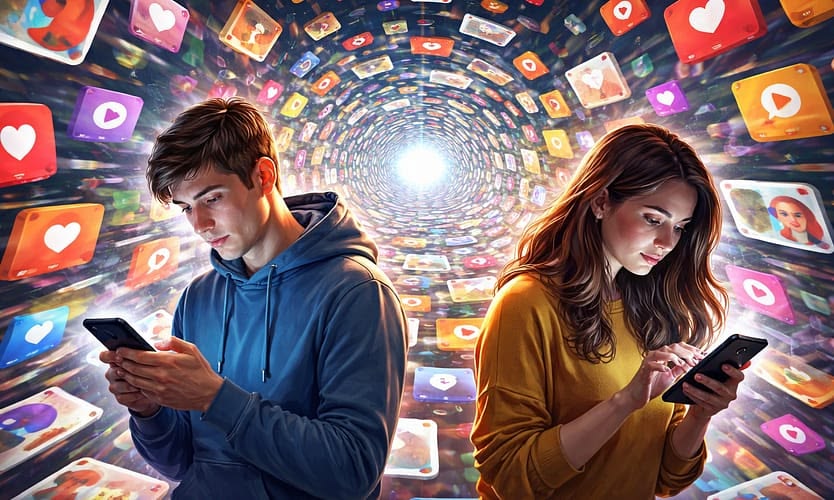
The use of social media has skyrocketed during the past ten years. Nowadays, people browse, like, and share content for hours every day.
Studies reveal:
A lot of people use social media for two to three hours each day.
Teens use the internet “almost constantly,” and their usage is far higher.
About 45% of children acknowledge that they use social media excessively.
Despite its seeming innocence, this constant connectivity has detrimental psychological effects.
1. Social media exacerbates depression and anxiety.
An elevated risk of anxiety and depression is one of the most important effects of social media use.
What Studies Indicate:
Poor social media use is linked to increased symptoms of anxiety and sadness over time, according to a 2025 longitudinal study.
Additionally, increased screen usage is linked to worse mental health, especially among young adults, according to studies.
Why this happens:
continual assessment of others.
FOMO is the fear of missing out.
pressure to maintain one’s reputation online.
Examples from Real Life:
Even well-edited posts about prosperity, travel, or perfect lifestyles might make you feel inferior.
2. Self-esteem is destroyed by the comparison trap.
Highlight reels, not reality, are the foundation of social media.
The issue
People often contrast their actual lives with the altered and filtered versions of others’ lives.
Impact on the Mind:
low self-worth.
issues with body image.
According to research, emotions of inadequacy are common.
Consuming visual content on social media has a significant impact on negative self-perception and declining mental health, according to a large meta-analysis of 60 studies.
3. Social media interferes with sleep, which leads to mental exhaustion.
Social media is one of the biggest enemies of sleep, which is essential for mental wellness.
What Studies Indicate:
Using social media late at night is linked to higher levels of stress and poorer mental health.
The relationship between social media use and depression is modulated by sleep deprivation.
Why This Occurs:
Melatonin production is inhibited by blue light.
Sleep is delayed by endless scrolling.
The brain is kept active by emotional content.
Outcome:
You wake up feeling drowsy, distracted, and mentally spent.
4. Brain weariness is a result of digital overload.
Your brain was not designed to handle an infinite amount of data.
What takes place:
Your brain is overloaded by constant alerts.
Attention is diminished when multitasking.
Mental fatigue is a result of cognitive excess.
Professional Perspective:
The absence of genuine human interaction in modern digital communication leads to stress and emotional exhaustion.
Result:
Fog in the brain
Decreased output
inability to concentrate
5. Dopamine Dependency and Addiction.
Social media platforms are designed to be addictive.
The Science of It:
Dopamine, the brain’s “reward chemical,” is released with each like, comment, or observation.
Why It’s Risky:
develops a reliance on validation.
causes compulsive checking.
shortens the time spent paying attention.
Addiction Symptoms:
checking your phone aimlessly.
uncomfortable in the absence of the internet.
While scrolling, I lost count of time.
This addiction gradually rewires your brain, making it challenging to focus on work-related tasks.
6. Online harassment and cyberbullying
Cyberbullying has also taken place on social media, which can have detrimental effects on a person’s mental health.
Studies and Reports:
The prevalence of online harassment is increasing, especially among youth.
Anxiety, depression, and even PTSD are common in victims.
Impact:
Traumatic Emotions
low self-esteem and a lack of social connection.
Internet abuse is persistent and challenging to prevent, in contrast to traditional bullying.
7. Feeling alone despite being “connected”
Paradoxically, social media can exacerbate feelings of loneliness.
Why This Occurs:
Online communication takes the place of face-to-face relationships.
Sincere communication is lacking.
relationships that are superficial.
Research Findings:
Even while 74% of children claim that social media makes them feel connected, a sizable portion still report negative effects on their mental health.
Results:
Even if you have hundreds of followers, you could still feel alone.
8. Fear and anxiety are caused by false information.
Information spreads quickly on social media, but it’s not always factual.
Findings of the Study:
Misinformation can be found in more than half of popular mental health articles on the internet.
Higher levels of stress and anxiety are linked to misinformation.
Why it’s dangerous
causes excessive fear.
encourages erroneous solutions
deceives those who are susceptible
9. Reduced productivity and attention span
Short-form content, like TikToks and reels, primes your brain for rapid dopamine surges.
Effect:
Diminished concentration
Having trouble completing tasks
Reduced output
Long-Term Impact:
Deep work is difficult because your brain becomes conditioned to seek for constant stimulation.
10. Burnout or emotional weariness
Emotional tiredness can result from constant exposure to content (news, opinions, trends).
What takes place:
You take in too much negativity.
Dissipation of emotional energy
Impact in Real Life: Feeling overpowered and not knowing why.
Even if they haven’t engaged in any physically demanding activities, many people report feeling mentally exhausted after browsing.
Is social media inherently harmful?
Not precisely.
According to research, social media can:
Assist people in maintaining their connections.
Offer communities of support.
Educate people about mental health.
But how much and how you utilize it is the crucial thing.
How to Keep Your Mental Health Safe.
Here are a few useful, empirically supported tactics:
- Set screen time limits.
Set daily limits (e.g., 1-2 hours maximum).
- Steer clear of social media right before bed.
At least one hour before going to bed, put down your electronics.
- Unfollow harmful content.
Instead of comparing, follow accounts that motivate you.
- Take pauses for digital detoxification.
Every week, take at least one day off.
- Focus on connections in real life.
Make in-person interactions a priority.
- Disable alerts.
Cut down on unnecessary distractions.
- Use with awareness.
Why are you opening this app?
Concluding Remarks
Although social media is a useful tool, there are unintended psychological consequences. There is growing evidence of its impact on mental health, ranging from addiction and sleep disturbance to anxiety and despair.
The goal is to use social media sensibly and morally rather than completely avoiding it.
Recall:
👉 Don’t let social media dominate you; you are in charge of it.