In this article
- Bronze vs Silver Plan 2027: Which Is Cheaper?
- The quick answer
- Bronze or Silver plan: what’s the real difference?
- How much do Bronze and Silver plans cost in 2027?
- Silver plan cost-sharing reductions: the hidden discount
- Bronze plan deductible, out-of-pocket max and HSA rules for 2027
- Which is cheaper in 2027? Four real-world examples
- Keep yearly costs down, whichever plan you pick
- How to choose between Bronze and Silver: a 5-step checklist
- FAQ: Bronze vs Silver plan 2027
- The bottom line
- Sources
Bronze vs Silver Plan 2027: Which Is Cheaper?
If you’re shopping for a marketplace plan right now, you’ve probably had the same thought I hear from almost everyone: “Bronze is cheaper, so why would I pay more for Silver?” It’s a fair question. In the bronze vs silver plan 2027 debate, Bronze almost always wins on the monthly bill. But the monthly bill is only half the story.
This year the stakes are higher than usual. Benchmark Silver premiums are up about 13% on average for 2027, the second double-digit jump in a row (KFF). The extra federal subsidies from 2021–2025 are gone. And the most you can be asked to pay out of pocket on an ACA plan just climbed to $12,000 for one person.
So let’s work out which plan is actually cheaper for you, not just which one has the smaller number on the screen.
The quick answer
- Bronze is cheaper if you’re healthy, rarely see a doctor, earn too much for cost-sharing help, and have savings to cover a big bill if something goes wrong.
- Silver is cheaper if your income is at or below 250% of the poverty level (about $39,900 for a single person for 2027 coverage), or if you expect regular doctor visits, prescriptions or a planned procedure.
- For everyone in between, add up a full year: premiums plus what you’d likely spend on care. The plan with the lower total wins.
Open enrollment for 2027 runs from November 1, 2026 to January 15, 2027 in most states. Pick a plan by December 15 if you want coverage starting January 1.
Bronze or Silver plan: what’s the real difference?
Every ACA marketplace plan covers the same essential health benefits: doctor visits, hospital care, prescriptions, mental health, maternity care and free preventive care. Bronze and Silver are not two different types of coverage. They’re two different ways of splitting the bill between you and the insurer.
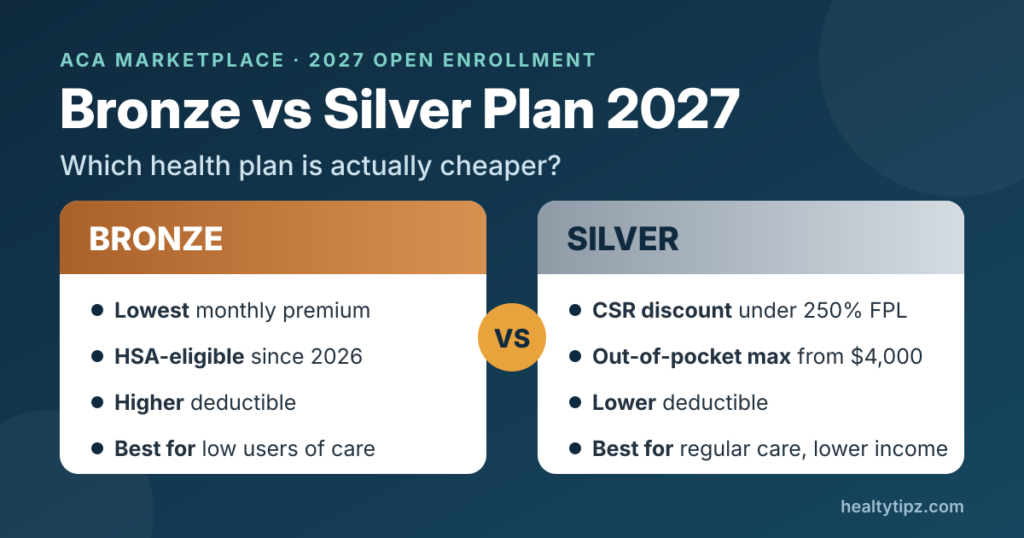
| Bronze | Silver | |
|---|---|---|
| Share of average costs the plan pays | About 60% | About 70% |
| Monthly premium | Lowest of the metal tiers | Middle |
| Deductible | High | Moderate |
| Extra help for lower incomes | No | Yes: cost-sharing reductions (CSR) |
| HSA eligible | Yes, every Bronze plan since 2026 | Only if it qualifies as an HDHP |
| Best for | Low users of care with savings | Regular users of care, lower incomes |
In plain terms, Bronze asks you to pay less every month and more when you get sick. Silver flips that a little, and for lower-income households it flips it a lot.
How much do Bronze and Silver plans cost in 2027?
Before any tax credit, Bronze is clearly cheaper. For a 40-year-old in 2026, the cheapest Bronze plan averaged $456 a month nationally, against $611 for the cheapest Silver and $625 for the benchmark Silver (KFF). For 2027, KFF puts the national average at $681 for the lowest-cost Silver and $703 for the benchmark Silver. Bronze prices are rising too, so expect the gap of roughly $150 to $200 a month to hold.
What changed for 2027:
- Premiums are up again. Benchmark Silver premiums rose about 13% for 2027 and about 42% in total since 2025 (KFF).
- The subsidy cliff is back. The enhanced tax credits expired after 2025. For 2027 you’re expected to pay between 2.15% and 10.22% of your income for the benchmark Silver plan, and above 400% of the poverty level ($63,840 for one person) you get no tax credit at all (Cover Health CA).
- More people are choosing Bronze. Bronze went from 30% to 40% of plan selections in 2026, up from 7.3 million to 9.2 million people (CBS News / KFF Health News).
Here’s the part most people miss. Your tax credit is pegged to the benchmark Silver plan, but you can spend it on any metal level. Because Bronze costs less than the benchmark, the same credit covers a much bigger share of a Bronze premium. At some incomes it covers all of it, and your Bronze plan costs $0 a month.
Silver plan cost-sharing reductions: the hidden discount
This is the single biggest reason Silver can beat Bronze. If your household income is between 100% and 250% of the federal poverty level, any Silver plan you buy on the marketplace comes with cost-sharing reductions (CSR) built in. You don’t apply separately. Your deductible, copays and out-of-pocket maximum simply drop.
For 2027 coverage, 250% of the poverty level is $39,900 for a single person and $82,500 for a family of four in the lower 48 states (healthinsurance.org). Only Silver plans carry this help. Pick Bronze or Gold and you leave it on the table.
| Your income (% of poverty level) | What a standard Silver plan becomes | 2027 Silver out-of-pocket max (single) |
|---|---|---|
| 100% to 150% | Covers about 94% of costs, better than Platinum | $4,000 |
| 151% to 200% | Covers about 87% of costs, better than Gold | $4,000 |
| 201% to 250% | Covers about 73% of costs | $9,600 |
| Above 250% | Standard Silver, about 70% | Up to $12,000 |
Out-of-pocket figures: BenefitsUSA. Coverage levels: Health Reform Beyond the Basics.
The help is strongest below 200%. Between 201% and 250% it’s modest, which is why some people in that band still come out ahead with a $0 or near-$0 Bronze plan.
Bronze plan deductible, out-of-pocket max and HSA rules for 2027
The premium is what you pay to stay covered. The deductible and out-of-pocket maximum are what you pay when you actually use the coverage. That’s where Bronze can bite.
- The ACA out-of-pocket maximum for 2027 is $12,000 for one person and $24,000 for a family, up from $10,600 and $21,200 in 2026 (HUB International).
- Some Bronze plans can go higher. Under the 2027 rules, an insurer that already sells one standard Bronze plan may also sell Bronze plans with an out-of-pocket maximum up to $15,600 for one person (BenefitsUSA). Always check the “out-of-pocket limit” line in the plan summary.
- Deductibles are climbing. The average ACA deductible jumped from $2,759 in 2025 to $3,786 in 2026, the steepest rise on record (CBS News / KFF Health News). Bronze deductibles sit well above that average.
There is one real perk on the Bronze side. Since January 1, 2026, every Bronze and Catastrophic marketplace plan counts as HSA-eligible, whatever its deductible or design (Peterson-KFF Health System Tracker). For 2027 you can put up to $4,500 into a Health Savings Account as a single person, or $9,000 for a family. That money is tax-free going in and tax-free when spent on care. HSA contributions also lower your MAGI, which can increase your tax credit or even bring you under the 250% line for Silver CSR.
Which is cheaper in 2027? Four real-world examples
The cleanest way to compare is two numbers for each plan: what you pay in a quiet year (premiums only) and what you pay in a bad year (premiums plus the out-of-pocket maximum). The examples below are a single 40-year-old, using U.S. average prices with the 2027 tax credit rules (InsuranceQuotes, based on KFF data).
| Yearly income | Plan | Monthly premium after credit | Quiet year (premiums) | Bad year (premiums + max out-of-pocket) | Cheaper overall |
|---|---|---|---|---|---|
| $25,000 (156% FPL) | Silver | $96 | $1,152 | $5,152 | Silver, unless you’re sure you’ll barely use care |
| Bronze | $0 | $0 | up to $12,000 | ||
| $35,000 (219% FPL) | Silver | $219 | $2,628 | $12,228 | Bronze for light users; close to even in a bad year |
| Bronze | $50 | $600 | up to $12,600 | ||
| $45,000 (281% FPL) | Silver | $361 | $4,332 | up to $16,332 | Bronze in most cases |
| Bronze | $192 | $2,304 | up to $14,304 | ||
| $70,000 (438% FPL, no credit) | Silver | $625 | $7,500 | up to $19,500 | Bronze on price; Silver only if its deductible is much lower |
| Bronze | $456 | $5,472 | up to $17,472 |
These use 2026 average premiums, so 2027 quotes in your area will be a little higher. Bad-year totals assume each plan’s highest allowed out-of-pocket limit; many plans set theirs lower.
What the table tells you:
- Under 200% of the poverty level, Silver usually wins. Paying about $1,150 a year to cap your worst case at roughly $5,000 instead of $12,000 is a very good trade.
- Between 200% and 250%, it’s a coin flip. Bronze saves you about $2,000 a year in premiums, and the bad-year totals end up close. Your health decides it.
- Above 250%, Bronze is usually cheaper because Silver loses its CSR discount, while still costing more each month.
- Above 400%, you pay full price. Bronze saves around $2,000 a year, but compare carefully. A Silver or even Gold plan with a much lower deductible can still win if you have ongoing medical needs.
Keep yearly costs down, whichever plan you pick
A Bronze plan works best when you stay out of the doctor’s office. You can’t control everything, but daily habits make a real difference to blood pressure, blood sugar and weight. Those are the conditions that turn into prescriptions and specialist visits, and those visits are how a cheap plan becomes an expensive year.
Two small things that help:
- Walk more, and track it. Our walking calories calculator shows how much a daily walk actually burns, based on your weight, pace and time. It’s an easy way to set a goal you’ll keep.
- Manage your weight with a plan. If your doctor has suggested losing a few pounds, the calorie deficit calculator helps you find a realistic daily calorie target instead of guessing.
Also use what’s already free. Every ACA plan, Bronze included, covers preventive care at no cost before the deductible: annual check-ups, many screenings and vaccines. Catching a problem early is cheaper on any plan.
How to choose between Bronze and Silver: a 5-step checklist
- Estimate your 2027 income honestly. Your tax credit and CSR eligibility depend on it. With the repayment caps removed, guessing too low can mean paying back the whole extra credit at tax time.
- Check whether you’re under 250% of the poverty level. If you are, look at Silver first. If you’re under 200%, Silver is very likely your best value.
- List the care you already know about. Count regular prescriptions, specialist visits, therapy and any planned surgery or pregnancy. The more you expect, the more Silver’s lower deductible pays off.
- Do the bad-year math. Add 12 months of premiums to the out-of-pocket maximum for each plan. Ask yourself whether you could cover that number without going into debt.
- Check the network and your drugs. A cheap plan that leaves out your doctor or your medication isn’t cheap. Use the provider and drug search on HealthCare.gov or your state marketplace before you enroll.
If you go with Bronze, open an HSA and put in whatever you’d have spent on the higher Silver premium. You’ll build a tax-free cushion for the year something does go wrong.
FAQ: Bronze vs Silver plan 2027
Is a Bronze plan cheaper than a Silver plan in 2027? On the monthly premium, yes, almost always, often by $150 to $200 a month before tax credits. Over a full year it depends on your income and how much care you use. Below 200% of the poverty level, Silver usually costs less overall because of cost-sharing reductions.
What is the cheapest ACA plan for 2027? For most people it’s the lowest-cost Bronze plan. With a tax credit, many lower-income buyers can get one for $0 a month. Catastrophic plans can be cheaper still, but only people under 30 or with a hardship exemption can buy them.
Who qualifies for Silver cost-sharing reductions in 2027? Households earning from 100% to 250% of the poverty level who buy a Silver plan on the marketplace. For 2027 coverage that’s up to $39,900 for one person or $82,500 for a family of four.
What is the ACA out-of-pocket maximum for 2027? $12,000 for one person and $24,000 for a family. Some Bronze plans can go up to $15,600 for one person, so read the plan summary.
Can I use an HSA with a Bronze plan? Yes. Since 2026 every marketplace Bronze plan is HSA-eligible. For 2027 you can contribute up to $4,500 (single) or $9,000 (family).
When is open enrollment for 2027? November 1, 2026 to January 15, 2027 on HealthCare.gov and in most states. Enroll by December 15 for coverage that starts January 1. Some state marketplaces set different dates.
The bottom line
Bronze has the lower price tag, and for healthy people earning above 250% of the poverty level it’s usually the cheaper plan overall. If you earn less than that, especially under 200%, Silver’s built-in cost-sharing reductions often make it the better deal, even though the premium is higher. Run the quiet-year and bad-year numbers for both plans before December 15, and choose the plan you could still afford in a bad year.
This article is general information, not financial or insurance advice. Prices, subsidies and plan rules vary by state and county. Confirm your options on HealthCare.gov or your state marketplace.
Sources
- 9 Things to Watch for the 2027 ACA Open Enrollment Period (KFF, Oct 30, 2026)
- Average Monthly Marketplace Premiums by Metal Tier (KFF)
- ACA Out-of-Pocket Maximum 2027: New Limits and Cost-Sharing Caps (BenefitsUSA)
- 2027 ACA, HSA, HDHP and EBHRA Limits Announced (HUB International)
- Cost-sharing reduction (CSR) (healthinsurance.org)
- FAQ: Cost-Sharing Reductions (Health Reform: Beyond the Basics)
- Explaining Health Savings Accounts in the ACA Marketplaces (Peterson-KFF Health System Tracker)
- How Subsidies Work in 2027 (Cover Health CA)
- Compare 2027 ACA Plans: premiums after tax credits (InsuranceQuotes)
- ACA enrollment and deductible trends (CBS News / KFF Health News)