In this article
- Catastrophic Health Plan Eligibility 2027
- Quick answer: who qualifies for a catastrophic plan in 2027?
- What is a catastrophic health plan?
- Catastrophic health plan eligibility 2027: the three paths in detail
- What changed for 2027: the court ruling explained
- How much does a catastrophic plan cost in 2027?
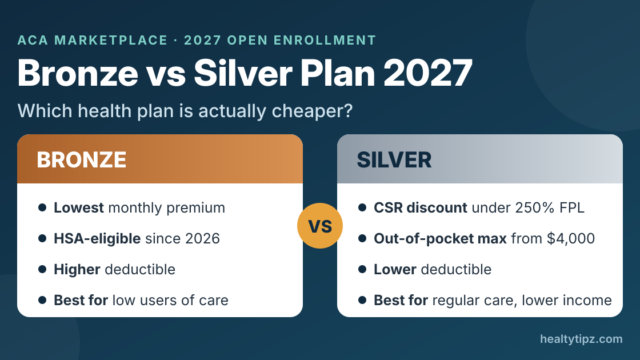
- Catastrophic vs Bronze plan in 2027
- How to apply for a catastrophic plan in 2027
- Staying healthy on a catastrophic plan
- FAQ: catastrophic health plan eligibility 2027
- The bottom line
- Sources
Catastrophic Health Plan Eligibility 2027
If you read last year that “anyone who loses their subsidy can now buy a catastrophic plan,” I have some bad news. That shortcut is closed for 2027. A federal court put it on hold in July 2026, and the rules on catastrophic health plan eligibility 2027 have gone back to the way they worked before.
That matters, because a lot of people are hunting for the cheapest coverage they can find this year. Premiums are up again and the extra federal subsidies are gone. Catastrophic plans often have the lowest sticker price on the marketplace, but you can’t just pick one. You have to qualify first.
Here’s who can buy one in 2027, what you actually get, and how to apply if you’re 30 or older.
Quick answer: who qualifies for a catastrophic plan in 2027?
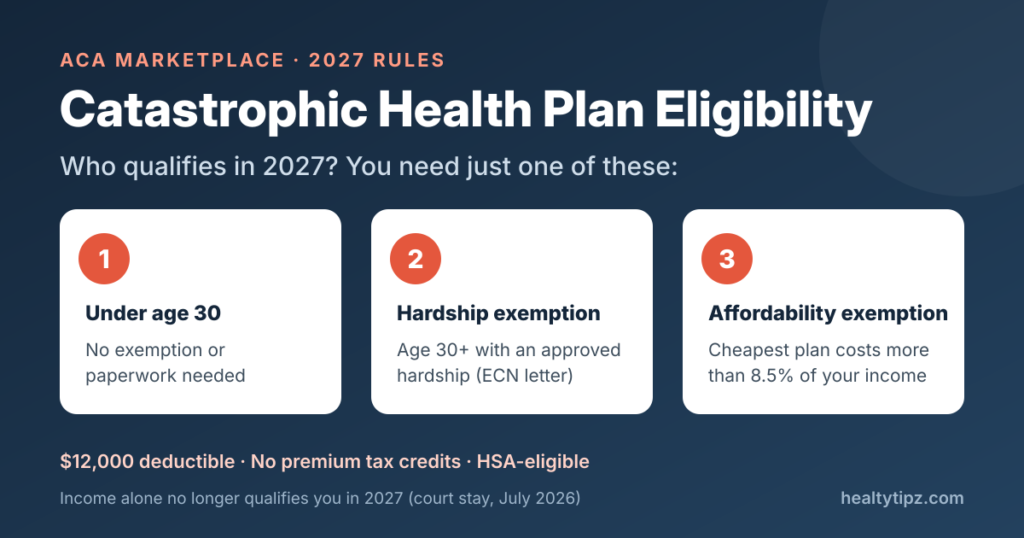
You can buy a catastrophic health plan for 2027 if one of these is true:
- You’re under 30 when your coverage starts. No paperwork needed.
- You have a hardship exemption, approved by the Marketplace for a qualifying hardship such as homelessness, eviction, a disaster, or big unpaid medical bills.
- You have an affordability exemption, because the cheapest coverage available to you costs more than 8.5% of your household income in 2027 (HealthCare.gov).
Being ineligible for a subsidy because of your income is not enough on its own in 2027. Open enrollment runs November 1, 2026 to January 15, 2027 in most states.
What is a catastrophic health plan?
A catastrophic plan is an ACA marketplace plan built for one job: protecting you from a financial disaster if you get seriously sick or hurt. It has low monthly premiums and a very high deductible.
It still has to follow ACA rules, so it covers all the essential health benefits. Before you meet the deductible, it covers:
- Preventive care at no cost, such as yearly check-ups, many screenings and vaccines.
- Up to three primary care visits a year, with the plan paying at least part of the cost even though you haven’t met the deductible (healthinsurance.org).
After that, you pay the full cost of most care until you hit the deductible. In 2027 the deductible and the out-of-pocket maximum are the same number: $12,000 for one person. Once you reach it, the plan pays 100% of covered care for the rest of the year.
Catastrophic plans are a small corner of the market. About 67,500 people had one in 2026, roughly 0.3% of marketplace enrollees (healthinsurance.org).
Catastrophic health plan eligibility 2027: the three paths in detail
1. You’re under 30
This is the simple one. If you’re under 30 when your coverage starts, catastrophic plans show up next to Bronze, Silver and Gold when you shop on HealthCare.gov or your state marketplace (Healthcare Insider). You don’t need an exemption or any documents. Turning 30 partway through the year doesn’t knock you off your plan. You just can’t renew it the following year without an exemption.
2. You have a hardship exemption (30 and older)
If you’re 30 or older, you need the Marketplace to approve a hardship before you can enroll. Common hardships include:
- Being homeless, or being evicted or facing foreclosure
- Getting a shut-off notice from a utility company
- Experiencing domestic violence
- A fire, flood or other disaster that badly damaged your property
- The death of a close family member
- Filing for bankruptcy
- Large unpaid medical bills
- Living in an area with only one insurer, or none, on the marketplace
- Another hardship that kept you from getting coverage, which you explain in your own words
Your hardship must have happened within the last 2 years. You can use it to enroll in a catastrophic plan for up to 2 years after it ended (HealthCare.gov).
3. You have an affordability exemption (30 and older)
You qualify for an affordability exemption if the lowest-priced coverage you can get, through the marketplace or a job, costs more than 8.5% of your household income in 2027 (it was 7.7% in 2026). You’ll need to send copies of documents that prove your income (HealthCare.gov).
This one is easy to overlook. If you earn more than 400% of the poverty level ($63,840 for one person), you get no tax credit in 2027. If you’re older, even a Bronze plan can cost more than 8.5% of your income, and that could qualify you.
What changed for 2027: the court ruling explained
The last two years have been confusing, so here’s the timeline in plain English.
| When | What happened |
|---|---|
| Sept 4, 2025 | CMS issued guidance letting people who couldn’t get a premium tax credit or cost-sharing reduction because of their income claim a hardship exemption and buy a catastrophic plan, starting with 2026 coverage (CMS). |
| 2026 open enrollment | A little more than 20,000 people bought catastrophic plans through this new route (healthinsurance.org). |
| May 15, 2026 | The final 2027 marketplace rule wrote the income-based exemption into law for every state. It also allowed multi-year catastrophic plans of up to 10 years (JD Supra / McDermott+). |
| July 16, 2026 | In City of Columbus v. Kennedy, a federal judge in Maryland paused the income-based exemption and seven other provisions, days before they took effect. The court said a “hardship” can’t be defined by income alone (Becker’s Payer Issues). |
| 2027 open enrollment | Catastrophic eligibility is back to the pre-2026 rules: under 30, or 30+ with a traditional hardship or affordability exemption (Mountain Health CO-OP). |
What this means for you:
- If you’re over 30 and bought a catastrophic plan for 2026 under the income rule, you can’t simply renew it for 2027. You’ll need a standard hardship or affordability exemption, or you’ll need to switch to a metal-level plan. Bronze is the closest match.
- Watch for multi-year catastrophic plans. The 10-year option was finalized for plan years starting in 2027 (Trusaic). Whether insurers in your area offer one is a separate question. You still have to be eligible when you enroll.
- The case isn’t over. Rules could change again for 2028, so check the eligibility rules again each fall.
How much does a catastrophic plan cost in 2027?
The premium is usually low, but there are three catches people don’t expect.
1. No tax credits, ever. You can’t use a premium tax credit on a catastrophic plan. You can’t get cost-sharing reductions either, because those only come with Silver plans (healthinsurance.org). If you qualify for a tax credit, a subsidized Bronze plan is often cheaper than a full-price catastrophic plan.
2. A $12,000 deductible. In 2027 a catastrophic plan’s deductible and out-of-pocket maximum are both $12,000 for an individual. A rule to raise that to 130% of the regular limit for 2028 has also been paused by the court (healthinsurance.org).
3. It isn’t always cheaper than Bronze. CMS says the lowest-cost catastrophic plan averages nearly 10% less than the next-cheapest plan (Healthcare Insider). But prices swing by area. In 2026, an unsubsidized 50-year-old in Orlando could get a catastrophic plan from $462 a month against $700 for the cheapest Bronze. In Houston, Bronze started at $523 and the cheapest catastrophic plan cost $628 (healthinsurance.org).
The upside: HSA eligibility. Since January 1, 2026, catastrophic marketplace plans count as HSA-eligible. If you have no other coverage, you can put money into a Health Savings Account tax-free. For 2027 the limit is $4,500 for one person and $9,000 for a family (BenefitsUSA). Building up an HSA is the smartest way to cover that $12,000 deductible if you ever need to.
Catastrophic vs Bronze plan in 2027
If you’re deciding between the two, this side-by-side covers what matters.
| Catastrophic plan | Bronze plan | |
|---|---|---|
| Who can buy it | Under 30, or 30+ with an exemption | Anyone |
| Premium tax credit | Not allowed | Allowed, often making it $0 at lower incomes |
| 2027 out-of-pocket max (single) | $12,000 (same as the deductible) | Up to $12,000 |
| Care covered before the deductible | Preventive care plus 3 primary care visits | Preventive care; some plans add copays for visits or drugs |
| HSA eligible | Yes | Yes |
| Typical premium | Usually the lowest full price, but not everywhere | A bit higher at full price |
Rule of thumb: If you qualify for a premium tax credit, compare your subsidized Bronze price first. It often beats a catastrophic plan. If you get no tax credit (for example, you earn above 400% of the poverty level), compare full prices. In some areas the catastrophic plan wins and in others Bronze does.
How to apply for a catastrophic plan in 2027
If you’re under 30: Fill out a normal marketplace application on HealthCare.gov or your state’s site between November 1, 2026 and January 15, 2027. Catastrophic plans will appear in your results. Pick one by December 15 if you want coverage from January 1.
If you’re 30 or older:
- Work out which exemption fits. Is it a hardship from the list above, or is the cheapest coverage you can get more than 8.5% of your income?
- Get the exemption form. Use the hardship exemption application from CMS (PDF form) or the affordability exemption form on HealthCare.gov. California, Connecticut, Maryland and Washington, D.C. run their own exemption process (healthinsurance.org).
- Mail it with your proof. Include documents such as an eviction notice, medical bills or income records.
- Wait for your Exemption Certificate Number (ECN). If you’re approved, the Marketplace mails you a letter with this number (HealthCare.gov).
- Enroll using your ECN. Enter it on your marketplace application. You need one for each person in your household who wants a catastrophic plan (CMS Agent and Broker FAQ).
Tip: Mail-in applications take time, so apply in November. If your exemption hasn’t come through by January 15, enroll in a Bronze plan so you aren’t left uninsured. If you’re denied, you can appeal through HealthCare.gov.
Staying healthy on a catastrophic plan
A catastrophic plan works best for people who rarely need care. Apart from preventive care and three visits, almost everything comes out of your pocket until you reach $12,000. So the healthier you stay, the better the plan works for you.
Two free tools can help you build habits that last:
- Know how much you really burn. Our TDEE calculator estimates your total daily energy expenditure. It’s a solid starting point for eating to maintain, lose or gain weight without guessing.
- Train at the right intensity. The heart rate zone calculator shows your personal training zones. You can get real cardio benefits from your workouts without overdoing it.
And use your free preventive visit every year. Blood pressure, cholesterol and blood sugar checks cost you nothing on a catastrophic plan. Catching a problem early is far cheaper than treating it late.
FAQ: catastrophic health plan eligibility 2027
Can I get a catastrophic plan if I’m over 30 in 2027? Only with an approved hardship or affordability exemption. The income-based shortcut that applied in 2026 was paused by a federal court in July 2026, so it isn’t available for 2027 coverage.
Do I qualify for a catastrophic plan if I earn too much for a subsidy? Not by itself in 2027. You may still qualify for an affordability exemption if the cheapest plan available to you costs more than 8.5% of your household income.
What does a catastrophic plan cover before the deductible? Preventive care at no cost and up to three primary care visits a year. Everything else counts toward the $12,000 deductible.
Can I use my premium tax credit on a catastrophic plan? No. Tax credits and cost-sharing reductions can’t be used with catastrophic plans.
Is a catastrophic plan HSA-eligible? Yes. Since 2026, marketplace catastrophic plans count as HSA-eligible, so you can contribute up to $4,500 (single) for 2027 if you have no other coverage.
What happens to my catastrophic plan when I turn 30? You keep it for the rest of that plan year. For the next year, you’ll need an exemption or a different plan.
When can I enroll in a catastrophic plan for 2027? During open enrollment, November 1, 2026 to January 15, 2027 in most states, or within 60 days of a qualifying life event such as losing other coverage.
The bottom line
For 2027, catastrophic health plan eligibility comes down to three things: being under 30, getting a hardship exemption, or getting an affordability exemption. The income-only route from 2026 is on hold. If you’re 30 or older, apply for your exemption early in open enrollment. Before you commit, compare the catastrophic plan with a Bronze plan, because a subsidized Bronze plan is often the better deal.
This article is general information, not insurance or legal advice. Rules can change while the court case continues. Check HealthCare.gov or your state marketplace before you enroll.
Sources
- Catastrophic plan glossary and 2027 rules (healthinsurance.org)
- Exemptions for catastrophic coverage (HealthCare.gov)
- Judge pauses ACA catastrophic plan expansion, 7 other provisions (Becker’s Payer Issues)
- Court stays challenged provisions of the 2027 Notice of Benefit and Payment Parameters (Groom Law Group)
- 2027 Catastrophic Plans, Eligibility Changes (Mountain Health CO-OP)
- Expanding access: catastrophic health insurance plans for 2026 (CMS fact sheet, Sept 4, 2025)
- The 2027 Notice of Benefit and Payment Parameters is served (McDermott+ via JD Supra)
- 2027 ACA exchange expansion: new plan types (Trusaic)
- Catastrophic Health Insurance 2027 (Healthcare Insider)
- What are catastrophic health plans and how do they relate to hardship exemptions? (CMS Agent and Broker FAQ)
- ACA Out-of-Pocket Maximum 2027 (BenefitsUSA)