In this article
- Can a 10-Minute Walk Help Calm Anxiety?
- The quick answer
- Does walking help anxiety? What the studies actually show
- Why walking calms an anxious mind
- How many minutes and steps of walking help anxiety?
- A simple 4-week walking plan for anxiety
- When walking isn’t enough
- FAQ: walking and anxiety
- The bottom line
- Sources
Can a 10-Minute Walk Help Calm Anxiety?
Anyone who’s ever stepped outside to “clear their head” already suspects the answer. But does walking help anxiety in a way that actually shows up in research, or does it just feel nice for a few minutes?
I went through the biggest studies on this so you don’t have to. The short version: walking does help, the evidence is better than most people think, and the amount you need is smaller than the famous 10,000 steps. There are also a few catches the wellness posts tend to skip, and they matter if you want this to work.
The quick answer
- Yes, walking reduces anxiety symptoms. A 2024 review of 75 randomized trials found walking significantly lowered anxiety and depression symptoms in adults (JMIR Public Health and Surveillance).
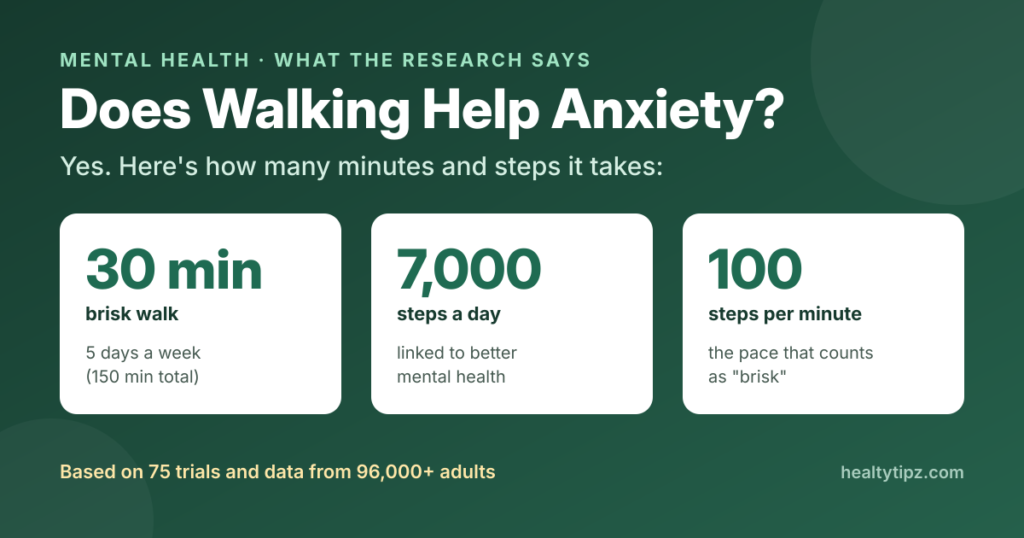
- Aim for about 30 minutes of brisk walking, 5 days a week. That’s the 150 minutes a week of moderate activity the CDC recommends for adults (CDC).
- In steps, 7,000 a day is a good target. It’s linked to clear mental health benefits, and the gains level off around 10,000 (JAMA Network Open, via Drugs.com).
- Walk briskly, about 100 steps a minute. That’s roughly the point where walking counts as moderate exercise (UMass Amherst).
Does walking help anxiety? What the studies actually show
Here are the studies worth knowing, newest first.
| Study | What they looked at | What they found |
|---|---|---|
| Bizzozero-Peroni et al., JAMA Network Open (2024) | 33 studies, about 96,000 adults wearing step trackers | People with 7,000+ steps a day had a lower risk of depression, and each extra 1,000 steps a day was linked to a 9% lower risk |
| Xu et al., JMIR Public Health and Surveillance (2024) | 75 randomized trials, 8,636 people | Walking reduced anxiety and depression symptoms. It worked indoors or outdoors, alone or in groups, and at different frequencies and lengths |
| Singh et al., British Journal of Sports Medicine (2023) | 97 reviews, 1,039 trials, 128,119 people | Physical activity improved anxiety, depression and distress. Walking was one of the activities that helped |
| Ensari et al., Depression and Anxiety (2015) | 36 trials of single exercise sessions | One session of exercise gave a small but real drop in in-the-moment anxiety |
| Bratman et al., PNAS (2015) | 90-minute walk in nature vs along a busy road | Nature walkers ruminated less and had less activity in a brain area tied to negative thinking. City walkers didn’t |
Three things stand out when you read these together.
Walking works about as well as other options. In the 2024 review, walking’s effect on anxiety was similar to the other treatments it was compared against (JMIR). That’s impressive for something free.
One walk helps a little. A habit helps a lot. Single sessions only produce a small effect. The bigger changes come from weeks of regular walking.
Be honest about the step-count research. The 96,000-person step study measured depression, not anxiety specifically. Most of those studies were also observational, so researchers can’t say for certain whether walking lowers depression or whether people with depression simply move less (CNN via WRAL). Anxiety and depression often travel together, though, and the randomized trials above do show a direct effect on anxiety.
Why walking calms an anxious mind
Scientists are still working out the full picture, but a few explanations have good support.
- It breaks the worry loop. Anxiety feeds on rumination, the same worried thought on repeat. In the Stanford nature-walk study, walkers ruminated less afterward, and a brain region linked to negative self-focused thinking became less active (Stanford Daily).
- It makes a racing heart less scary. Many anxious people fear the body’s alarm signals: a fast heartbeat, quick breathing, sweating. Aerobic exercise produces those same feelings in a safe setting. In one trial, a single aerobic session lowered anxiety sensitivity, and the effect was still there a week later (University of Regina).
- It uses up stress energy. Anxiety gets your body ready to fight or run. Walking gives that energy somewhere to go.
- It moves your eyes and your attention outward. Watching the street, trees or sky pulls your focus away from your thoughts and onto what’s around you.
How many minutes and steps of walking help anxiety?
Here’s the research turned into numbers you can use. Step counts assume a brisk pace of about 100 steps a minute, the point where walking becomes moderate exercise (UMass Amherst).
| Goal | Minutes | About how many steps | What the research says |
|---|---|---|---|
| Take the edge off right now | 10 minutes | ~1,000 | Short sessions can lower tension (SDSU summary of Butki 1997). In one trial, though, a 10-minute walk only beat sitting when paired with meditation (American Journal of Health Promotion), so add slow breathing |
| Weekly habit for lasting benefit | 30 minutes, 5 days a week (150 a week) | ~3,000 per walk | The CDC’s recommended amount for adults; it can be split into shorter chunks (CDC) |
| Daily step target | Spread through the day | 7,000 total | 7,000+ steps a day was linked to a lower risk of depression (HealthDay) |
| Where benefits level off | — | ~10,000 total | Extra steps beyond 10,000 didn’t add much mental health benefit (Drugs.com / HealthDay) |
| Deep reset for overthinking | 50–90 minutes in a park or green space | ~5,000–9,000 | A 90-minute nature walk reduced rumination; a city walk didn’t (Stanford Daily) |
Don’t know your current numbers? Use our steps to calories calculator to turn your step count into calories burned. Our walking calories calculator shows what a 10-, 30- or 60-minute walk burns at your weight and pace. It’s a nice bonus to see, even if calm is your main goal.
How brisk is brisk? Count your steps for 15 seconds and multiply by four. If you get 100 or more, you’re at moderate intensity (News-Medical). You should be able to talk, but not sing.
A simple 4-week walking plan for anxiety
Start small. Skipping days because the goal is too big helps nobody.
| Week | Walks per week | Minutes per walk | Daily step goal |
|---|---|---|---|
| 1 | 3 | 10–15 | Your current count + 1,000 |
| 2 | 4 | 20 | 5,000 |
| 3 | 5 | 25 | 6,000 |
| 4 | 5 | 30 | 7,000 |
Tips that make it work:
- Pair your walk with slow breathing. Breathe in for 4 steps and out for 6 steps. A longer out-breath is calming, and in the 10-minute study, walking plus a calming practice beat walking alone.
- Pick green routes when you can. A park, a tree-lined street or a riverside path. Even part of the walk in green space counts.
- Leave the news and doomscrolling at home. Try music, a calm podcast or silence instead.
- Walk when anxiety tends to peak. For many people that’s mid-afternoon or right after work.
- Walk with someone once a week. Group walks worked just as well in the 2024 review (JMIR), and having a walking partner makes you less likely to skip.
- Track it. Seeing your steps and your progress on our steps to calories calculator gives you a small win every day.
When walking isn’t enough
Walking is a good tool, but it isn’t a cure-all. Talk to a doctor or mental health professional if:
- Anxiety stops you from working, sleeping or seeing people
- You have panic attacks, or chest pain you’re not sure about
- You’ve been walking regularly for 4 to 6 weeks and nothing has changed
- You’re using alcohol or other substances to cope
Walking works well alongside therapy and medication, so you don’t have to choose one. If you ever feel unsafe or have thoughts of harming yourself, contact your local emergency number or a crisis line right away. In the US, call or text 988.
FAQ: walking and anxiety
Does walking help anxiety right away? Often, a little. A single session of exercise gives a small drop in in-the-moment anxiety. The bigger, longer-lasting benefits come from walking regularly for several weeks.
How long should I walk for anxiety? Aim for 30 minutes of brisk walking on 5 days a week. If that’s too much right now, start with 10 to 15 minutes and add a slow-breathing pattern.
How many steps a day is good for mental health? Around 7,000 steps a day is linked to clear benefits, and the gains level off near 10,000. Even 1,000 more steps than you take now is linked to a lower risk of depression.
Is walking better than running for anxiety? Both help. Walking is easier to start and stick with, which matters more than intensity for most people. If you like running, it’s a great option too.
Is walking in nature better for anxiety? The research says yes for overthinking. In one study, a 90-minute walk in green space reduced rumination, but the same walk along a busy road didn’t.
Can walking replace anxiety medication or therapy? Not on its own. Walking works well alongside treatment, but don’t stop any medication without talking to your doctor.
The bottom line
Does walking help anxiety? Yes. Dozens of trials show it lowers anxiety symptoms, and it’s free, safe and easy to start. Aim for 30 brisk minutes on most days and around 7,000 steps in total. Walk in green spaces when you can, and pair it with slow breathing. Give it four weeks before you judge the results.
I went through the biggest studies on this so you don’t have to. The short version: walking does help, the evidence is better than most people think, and the amount you need is smaller than the famous 10,000 steps. There are also a few catches the wellness posts tend to skip, and they matter if you want this to work.
The quick answer
• Yes, walking reduces anxiety symptoms. A 2024 review of 75 randomized trials found walking significantly lowered anxiety and depression symptoms in adults (JMIR Public Health and Surveillance).
• Aim for about 30 minutes of brisk walking, 5 days a week. That’s the 150 minutes a week of moderate activity the CDC recommends for adults (CDC).
• In steps, 7,000 a day is a good target. It’s linked to clear mental health benefits, and the gains level off around 10,000 (JAMA Network Open, via Drugs.com).
• Walk briskly, about 100 steps a minute. That’s roughly the point where walking counts as moderate exercise (UMass Amherst).
Does walking help anxiety? What the studies actually show
Here are the studies worth knowing, newest first.
Study
What they looked at
What they found
Bizzozero-Peroni et al., JAMA Network Open (2024)
33 studies, about 96,000 adults wearing step trackers
People with 7,000+ steps a day had a lower risk of depression, and each extra 1,000 steps a day was linked to a 9% lower risk
Xu et al., JMIR Public Health and Surveillance (2024)
75 randomized trials, 8,636 people
Walking reduced anxiety and depression symptoms. It worked indoors or outdoors, alone or in groups, and at different frequencies and lengths
Singh et al., British Journal of Sports Medicine (2023)
97 reviews, 1,039 trials, 128,119 people
Physical activity improved anxiety, depression and distress. Walking was one of the activities that helped
Ensari et al., Depression and Anxiety (2015)
36 trials of single exercise sessions
One session of exercise gave a small but real drop in in-the-moment anxiety
Bratman et al., PNAS (2015)
90-minute walk in nature vs along a busy road
Nature walkers ruminated less and had less activity in a brain area tied to negative thinking. City walkers didn’t
Three things stand out when you read these together.
Walking works about as well as other options. In the 2024 review, walking’s effect on anxiety was similar to the other treatments it was compared against (JMIR). That’s impressive for something free.
One walk helps a little. A habit helps a lot. Single sessions only produce a small effect. The bigger changes come from weeks of regular walking.
Be honest about the step-count research. The 96,000-person step study measured depression, not anxiety specifically. Most of those studies were also observational, so researchers can’t say for certain whether walking lowers depression or whether people with depression simply move less (CNN via WRAL). Anxiety and depression often travel together, though, and the randomized trials above do show a direct effect on anxiety.
Why walking calms an anxious mind
Scientists are still working out the full picture, but a few explanations have good support.
• It breaks the worry loop. Anxiety feeds on rumination, the same worried thought on repeat. In the Stanford nature-walk study, walkers ruminated less afterward, and a brain region linked to negative self-focused thinking became less active (Stanford Daily).
• It makes a racing heart less scary. Many anxious people fear the body’s alarm signals: a fast heartbeat, quick breathing, sweating. Aerobic exercise produces those same feelings in a safe setting. In one trial, a single aerobic session lowered anxiety sensitivity, and the effect was still there a week later (University of Regina).
• It uses up stress energy. Anxiety gets your body ready to fight or run. Walking gives that energy somewhere to go.
• It moves your eyes and your attention outward. Watching the street, trees or sky pulls your focus away from your thoughts and onto what’s around you.
How many minutes and steps of walking help anxiety?
Here’s the research turned into numbers you can use. Step counts assume a brisk pace of about 100 steps a minute, the point where walking becomes moderate exercise (UMass Amherst).
Goal
Minutes
About how many steps
What the research says
Take the edge off right now
10 minutes
~1,000
Short sessions can lower tension (SDSU summary of Butki 1997). In one trial, though, a 10-minute walk only beat sitting when paired with meditation (American Journal of Health Promotion), so add slow breathing
Weekly habit for lasting benefit
30 minutes, 5 days a week (150 a week)
~3,000 per walk
The CDC’s recommended amount for adults; it can be split into shorter chunks (CDC)
Daily step target
Spread through the day
7,000 total
7,000+ steps a day was linked to a lower risk of depression (HealthDay)
Where benefits level off
—
~10,000 total
Extra steps beyond 10,000 didn’t add much mental health benefit (Drugs.com / HealthDay)
Deep reset for overthinking
50–90 minutes in a park or green space
~5,000–9,000
A 90-minute nature walk reduced rumination; a city walk didn’t (Stanford Daily)
Don’t know your current numbers? Use our steps to calories calculator to turn your step count into calories burned. Our walking calories calculator shows what a 10-, 30- or 60-minute walk burns at your weight and pace. It’s a nice bonus to see, even if calm is your main goal.
How brisk is brisk? Count your steps for 15 seconds and multiply by four. If you get 100 or more, you’re at moderate intensity (News-Medical). You should be able to talk, but not sing.
A simple 4-week walking plan for anxiety
Start small. Skipping days because the goal is too big helps nobody.
Week
Walks per week
Minutes per walk
Daily step goal
1
3
10–15
Your current count + 1,000
2
4
20
5,000
3
5
25
6,000
4
5
30
7,000
Tips that make it work:
1. Pair your walk with slow breathing. Breathe in for 4 steps and out for 6 steps. A longer out-breath is calming, and in the 10-minute study, walking plus a calming practice beat walking alone.
2. Pick green routes when you can. A park, a tree-lined street or a riverside path. Even part of the walk in green space counts.
3. Leave the news and doomscrolling at home. Try music, a calm podcast or silence instead.
4. Walk when anxiety tends to peak. For many people that’s mid-afternoon or right after work.
5. Walk with someone once a week. Group walks worked just as well in the 2024 review (JMIR), and having a walking partner makes you less likely to skip.
6. Track it. Seeing your steps and your progress on our steps to calories calculator gives you a small win every day.
When walking isn’t enough
Walking is a good tool, but it isn’t a cure-all. Talk to a doctor or mental health professional if:
• Anxiety stops you from working, sleeping or seeing people
• You have panic attacks, or chest pain you’re not sure about
• You’ve been walking regularly for 4 to 6 weeks and nothing has changed
• You’re using alcohol or other substances to cope
Walking works well alongside therapy and medication, so you don’t have to choose one. If you ever feel unsafe or have thoughts of harming yourself, contact your local emergency number or a crisis line right away. In the US, call or text 988.
FAQ: walking and anxiety
Does walking help anxiety right away? Often, a little. A single session of exercise gives a small drop in in-the-moment anxiety. The bigger, longer-lasting benefits come from walking regularly for several weeks.
How long should I walk for anxiety? Aim for 30 minutes of brisk walking on 5 days a week. If that’s too much right now, start with 10 to 15 minutes and add a slow-breathing pattern.
How many steps a day is good for mental health? Around 7,000 steps a day is linked to clear benefits, and the gains level off near 10,000. Even 1,000 more steps than you take now is linked to a lower risk of depression.
Is walking better than running for anxiety? Both help. Walking is easier to start and stick with, which matters more than intensity for most people. If you like running, it’s a great option too.
Is walking in nature better for anxiety? The research says yes for overthinking. In one study, a 90-minute walk in green space reduced rumination, but the same walk along a busy road didn’t.
Can walking replace anxiety medication or therapy? Not on its own. Walking works well alongside treatment, but don’t stop any medication without talking to your doctor.
The bottom line
Does walking help anxiety? Yes. Dozens of trials show it lowers anxiety symptoms, and it’s free, safe and easy to start. Aim for 30 brisk minutes on most days and around 7,000 steps in total. Walk in green spaces when you can, and pair it with slow breathing. Give it four weeks before you judge the results.
This article is for general information and isn’t a substitute for advice from a doctor or mental health professional.
Sources
• The Effect of Walking on Depressive and Anxiety Symptoms: Systematic Review and Meta-Analysis (Xu et al., JMIR Public Health and Surveillance, 2024)
• Higher Daily Step Count Linked to Lower Risk for Depression (HealthDay, on Bizzozero-Peroni et al., JAMA Network Open, 2024)
• As Daily Steps Rise, Depression Levels Fall (Drugs.com / HealthDay)
• Exercise more effective than medicines to manage mental health (ScienceDaily, on Singh et al., British Journal of Sports Medicine, 2023)
• Meta-analysis of acute exercise effects on state anxiety (Ensari et al., Depression and Anxiety, 2015)
• Stanford study: walking in nature and rumination (Stanford Daily, on Bratman et al., PNAS, 2015)
• Differential effects of a short bout of walking, meditation, or both on state anxiety (American Journal of Health Promotion)
• Anxiety helped by small amounts of exercise (SDSU summary of Butki & Rudolph, 1997)
• Can a single bout of aerobic exercise reduce anxiety sensitivity? (University of Regina)
• Walking for health benefits just got easier to track (UMass Amherst)
• Adult Activity: An Overview (CDC)
• The next step to treating your depression may be upping your step count (CNN via WRAL)
This article is for general information and isn’t a substitute for advice from a doctor or mental health professional.
Sources
- The Effect of Walking on Depressive and Anxiety Symptoms: Systematic Review and Meta-Analysis (Xu et al., JMIR Public Health and Surveillance, 2024)
- Higher Daily Step Count Linked to Lower Risk for Depression (HealthDay, on Bizzozero-Peroni et al., JAMA Network Open, 2024)
- As Daily Steps Rise, Depression Levels Fall (Drugs.com / HealthDay)
- Exercise more effective than medicines to manage mental health (ScienceDaily, on Singh et al., British Journal of Sports Medicine, 2023)
- Meta-analysis of acute exercise effects on state anxiety (Ensari et al., Depression and Anxiety, 2015)
- Stanford study: walking in nature and rumination (Stanford Daily, on Bratman et al., PNAS, 2015)
- Differential effects of a short bout of walking, meditation, or both on state anxiety (American Journal of Health Promotion)
- Anxiety helped by small amounts of exercise (SDSU summary of Butki & Rudolph, 1997)
- Can a single bout of aerobic exercise reduce anxiety sensitivity? (University of Regina)
- Walking for health benefits just got easier to track (UMass Amherst)
- Adult Activity: An Overview (CDC)
- The next step to treating your depression may be upping your step count (CNN via WRAL)