In this article
How to Stop Overthinking at Night
You’re exhausted all day. Then the light goes off, your head hits the pillow, and your brain decides it’s the perfect time to replay that awkward comment from 2019, plan tomorrow’s meeting, and wonder whether you locked the back door.
There’s a reason this happens at night. During the day, your attention is pulled in a hundred directions. In a dark, quiet room there’s nothing left to distract you, so every unfinished task and unresolved worry gets the stage. On top of that, being tired makes it harder for the thinking part of your brain to keep emotions in check, so small worries can feel huge at midnight.
The good news is that night-time overthinking is a habit, and habits can be changed. Below are practical tricks for the evening, for when you’re already lying awake, and for the sleep schedule underneath it all. Most take five minutes or less.
Before bed: empty your head
The best time to deal with night-time overthinking is before you’re in bed.
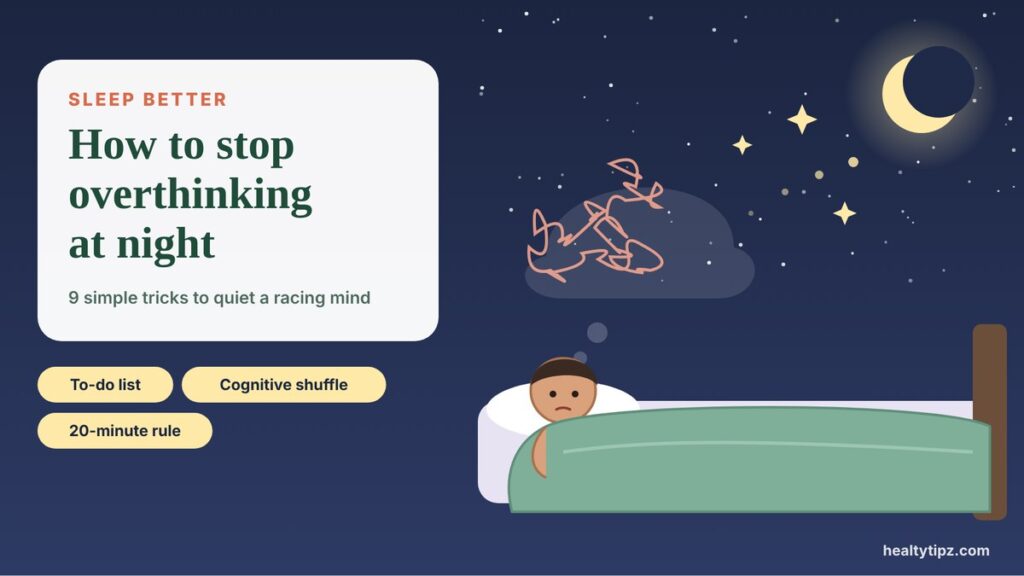
1. Write tomorrow’s to-do list
This sounds almost too simple, but it has good evidence behind it. In a Baylor University study, published in the Journal of Experimental Psychology, 57 young adults spent five minutes before bed either writing a to-do list for the coming days or writing about tasks they’d already finished. The to-do list group fell asleep about nine minutes faster. And the more specific their lists were, the faster they nodded off.
The researchers think writing tasks down “offloads” them, so your brain stops rehearsing them to make sure you don’t forget. Keep a notebook by the bed and be detailed: not “work stuff,” but “email Sara about the budget by 10 a.m.”
2. Schedule a “worry time” earlier in the evening
If it’s worries rather than tasks keeping you up, give them their own appointment. Pick a 15- to 20-minute slot in the early evening, well before bed. Sit somewhere that isn’t your bedroom and write down everything that’s bothering you, plus one small next step for each, if there is one.
When a worry pops up later, remind yourself: “I’ve dealt with that. It can wait for tomorrow’s worry time.” This is called worry postponement, and studies have found it can reduce how much people worry. It’s not about pushing thoughts away (which tends to backfire), but about telling your brain there’s a proper time for them.
3. Build a real wind-down
Your brain can’t go from inbox to asleep in five minutes. Give yourself 30 to 60 minutes of calmer, dimmer activities before bed: a shower, stretching, an easy book, music, or a chat with someone you live with. Keep work, news and intense conversations out of that window.
In bed: when your mind won’t switch off
4. Try the cognitive shuffle
Counting sheep is too boring to hold your attention, and planning tomorrow is too interesting. The cognitive shuffle sits in between. It was developed by Luc Beaudoin, a cognitive scientist at Simon Fraser University in Canada.
- Pick a random, neutral word, like “blanket.”
- Take the first letter, B, and think of other words that start with it: banana, bicycle, beach, button.
- Picture each one for a few seconds before moving on.
- When you run out, move to the next letter, L, and keep going.
The trick is not to connect the images or make a story. As you fall asleep, your thoughts naturally become random and dream-like, so the shuffle copies that state while crowding out worries. Research on it is still early, but small studies have been promising, and sleep experts see it as a reasonable thing to try.
5. Breathe out longer than you breathe in
Slow breathing with a long exhale calms the body’s stress response. Try breathing in through your nose for 4 counts and out through your mouth for 6 to 8 counts. Ten rounds is often enough to take the edge off.
6. Ground yourself in the room
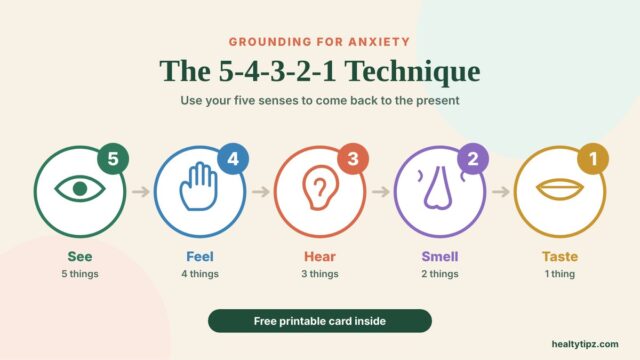
If your thoughts are spinning, bring your attention to what you can sense right now: the weight of the blanket, the cool side of the pillow, the hum of a fan, the dark. The 5-4-3-2-1 grounding technique works well here, done slowly and softly with your eyes closed.
7. Get up if you’ve been awake for about 20 minutes
This one feels backward, but it’s a core part of cognitive behavioral therapy for insomnia (CBT-I), the treatment sleep doctors recommend first for long-term sleep problems. The American Academy of Sleep Medicine advises that if you don’t fall asleep within about 20 minutes, you get out of bed.
Go to another room, keep the lights low, and do something calm and boring: read a paper book, fold laundry, or sit quietly. Go back to bed when you feel sleepy. Lying in bed worrying night after night teaches your brain that bed is a place for thinking. Getting up breaks that link. Don’t check the clock to time it. Just go by how long it feels.
Fix the schedule underneath it all
A lot of night-time overthinking is really a timing problem. If you go to bed before your body is sleepy, you’re handing your mind 30 or 60 minutes of free time in the dark.
8. Go to bed when you’re actually sleepy, and wake up at the same time
Pick a wake-up time you can keep every day, weekends included, and work backward from there. How much sleep you need depends partly on your age. Our bedtime by age calculator suggests a sensible bedtime based on age and the time you need to be up.
Then fine-tune it with our sleep calculator. It works out bedtimes that let you wake at the end of a 90-minute sleep cycle rather than in the middle of one, so you’re less likely to wake up groggy.
If you’ve been lying awake for ages most nights, try going to bed a little later for a week or two. A slightly shorter window in bed builds stronger sleep pressure, so you drift off faster and spend less time awake with your thoughts.
9. Keep naps short and early
A long or late nap takes the edge off your sleep pressure, which means you’ll be more awake, and more likely to overthink, at bedtime. If you need a nap, keep it to about 20 minutes and take it before mid-afternoon. Our nap calculator helps you pick a nap length and wake-up time, so you get the boost without wrecking your night.
Daytime habits that feed night-time worry
Some of what keeps your mind racing at night starts hours earlier.
- Late caffeine. Caffeine can stay in your system for many hours. A 3 p.m. coffee can still be working at 11 p.m., keeping your brain alert enough to churn. Try a cut-off around lunchtime.
- Alcohol as a sleep aid. A nightcap can make you drowsy at first, but it tends to break up sleep later in the night, so you wake at 3 a.m. with your mind in overdrive.
- Phones in bed. Scrolling feeds your brain new things to think about, and bright screens push back your body clock. Charge your phone outside the bedroom if you can, or at least across the room.
- No daylight or movement. Getting outside in the morning and moving during the day both help set your body clock and build healthy tiredness by evening.
- Never switching off during the day. If the first quiet moment you get is when your head hits the pillow, that’s where your brain will do its processing. Even a 10-minute walk without your phone gives thoughts somewhere else to go.
When to get help
Occasional racing thoughts at night are normal, especially during stressful periods. It’s worth talking to a doctor if:
- You have trouble falling or staying asleep at least three nights a week for three months or more. That’s the usual definition of chronic insomnia.
- You’re exhausted during the day, or your sleep is affecting your work, mood or safety (for example, while driving).
- Your worries feel constant or out of control during the day too.
- You feel low, hopeless or have lost interest in things you used to enjoy.
- You snore loudly, gasp at night or wake up with headaches, which can be signs of sleep apnea.
The good news is that CBT-I works well for chronic insomnia, and the effects tend to last. You can get it from a sleep specialist or psychologist, and some online CBT-I programs have good evidence too.
If you’re having thoughts of harming yourself, please reach out now. In the US, call or text 988. Elsewhere, contact your local emergency number or a crisis line in your country.
Frequently asked questions
Why do I overthink more at night?
At night there are fewer distractions, so unfinished tasks and worries get your full attention. Being tired also makes emotions harder to manage, so problems can feel bigger than they really are.
What is the fastest way to stop racing thoughts in bed?
Give your mind something neutral to do. The cognitive shuffle and slow breathing with a long exhale are two of the quickest options. If you’re still awake after about 20 minutes, get up for a while.
Does writing things down before bed really help?
In a Baylor University study, people who wrote a specific to-do list for five minutes before bed fell asleep about nine minutes faster than people who wrote about tasks they had already done.
Should I stay in bed if I can’t sleep?
Sleep specialists generally say no. If you’ve been awake for about 20 minutes, get up, do something quiet in dim light, and come back when you feel sleepy.
Can naps make overthinking at night worse?
They can. Long or late naps reduce your sleep drive, so you’re more alert at bedtime. Keep naps to about 20 minutes and before mid-afternoon.
Is it insomnia or just overthinking?
If trouble sleeping happens at least three nights a week for three months and affects your days, it may be chronic insomnia. Talk to a doctor about CBT-I.
This article is for general information and isn’t a substitute for advice from your own doctor or sleep specialist.
Sources
- Scullin MK, et al. The effects of bedtime writing on difficulty falling asleep. Journal of Experimental Psychology: General, 2018. Summary: Baylor University.
- The Conversation. What is “cognitive shuffling” and does it really help you get to sleep? Two sleep scientists explain.
- American Academy of Sleep Medicine. Cognitive behavioral therapy for insomnia (CBT-I) patient fact sheet.
- Krzikalla C, et al. Worry postponement from the metacognitive perspective: a randomized waitlist-controlled trial. Clinical Psychology in Europe, 2024.
- Live Science. Planning “worry time” may help ease anxiety.