In this article
The 5-4-3-2-1 Grounding Technique (With a Printable Card)
When anxiety spikes, your mind races off into the future: what could go wrong, what people think, what happens if this feeling never stops. Telling yourself to “calm down” rarely works, because your brain is busy scanning for danger.
Grounding works differently. Instead of arguing with anxious thoughts, it pulls your attention back into your body and the room you’re in. The 5-4-3-2-1 technique is one of the most popular ways to do that. It uses your five senses as a countdown, takes about a minute, needs no equipment, and nobody around you will know you’re doing it.
The University of Rochester Medical Center recommends it as a way to ground yourself in the early stages of an anxiety attack. This guide shows you exactly how to do it, explains what the research does and doesn’t say, and includes a free printable card you can keep in your wallet, on your fridge or on your phone’s lock screen.
How to do the 5-4-3-2-1 technique, step by step
Before you start, take one slow breath in through your nose and a longer breath out through your mouth. Then work through each sense, naming things silently or out loud. Take your time with each one.
5: Notice five things you can see
Look around and pick out five things. Go for detail rather than speed: not just “a mug,” but “a blue mug with a chip on the handle.” The more specific you are, the more your attention has to settle on the present.
Example: the light switch, a crack in the ceiling, a green leaf on the plant, my shoelace, the clock reading 3:42.
4: Notice four things you can feel
Tune into touch. Feel your feet pressing into the floor, the weight of your body on the chair, the fabric of your sleeve, or the cool surface of a table. You can also reach out and touch something on purpose.
Example: my socks, the chair against my back, my hair on my neck, the smooth phone case in my hand.
3: Notice three things you can hear
Listen for sounds you’d normally tune out: traffic, a fan, birds, your own breathing, the hum of a fridge.
Example: a car passing, someone typing, the air conditioning.
2: Notice two things you can smell
This one is harder, which is useful, because it makes you concentrate. Sniff your sleeve, your coffee, hand cream or the air near a window. If you can’t smell anything, name two smells you like.
Example: coffee, laundry detergent on my shirt.
1: Notice one thing you can taste
Notice the taste in your mouth right now: toothpaste, your last drink, or nothing in particular. You can also take a sip of water or eat a mint.
Example: the mint from my bag.
Finish with another slow breath. Check in with yourself: has the intensity dropped even a little? If you’re still very anxious, go through it again, or pair it with a breathing exercise.
Why it works (and what the research actually says)
Anxiety is mostly about the future and the inside of your head. Grounding drags your attention to the present and the outside world. A few things seem to be going on:
- It gives your brain a job. Searching for five specific things takes real attention, which leaves less room for the worry loop.
- It slows you down. Most people breathe more slowly while they scan and listen, which helps settle the body’s alarm response.
- It reminds you that you’re safe right now. Noticing the ordinary details of the room is a quiet signal that nothing is actually attacking you.
The honest part: there are no large clinical trials testing the 5-4-3-2-1 sequence on its own. It’s a practical coping skill widely used by therapists, including in trauma care, where grounding is a standard tool for flashbacks and dissociation. Its support comes mostly from the wider research on mindfulness and attention-based techniques.
That wider research is solid. A well-known 2010 meta-analysis in the Journal of Consulting and Clinical Psychology pooled 39 studies with more than 1,100 people and found that mindfulness-based therapy moderately reduced anxiety, with larger effects in people with anxiety disorders. Grounding is a bite-sized version of the same skill: noticing the present moment on purpose.
So think of 5-4-3-2-1 as a reliable first-aid tool, not a cure.
Tips to make it work better
- Practice when you’re calm. It’s much easier to use a skill in a crisis if you’ve rehearsed it on an ordinary day. Try it once a day for a week, while waiting for the kettle or sitting in traffic.
- Pair it with slow breathing. Take one long exhale between each number. A longer out-breath helps switch on your body’s calming system.
- Say it out loud if you can. Speaking engages more of your brain than thinking silently. In public, a whisper or moving your lips works too.
- Don’t worry about “getting it right.” If you can only find three things you see, that’s fine. The point is the noticing, not the count.
- Swap senses if one is hard. If smell is impossible, name two textures instead, or two colors.
Variations for different situations
- During a panic attack: keep it short and physical. Press your feet into the floor and focus mostly on the “see” and “feel” steps.
- At night in bed: use soft, slow versions: the weight of the blanket, the feel of the pillow, the quiet sounds of the house. Keep your eyes half closed and the lights off.
- With kids: turn it into a game. “Can you find five blue things? Four soft things?” It works well for children aged about 5 and up.
- At work or in a meeting: do it silently with your eyes. Nobody will notice.
Your free printable 5-4-3-2-1 card
When anxiety is high, even simple steps can be hard to remember. That’s what this card is for. Keep it somewhere you’ll see it when you need it.
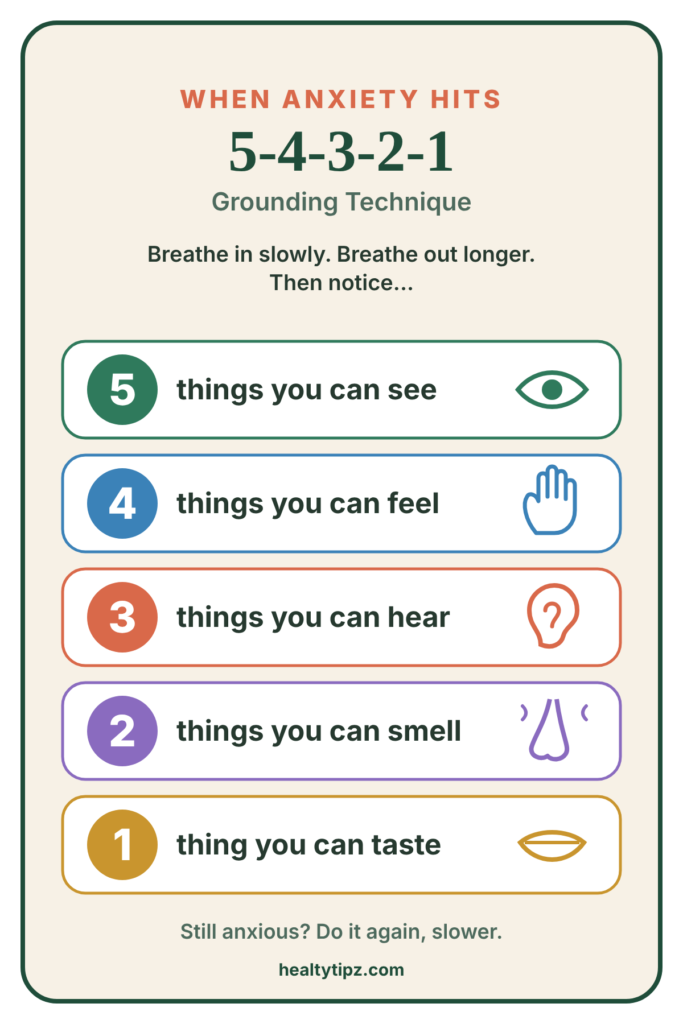
Download the printable card (PDF, 4 x 6 in) (editor: upload the PDF to the WordPress media library and paste its URL here)
Ways to use it:
- Print it at 4 x 6 inches, the size of a standard photo print, and stick it on your fridge, mirror or desk.
- Shrink it to wallet size (about 2 x 3 inches) by printing at 50%, and keep it with your cards.
- Save the image to your phone and set it as your lock screen during a stressful week.
- Share it with your kids, partner or a friend who struggles with anxiety. Practicing together makes it easier to remember.
Beyond the moment: lowering anxiety day to day
Grounding helps you ride out a wave of anxiety. These habits can make the waves smaller and less frequent.
Get enough sleep
Sleep and anxiety feed each other. A 2019 UC Berkeley study found that one sleepless night raised next-day anxiety by up to 30%, and that deep sleep seemed to calm the anxious brain overnight. If your nights are short or irregular, start by fixing your timing. Our sleep calculator works out bedtimes and wake times that line up with your natural 90-minute sleep cycles.
Grounding can also help at bedtime. Lie in the dark and slowly work through 5-4-3-2-1 with whatever you can feel and hear. Many people find it quiets a racing mind enough to drift off.
Know when it’s more than everyday anxiety
Grounding is a coping skill, not a treatment. Talk to a doctor or therapist if:
- You need grounding techniques several times a day just to get by
- Panic attacks are happening often, or you avoid places because of them
- You feel detached from yourself or the world for long stretches
- Anxiety has gone on for weeks and is affecting your work, sleep or relationships
- You also feel low, empty or hopeless much of the time
Anxiety and depression often overlap. If that last point sounds like you, our free depression screening test takes a few minutes and can help you put words to what you’re feeling. It doesn’t diagnose anything, but it gives you a starting point for a conversation with a professional.
If you’re in crisis or thinking about harming yourself, please get help right away. In the US, call or text 988. Elsewhere, contact your local emergency number or a crisis line in your country.
Frequently asked questions
What is the 5-4-3-2-1 grounding technique?
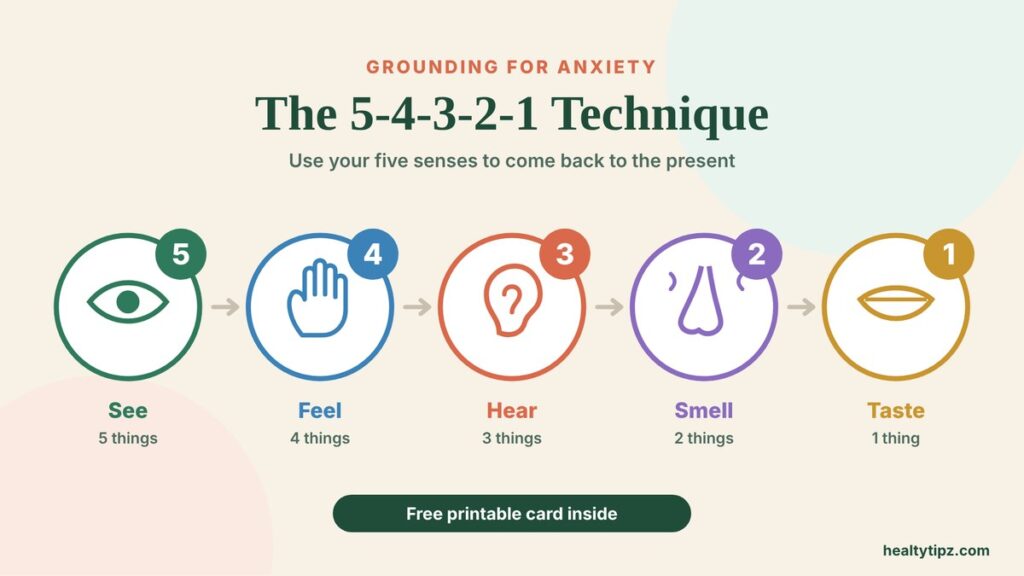
It’s a quick exercise that uses your five senses to bring your attention back to the present. You name 5 things you can see, 4 you can feel, 3 you can hear, 2 you can smell and 1 you can taste.
How long does it take?
Usually one to three minutes. You can repeat it as many times as you need.
Does 5-4-3-2-1 work for panic attacks?
Many people find it helps, especially if they start it early, as soon as they notice panic building. Focus on the “see” and “feel” steps, and pair it with slow breathing. If you’ve never had a panic attack before, or you have chest pain, get checked by a doctor to rule out other causes.
Is there research behind it?
There aren’t large studies on this exact sequence. It’s based on grounding and mindfulness, which have good evidence for reducing anxiety, and it’s widely recommended by therapists and medical centers.
Can kids use the 5-4-3-2-1 technique?
Yes. Children often enjoy it as a game, such as finding five red things or four soft things. It’s a nice tool to practice together at bedtime.
What if I can’t smell or taste anything?
That’s fine. Swap in another sense: name two textures you can feel, or two colors you can see. The aim is to focus your attention, not to complete a perfect checklist.
This article is for general information and isn’t a substitute for advice from your own doctor or mental health professional.
Sources
- University of Rochester Medical Center, Behavioral Health Partners. 5-4-3-2-1 coping technique for anxiety. 2018.
- Hofmann SG, et al. The effect of mindfulness-based therapy on anxiety and depression: a meta-analytic review. Journal of Consulting and Clinical Psychology, 2010.
- Psychology Tools. Grounding techniques (use in PTSD and dissociation).
- Medical News Today. Grounding techniques: how to use them.
- Ben Simon E, et al. Overanxious and underslept. Nature Human Behaviour, 2019. Summary: ScienceDaily.