In this article
- How to Calm Anxiety in 5 Minutes
- 1. Try cyclic sighing (the double-inhale breath)
- 2. Use box breathing
- 3. Ground yourself with 5-4-3-2-1
- 4. Use cold water
- 5. Squeeze and release your muscles
- 6. Walk it off, briskly
- 7. Name it, then write it down
- Quick reference: which one to use when
- How to make the next spike less likely
- Frequently asked questions
- Sources
How to Calm Anxiety in 5 Minutes
Your chest tightens. Your heart speeds up. Your thoughts start racing ahead to every way things could go wrong. When anxiety hits like that, “just relax” is about the least helpful advice there is.
What does help is giving your body a different signal. Anxiety sets off your fight-or-flight response, the same system that would kick in if you stepped in front of a bus. Your breathing gets quick and shallow, your muscles tense, and your brain scans for danger. The good news is that this system can be turned down from the outside in. Slow your breath, move your muscles, or shift your attention, and your nervous system starts to follow.
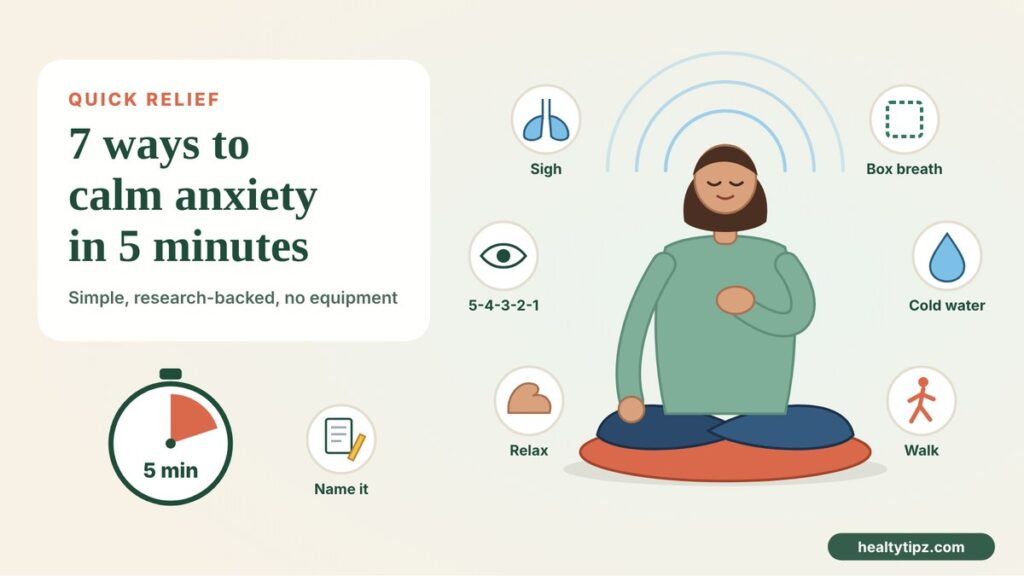
Here are seven ways to do that, each one taking five minutes or less. None of them is magic, and they won’t fix an anxiety disorder on their own. But they’re quick, free, and backed by research, and having a few ready can make a hard moment feel a lot more manageable.
1. Try cyclic sighing (the double-inhale breath)
If you only learn one technique from this list, make it this one.
How to do it:
- Breathe in through your nose until your lungs feel comfortably full.
- Without breathing out, take a second short “top-up” breath through your nose.
- Breathe out slowly through your mouth until your lungs feel completely empty. Make the exhale longer than both inhales together.
- Repeat for up to 5 minutes.
Why it works: long, slow exhales activate the parasympathetic nervous system, the “rest and digest” side that slows your heart. In a 2023 Stanford study published in Cell Reports Medicine, about 110 adults practiced one of three breathing techniques or mindfulness meditation for five minutes a day for a month. All of them reported less anxiety and better mood, but cyclic sighing gave the biggest daily boost in positive mood, beating meditation.
Even a single sigh or two can take the edge off in the moment. Five minutes a day may help you feel calmer in general.
2. Use box breathing
Box breathing gives your mind something to count, which helps when your thoughts are racing.
How to do it: breathe in for 4 counts, hold for 4, breathe out for 4, hold for 4. Picture tracing the four sides of a square. Repeat for a few minutes.
Box breathing was one of the techniques in that same Stanford study, and it also lowered anxiety. If holding your breath makes you feel more panicky, skip the holds, or use a shorter count such as 3.
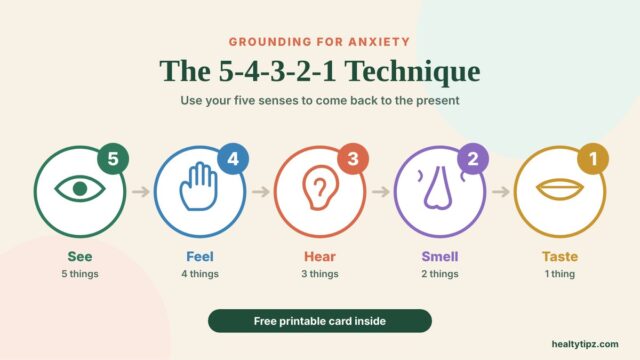
3. Ground yourself with 5-4-3-2-1
Anxiety pulls you into the future. Grounding drags your attention back to right now, using your senses.
How to do it: look around and name, silently or out loud:
- 5 things you can see
- 4 things you can feel (your feet on the floor, your shirt on your skin)
- 3 things you can hear
- 2 things you can smell
- 1 thing you can taste
This technique is widely taught by therapists. It doesn’t have the large clinical trials that breathing exercises do, but many people find it especially useful during a panic attack, when it’s too hard to focus on counting breaths.
4. Use cold water
Splash cold water on your face, hold something cold against your wrists or the back of your neck, or press a cold pack under your eyes for 15 to 30 seconds.
Why it works: cold water on your face can trigger what’s known as the diving reflex, an automatic response that slows your heart rate. It’s a fast physical “interrupt” that can make it easier to start one of the breathing exercises above.
Go gently with this one if you have a heart condition or Raynaud’s, and don’t plunge into icy water.
5. Squeeze and release your muscles
Anxiety lives in your body as much as your head: tight jaw, raised shoulders, clenched fists. Progressive muscle relaxation works by making that tension obvious and then letting it go.
A 5-minute version:
- Curl your toes tightly for 5 seconds, then release and notice the difference for 10 seconds.
- Move up: calves, thighs, stomach, hands (make fists), arms, shoulders (lift them to your ears), and finally your face (scrunch it up).
- Breathe out each time you release.
A 2024 systematic review of 46 studies with more than 3,400 adults found that progressive muscle relaxation reduced stress, anxiety and depression, and worked even better when combined with other techniques like breathing.
6. Walk it off, briskly
When your body is flooded with stress hormones, moving can burn off some of that nervous energy. A brisk walk around the block, a few flights of stairs, or even marching on the spot for a few minutes can help.
A 2015 meta-analysis of 36 randomized trials found that a single bout of exercise produced a small but real drop in anxiety compared with not exercising. It’s not a dramatic effect from one walk. But it adds up, and many people find it easier to calm down once their body has had a chance to move.
7. Name it, then write it down
It sounds too simple to work, but putting a feeling into words can reduce its intensity. Try saying to yourself, “This is anxiety. My body is in alarm mode, and it will pass.”
In a well-known UCLA brain-imaging study, people who labeled the emotion in an upsetting image showed less activity in the amygdala, the brain’s alarm center, than people who didn’t. The researchers compared it to tapping the brakes on your emotional response.
If you have a few more minutes, grab your phone notes or a scrap of paper and write down:
- What you’re worried about, in one sentence
- The worst, best and most likely outcome
- One small thing you can do about it today, if anything
Getting the worry out of your head and onto paper often makes it feel smaller and more manageable.
Quick reference: which one to use when
| Technique | Time | Best when |
|---|---|---|
| Cyclic sighing | 30 seconds to 5 minutes | You need fast relief anywhere, even in a meeting |
| Box breathing | 2 to 5 minutes | Your thoughts are racing and you need focus |
| 5-4-3-2-1 grounding | 2 to 3 minutes | You feel panicky or “not really here” |
| Cold water | 30 seconds | Your heart is pounding and you need an instant reset |
| Muscle relaxation | 5 minutes | You feel tense or can’t sleep |
| Brisk walk | 5 minutes | You feel restless and full of nervous energy |
| Name it and write it | 2 to 5 minutes | One specific worry keeps looping |
It’s worth practicing one or two of these when you’re calm. Skills you’ve rehearsed are much easier to reach for when anxiety hits.
How to make the next spike less likely
Quick techniques help in the moment. A few everyday habits lower how often and how hard anxiety hits in the first place.
Protect your sleep
This one is huge. In a 2019 UC Berkeley study published in Nature Human Behaviour, a single sleepless night raised anxiety levels by up to 30% the next day. The researchers found that deep sleep seemed to calm the anxious brain overnight, and even small night-to-night drops in sleep quality nudged anxiety up the following day.
If your sleep is all over the place, start with a steady schedule. Our sleep calculator works out the best times to go to bed or wake up based on 90-minute sleep cycles, so you’re less likely to wake up groggy in the middle of one.
Watch the caffeine
Caffeine causes a racing heart, jitters and restlessness, which feel almost exactly like anxiety. If you’re anxiety-prone, try cutting back gradually and avoiding caffeine after midday.
Move most days
One walk gives a small lift. Regular activity over weeks has a much stronger effect on anxiety than any single session.
Know when to get help
These techniques are for everyday anxiety. Please reach out to a doctor or therapist if:
- Anxiety gets in the way of work, relationships or sleep most days
- You’re having panic attacks, or avoiding places because you fear one
- The worry has gone on for weeks and nothing seems to help
- You also feel low, hopeless or have lost interest in things you used to enjoy
Anxiety and depression often show up together. If that last point sounds familiar, take a few minutes with our free depression screening test. It can’t diagnose you, but it can help you put words to what you’re feeling and give you something concrete to bring to a professional. Therapy, especially CBT, works well for both.
If you’re in crisis or thinking about harming yourself, please get help now. In the US, call or text 988. Elsewhere, contact your local emergency number or a crisis line in your country.
Frequently asked questions
What is the fastest way to calm anxiety?
A slow breathing technique with a long exhale, like cyclic sighing, is one of the fastest. One or two deep sighs can start to settle you within seconds, and a few minutes of practice usually helps more.
What should I do during a panic attack?
Remind yourself it’s a panic attack and that it will pass, usually within minutes. Then slow your breathing, focusing on long exhales, and use 5-4-3-2-1 grounding to bring your attention back to the room. If it’s your first panic attack, or you have chest pain and aren’t sure what’s happening, get medical help to rule out other causes.
Does deep breathing really help anxiety?
Yes, for many people. Slow breathing with long exhales activates the body’s calming nervous system. In the Stanford study, five minutes a day of controlled breathing lowered anxiety and improved mood over a month.
Why does my anxiety feel worse at night?
There are fewer distractions, so worries get more room. Being tired also makes it harder to manage emotions. A wind-down routine, a regular bedtime and writing down worries before bed can help.
Can these techniques replace therapy or medication?
No. They’re helpful tools for everyday anxiety and a good addition to treatment, but they aren’t a substitute for professional care if you have an anxiety disorder.
This article is for general information and isn’t a substitute for advice from your own doctor or mental health professional.
Sources
- Balban MY, et al. Brief structured respiration practices enhance mood and reduce physiological arousal. Cell Reports Medicine, 2023. Summary: Stanford Medicine.
- Muhammad Khir S, et al. Efficacy of progressive muscle relaxation in adults for stress, anxiety, and depression: a systematic review. Psychology Research and Behavior Management, 2024.
- Ensari I, et al. Meta-analysis of acute exercise effects on state anxiety. Depression and Anxiety, 2015.
- Lieberman MD, et al. Putting feelings into words: affect labeling disrupts amygdala activity. Psychological Science, 2007. Summary: UCLA Health.
- Ben Simon E, et al. Overanxious and underslept. Nature Human Behaviour, 2019. Summary: ScienceDaily.