In this article
L-Theanine vs Magnesium for Anxiety
Walk into any supplement aisle, or scroll any wellness feed, and two names keep coming up for anxiety: L-theanine and magnesium. Both are sold as natural ways to take the edge off. Both have fans who swear by them. And both have research that’s promising, but a lot thinner than the marketing suggests.
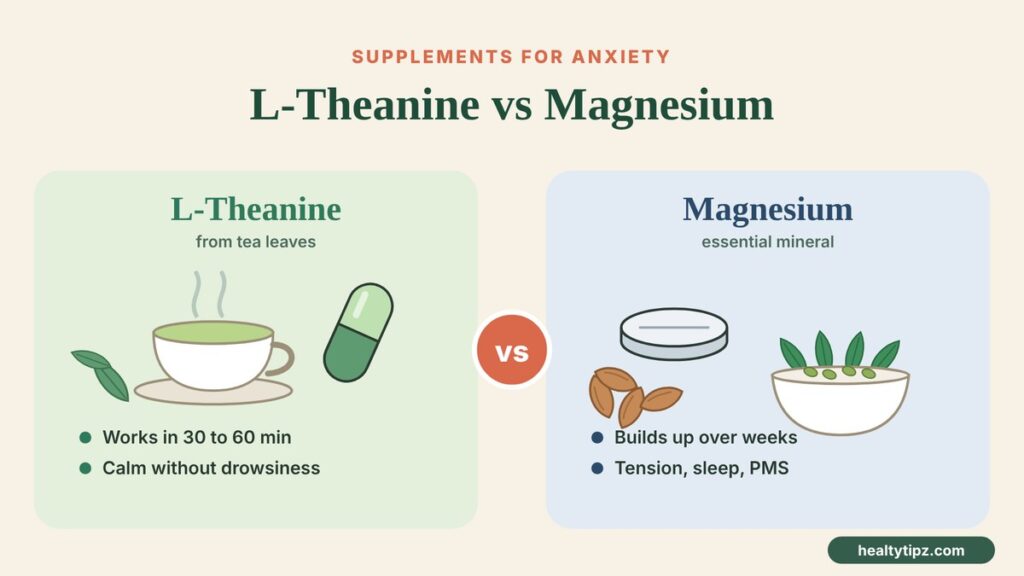
They also work in quite different ways, so the better choice depends on what your anxiety looks like.
The short answer: L-theanine tends to suit situational stress, the kind that spikes before a presentation or after too much coffee, because it acts within about an hour and doesn’t make most people drowsy. Magnesium is more of a slow, steady option, and it may help most if your diet is low in it or your anxiety comes with muscle tension, poor sleep or PMS. Neither one treats an anxiety disorder, and neither replaces professional care.
Here’s what the evidence actually says about each.
L-theanine: the green tea calmer
L-theanine is an amino acid found almost only in tea leaves. It’s a big part of why a cup of green tea feels calmer than a cup of coffee, even though both contain caffeine.
How it seems to work. L-theanine crosses from the blood into the brain. Researchers think it nudges the balance between “excitatory” and “calming” brain chemicals, including GABA. In a 1998 study from Japan, a 200 mg dose increased alpha brain waves, the pattern linked with being relaxed but awake, within about 40 minutes.
What the research shows. A 2020 systematic review in Plant Foods for Human Nutrition looked at nine controlled trials. The authors concluded that 200 to 400 mg a day may help reduce stress and anxiety in people going through stressful situations. They were also clear that larger, longer studies are still needed.
One of the better trials, published in Nutrients in 2019, gave healthy adults 200 mg a day for four weeks. Compared with placebo, the L-theanine group reported fewer stress-related symptoms and better sleep.
What the research doesn’t show yet is that L-theanine helps diagnosed anxiety disorders. Most studies were short, small, and done in healthy people under temporary stress.
Typical use: 100 to 200 mg, taken when you need it or once or twice a day. Many people like to pair it with their morning coffee to take the jittery edge off.
Magnesium: the steady background mineral
Magnesium is a mineral your body uses in hundreds of processes, from muscle relaxation to nerve signaling and sleep. Unlike L-theanine, it isn’t a “take it and feel it” supplement. It works more like filling a gap.
How it seems to work. Magnesium helps calm the nervous system by damping down glutamate, an excitatory brain chemical, and supporting GABA. It also seems to influence the body’s main stress-hormone system. Low magnesium has been linked with higher anxiety in several studies.
What the research shows. A 2017 systematic review in Nutrients from the University of Leeds looked at 18 studies. All of them involved people who were already prone to anxiety: mildly anxious adults, women with PMS, people with high blood pressure, and new mothers. Results were mixed:
- About half of the studies in anxious people found a benefit
- Four of seven PMS studies found less anxiety
- One study found no effect on postpartum anxiety
The authors called the evidence “suggestive” but rated its quality as poor. So magnesium may help, particularly if you’re low in it, but it isn’t a proven anxiety treatment.
Why so many people may benefit anyway. A lot of adults don’t get enough magnesium from food. Analyses of US national survey data suggest more than half of adults eat less than the estimated average requirement. Topping up a real shortfall is a much more reasonable goal than expecting a supplement to fix anxiety on its own.
Forms matter. Magnesium glycinate is usually the gentlest on the stomach and the most popular choice for anxiety and sleep. Citrate is well absorbed but can loosen stools. Oxide is cheap, poorly absorbed, and the most likely to cause diarrhea. Always check the label for elemental magnesium, since that’s the number that counts.
Typical use: 100 to 350 mg of elemental magnesium a day, often taken in the evening.
L-theanine vs magnesium: side by side
| L-theanine | Magnesium | |
|---|---|---|
| What it is | Amino acid from tea leaves | Essential mineral |
| How fast it works | About 30 to 60 minutes | Gradual, over days to weeks |
| Best for | Situational stress, caffeine jitters, racing thoughts | Ongoing tension, poor sleep, PMS-related anxiety, low dietary intake |
| Drowsiness | Usually none at typical doses | Can feel relaxing, especially at night |
| Typical dose | 100 to 200 mg, up to 400 mg a day | 100 to 350 mg elemental a day from supplements |
| Strength of evidence | Small trials, mostly healthy people under stress | 18 studies, mixed results, low quality |
| Most common side effects | Rare; mild headache or stomach upset | Loose stools or cramps, mostly with oxide and citrate |
| Food sources | Green and black tea | Leafy greens, nuts, seeds, beans, whole grains |
Which should you try?
Try L-theanine first if your anxiety comes and goes with specific situations, you drink a lot of coffee, or you want something you can take only on hard days.
Try magnesium first if your anxiety feels more constant, you also have muscle tension, headaches or trouble sleeping, your symptoms get worse before your period, or your diet is light on greens, nuts and beans.
Can you take both? For most healthy adults, yes. They work through different routes and there’s no known harmful interaction between them, which is why many calming blends combine the two. Start one at a time, though, for a week or two each, so you can tell which one is actually helping.
Safety, side effects and interactions
Both supplements are considered low risk for most healthy adults, but “natural” doesn’t mean risk-free.
Magnesium:
- The NIH sets the upper limit for magnesium from supplements at 350 mg a day for adults. Magnesium from food doesn’t count toward this. Going above it mostly raises the chance of diarrhea and cramps.
- If you have kidney disease, don’t take magnesium supplements without your doctor’s okay. Your kidneys clear extra magnesium, and when they don’t work well, it can build up to dangerous levels.
- Magnesium can reduce how well some medicines are absorbed, including certain antibiotics (tetracyclines and quinolones) and osteoporosis drugs (bisphosphonates). Take them at least 2 hours apart, and ask your pharmacist about timing.
- Count every source. Multivitamins, antacids and laxatives often contain magnesium too.
L-theanine:
- Side effects are uncommon. Some people notice a mild headache, dizziness or stomach upset.
- It may slightly lower blood pressure, so check with your doctor if you take blood pressure medication.
- If you take sedatives, sleep medication or prescription anti-anxiety drugs, talk to your doctor first, since the effects could add up.
For both: there’s limited safety research in pregnancy and breastfeeding, so check with your doctor or midwife first. And never stop a prescribed medication to switch to a supplement without medical advice.
When a supplement isn’t enough
Supplements can take the edge off everyday stress. They aren’t built to carry the weight of an anxiety disorder, and they can’t fix what’s driving your anxiety in the first place.
Check in on your mood, not just your nerves
Anxiety and depression often travel together, and low mood can show up as restlessness, irritability or constant worry. If you’ve felt down, flat or hopeless for more than a couple of weeks, take a few minutes with our free depression screening test. It can’t diagnose anything, but it gives you a clearer picture to bring to a doctor or therapist.
Talk to a professional if:
- Anxiety stops you from working, sleeping or doing things you used to enjoy
- You’re having panic attacks
- You’ve been relying on alcohol or other substances to calm down
- Supplements haven’t made a noticeable difference after a month
Therapy, especially cognitive behavioral therapy (CBT), and prescription treatments have much stronger evidence for anxiety disorders than either supplement here.
If you’re having thoughts of harming yourself, please reach out now. In the US, call or text 988. Elsewhere, contact your local emergency number or a crisis line in your country.
Look at what’s on your plate
Food won’t cure anxiety, but a few patterns can make it noticeably worse:
- Aggressive dieting. Big calorie deficits and skipped meals can leave you shaky, irritable and on edge, which feels a lot like anxiety. If you’re trying to lose weight, use our calorie deficit calculator to set a moderate target instead of slashing calories.
- Low-protein meals. A breakfast of just coffee and a pastry often leads to a mid-morning crash. Building meals around protein keeps your energy steadier. Our protein intake calculator shows roughly how much you need a day based on your weight and activity.
- Too much caffeine. If your heart races by 11 a.m., cut back gradually. This is also where L-theanine is most useful.
- Low magnesium foods. Before you buy a supplement, try adding pumpkin seeds, almonds, spinach, black beans or whole grains to your meals. It’s the cheapest form of magnesium there is.
Movement, regular sleep and time outside help too. They’re less exciting than a new supplement, but they have far more evidence behind them.
Frequently asked questions
Is L-theanine or magnesium better for anxiety?
It depends on the type of anxiety. L-theanine works faster and suits stress that flares up in specific moments. Magnesium works slowly and may help more with ongoing tension and sleep, especially if your diet is low in it. Neither has strong enough evidence to call it a treatment for an anxiety disorder.
How long does L-theanine take to work?
Most people notice an effect within 30 to 60 minutes of a 100 to 200 mg dose.
How long does magnesium take to work for anxiety?
There’s no fixed timeline. Many people give it two to four weeks of daily use before deciding whether it helps.
Which magnesium is best for anxiety?
Magnesium glycinate is the usual pick because it’s well absorbed and gentle on the stomach. Avoid relying on magnesium oxide, which is poorly absorbed and more likely to cause diarrhea.
Can I take L-theanine and magnesium at night?
Yes. Both are often taken in the evening to help you unwind. L-theanine doesn’t usually cause drowsiness on its own, but it may make it easier to relax into sleep.
Can I take them with my anxiety medication?
Ask your doctor or pharmacist first. L-theanine may add to the effect of sedatives, and magnesium can interfere with the absorption of some other medicines.
They also work in quite different ways, so the better choice depends on what your anxiety looks like.
The short answer: L-theanine tends to suit situational stress, the kind that spikes before a presentation or after too much coffee, because it acts within about an hour and doesn’t make most people drowsy. Magnesium is more of a slow, steady option, and it may help most if your diet is low in it or your anxiety comes with muscle tension, poor sleep or PMS. Neither one treats an anxiety disorder, and neither replaces professional care.
Here’s what the evidence actually says about each.
L-theanine: the green tea calmer
L-theanine is an amino acid found almost only in tea leaves. It’s a big part of why a cup of green tea feels calmer than a cup of coffee, even though both contain caffeine.
How it seems to work. L-theanine crosses from the blood into the brain. Researchers think it nudges the balance between “excitatory” and “calming” brain chemicals, including GABA. In a 1998 study from Japan, a 200 mg dose increased alpha brain waves, the pattern linked with being relaxed but awake, within about 40 minutes.
What the research shows. A 2020 systematic review in Plant Foods for Human Nutrition looked at nine controlled trials. The authors concluded that 200 to 400 mg a day may help reduce stress and anxiety in people going through stressful situations. They were also clear that larger, longer studies are still needed.
One of the better trials, published in Nutrients in 2019, gave healthy adults 200 mg a day for four weeks. Compared with placebo, the L-theanine group reported fewer stress-related symptoms and better sleep.
What the research doesn’t show yet is that L-theanine helps diagnosed anxiety disorders. Most studies were short, small, and done in healthy people under temporary stress.
Typical use: 100 to 200 mg, taken when you need it or once or twice a day. Many people like to pair it with their morning coffee to take the jittery edge off.
Magnesium: the steady background mineral
Magnesium is a mineral your body uses in hundreds of processes, from muscle relaxation to nerve signaling and sleep. Unlike L-theanine, it isn’t a “take it and feel it” supplement. It works more like filling a gap.
How it seems to work. Magnesium helps calm the nervous system by damping down glutamate, an excitatory brain chemical, and supporting GABA. It also seems to influence the body’s main stress-hormone system. Low magnesium has been linked with higher anxiety in several studies.
What the research shows. A 2017 systematic review in Nutrients from the University of Leeds looked at 18 studies. All of them involved people who were already prone to anxiety: mildly anxious adults, women with PMS, people with high blood pressure, and new mothers. Results were mixed:
• About half of the studies in anxious people found a benefit
• Four of seven PMS studies found less anxiety
• One study found no effect on postpartum anxiety
The authors called the evidence “suggestive” but rated its quality as poor. So magnesium may help, particularly if you’re low in it, but it isn’t a proven anxiety treatment.
Why so many people may benefit anyway. A lot of adults don’t get enough magnesium from food. Analyses of US national survey data suggest more than half of adults eat less than the estimated average requirement. Topping up a real shortfall is a much more reasonable goal than expecting a supplement to fix anxiety on its own.
Forms matter. Magnesium glycinate is usually the gentlest on the stomach and the most popular choice for anxiety and sleep. Citrate is well absorbed but can loosen stools. Oxide is cheap, poorly absorbed, and the most likely to cause diarrhea. Always check the label for elemental magnesium, since that’s the number that counts.
Typical use: 100 to 350 mg of elemental magnesium a day, often taken in the evening.
L-theanine vs magnesium: side by side
L-theanine
Magnesium
What it is
Amino acid from tea leaves
Essential mineral
How fast it works
About 30 to 60 minutes
Gradual, over days to weeks
Best for
Situational stress, caffeine jitters, racing thoughts
Ongoing tension, poor sleep, PMS-related anxiety, low dietary intake
Drowsiness
Usually none at typical doses
Can feel relaxing, especially at night
Typical dose
100 to 200 mg, up to 400 mg a day
100 to 350 mg elemental a day from supplements
Strength of evidence
Small trials, mostly healthy people under stress
18 studies, mixed results, low quality
Most common side effects
Rare; mild headache or stomach upset
Loose stools or cramps, mostly with oxide and citrate
Food sources
Green and black tea
Leafy greens, nuts, seeds, beans, whole grains
Which should you try?
Try L-theanine first if your anxiety comes and goes with specific situations, you drink a lot of coffee, or you want something you can take only on hard days.
Try magnesium first if your anxiety feels more constant, you also have muscle tension, headaches or trouble sleeping, your symptoms get worse before your period, or your diet is light on greens, nuts and beans.
Can you take both? For most healthy adults, yes. They work through different routes and there’s no known harmful interaction between them, which is why many calming blends combine the two. Start one at a time, though, for a week or two each, so you can tell which one is actually helping.
Safety, side effects and interactions
Both supplements are considered low risk for most healthy adults, but “natural” doesn’t mean risk-free.
Magnesium:
• The NIH sets the upper limit for magnesium from supplements at 350 mg a day for adults. Magnesium from food doesn’t count toward this. Going above it mostly raises the chance of diarrhea and cramps.
• If you have kidney disease, don’t take magnesium supplements without your doctor’s okay. Your kidneys clear extra magnesium, and when they don’t work well, it can build up to dangerous levels.
• Magnesium can reduce how well some medicines are absorbed, including certain antibiotics (tetracyclines and quinolones) and osteoporosis drugs (bisphosphonates). Take them at least 2 hours apart, and ask your pharmacist about timing.
• Count every source. Multivitamins, antacids and laxatives often contain magnesium too.
L-theanine:
• Side effects are uncommon. Some people notice a mild headache, dizziness or stomach upset.
• It may slightly lower blood pressure, so check with your doctor if you take blood pressure medication.
• If you take sedatives, sleep medication or prescription anti-anxiety drugs, talk to your doctor first, since the effects could add up.
For both: there’s limited safety research in pregnancy and breastfeeding, so check with your doctor or midwife first. And never stop a prescribed medication to switch to a supplement without medical advice.
When a supplement isn’t enough
Supplements can take the edge off everyday stress. They aren’t built to carry the weight of an anxiety disorder, and they can’t fix what’s driving your anxiety in the first place.
Check in on your mood, not just your nerves
Anxiety and depression often travel together, and low mood can show up as restlessness, irritability or constant worry. If you’ve felt down, flat or hopeless for more than a couple of weeks, take a few minutes with our free depression screening test. It can’t diagnose anything, but it gives you a clearer picture to bring to a doctor or therapist.
Talk to a professional if:
• Anxiety stops you from working, sleeping or doing things you used to enjoy
• You’re having panic attacks
• You’ve been relying on alcohol or other substances to calm down
• Supplements haven’t made a noticeable difference after a month
Therapy, especially cognitive behavioral therapy (CBT), and prescription treatments have much stronger evidence for anxiety disorders than either supplement here.
If you’re having thoughts of harming yourself, please reach out now. In the US, call or text 988. Elsewhere, contact your local emergency number or a crisis line in your country.
Look at what’s on your plate
Food won’t cure anxiety, but a few patterns can make it noticeably worse:
• Aggressive dieting. Big calorie deficits and skipped meals can leave you shaky, irritable and on edge, which feels a lot like anxiety. If you’re trying to lose weight, use our calorie deficit calculator to set a moderate target instead of slashing calories.
• Low-protein meals. A breakfast of just coffee and a pastry often leads to a mid-morning crash. Building meals around protein keeps your energy steadier. Our protein intake calculator shows roughly how much you need a day based on your weight and activity.
• Too much caffeine. If your heart races by 11 a.m., cut back gradually. This is also where L-theanine is most useful.
• Low magnesium foods. Before you buy a supplement, try adding pumpkin seeds, almonds, spinach, black beans or whole grains to your meals. It’s the cheapest form of magnesium there is.
Movement, regular sleep and time outside help too. They’re less exciting than a new supplement, but they have far more evidence behind them.
Frequently asked questions
Is L-theanine or magnesium better for anxiety?
It depends on the type of anxiety. L-theanine works faster and suits stress that flares up in specific moments. Magnesium works slowly and may help more with ongoing tension and sleep, especially if your diet is low in it. Neither has strong enough evidence to call it a treatment for an anxiety disorder.
How long does L-theanine take to work?
Most people notice an effect within 30 to 60 minutes of a 100 to 200 mg dose.
How long does magnesium take to work for anxiety?
There’s no fixed timeline. Many people give it two to four weeks of daily use before deciding whether it helps.
Which magnesium is best for anxiety?
Magnesium glycinate is the usual pick because it’s well absorbed and gentle on the stomach. Avoid relying on magnesium oxide, which is poorly absorbed and more likely to cause diarrhea.
Can I take L-theanine and magnesium at night?
Yes. Both are often taken in the evening to help you unwind. L-theanine doesn’t usually cause drowsiness on its own, but it may make it easier to relax into sleep.
Can I take them with my anxiety medication?
Ask your doctor or pharmacist first. L-theanine may add to the effect of sedatives, and magnesium can interfere with the absorption of some other medicines.
This article is for general information and isn’t a substitute for advice from your own doctor or mental health professional.
Sources
1. Williams JL, et al. The effects of green tea amino acid L-theanine consumption on the ability to manage stress and anxiety levels: a systematic review. Plant Foods for Human Nutrition, 2020.
2. Hidese S, et al. Effects of L-theanine administration on stress-related symptoms and cognitive functions in healthy adults: a randomized controlled trial. Nutrients, 2019.
3. Kobayashi K, et al. Effects of L-theanine on the release of alpha-brain waves in human volunteers. 1998.
4. Boyle NB, Lawton C, Dye L. The effects of magnesium supplementation on subjective anxiety and stress: a systematic review. Nutrients, 2017.
5. NIH Office of Dietary Supplements. Magnesium fact sheet for health professionals.
6. Costello R, et al. Perspective: call for re-evaluation of the tolerable upper intake level for magnesium supplementation in adults. Advances in Nutrition, 2023.
This article is for general information and isn’t a substitute for advice from your own doctor or mental health professional.
Sources
- Williams JL, et al. The effects of green tea amino acid L-theanine consumption on the ability to manage stress and anxiety levels: a systematic review. Plant Foods for Human Nutrition, 2020.
- Hidese S, et al. Effects of L-theanine administration on stress-related symptoms and cognitive functions in healthy adults: a randomized controlled trial. Nutrients, 2019.
- Kobayashi K, et al. Effects of L-theanine on the release of alpha-brain waves in human volunteers. 1998.
- Boyle NB, Lawton C, Dye L. The effects of magnesium supplementation on subjective anxiety and stress: a systematic review. Nutrients, 2017.
- NIH Office of Dietary Supplements. Magnesium fact sheet for health professionals.
- Costello R, et al. Perspective: call for re-evaluation of the tolerable upper intake level for magnesium supplementation in adults. Advances in Nutrition, 2023.