In this article
A 15-Minute Healthy Morning Routine for Busy Moms
Most morning routine advice seems to be written for people who wake up alone. Journal for 20 minutes. Meditate. Make a smoothie with nine ingredients. Go for a run while the house is quiet.
If you’re a mom, your house is rarely quiet, and your morning often starts with someone else’s needs: a feed, a lost shoe, a lunch box, a meltdown about the wrong color cup.
So this routine is built differently. It takes 15 minutes, it’s broken into small pieces you can do with kids around, and every piece has a reason behind it. You won’t need a 5 a.m. alarm. And if you only manage half of it on a bad day, that half still counts.
The night before: 5 minutes that save your morning
A calm morning usually starts the evening before. Not with a big prep session, just a few small things done while the kettle boils or the bath fills:
- Fill a water bottle and leave it by your bed or the coffee maker.
- Prep breakfast protein. Boil a batch of eggs for the week, portion out Greek yogurt, or set out the oats and peanut butter.
- Lay out your clothes, including shoes you can walk in. If your workout clothes are already on, you’re far more likely to move.
- Pack the bags. School bag, work bag, diaper bag. Whatever leaves the house, put it by the door.
- Pick a bedtime and protect it. You won’t control every night waking, but you can stop scrolling at a set time. Even a little more sleep makes the morning feel different.
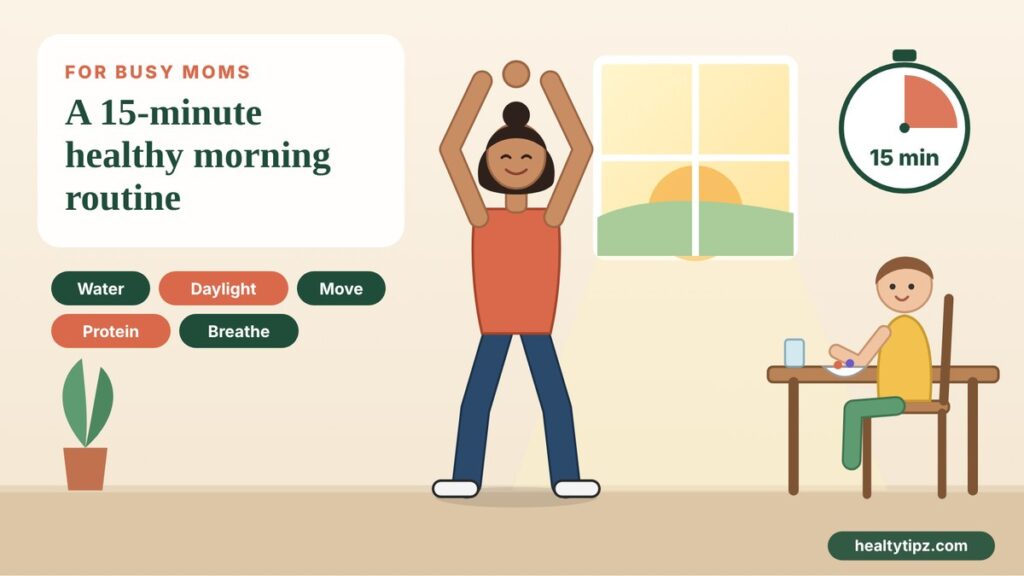
The 15-minute morning routine, minute by minute
You don’t have to do these in one block. Many moms do the first two before the kids wake, the movement while breakfast cooks, and the last step in the car. The order matters more than the timing.
| Minutes | What to do |
|---|---|
| 0 to 1 | Drink a full glass of water |
| 1 to 4 | Get daylight |
| 4 to 11 | 7-minute movement snack |
| 11 to 14 | Protein-first breakfast |
| 14 to 15 | One calm minute |
Minute 0 to 1: Drink a glass of water
You’ve gone 7 or 8 hours without a drink, and many busy moms reach for coffee before anything else. Start with a big glass of water instead, then have your coffee. It’s the easiest win of the day, and it takes about 30 seconds.
Minutes 1 to 4: Get some daylight
Open the curtains, step onto the porch, or stand by a bright window with your coffee. Morning light is one of the strongest signals your body clock gets. In a study of office workers published in Sleep Health, people who got more bright light in the morning fell asleep faster at night and reported less stress and fewer signs of depression than those who spent their mornings in dim light.
Outdoor light works best, even on a cloudy day. If you want to understand why, we cover it in how morning light resets your circadian rhythm.
Minutes 4 to 11: A 7-minute movement snack
This is the part most moms skip, and it’s the part with the biggest payoff for your mood. In a study of working mothers published in Mental Health and Physical Activity, moms who exercised on a given day reported a better mood that day, and exercise helped their mood more than an extra bit of sleep did. The researchers suggested short, intense bouts might suit time-pressed moms best.
Try this circuit in the kitchen or living room. Do each move for 40 seconds, rest 20 seconds, and go through it once (or twice if you have time):
- March in place or jumping jacks to warm up
- Squats, holding the counter if you need to
- Incline push-ups against the counter or a sturdy table
- Reverse lunges, alternating legs
- Glute bridges on the floor
- Plank, on your knees or toes
- Fast march or stair climb to finish
Kids are welcome to join. Toddlers love jumping jacks, and older kids can be in charge of the timer.
New mom? Check with your doctor or midwife before starting, especially after a C-section. Canada’s 2025 postpartum guideline also recommends daily pelvic floor exercises in the first year after birth.
Minutes 11 to 14: Build a protein-first breakfast
Busy-mom breakfast is often toast crusts and cold coffee. Swap that for something with about 25 to 30 grams of protein. Studies on breakfast keep finding the same thing: higher-protein breakfasts leave people feeling fuller through the morning than low-protein, carb-heavy ones like cereal or pancakes. That means fewer mid-morning raids on the snack cupboard.
Quick options that take under 3 minutes if you prepped the night before:
- Two boiled eggs, a slice of whole-grain toast and some fruit
- A big bowl of Greek yogurt with berries and a spoon of nut butter
- Overnight oats made with milk and a scoop of protein powder
- Leftover chicken or beans wrapped in a tortilla
Sit down for at least part of it if you can, even if the kids are eating too.
Minute 14 to 15: One calm minute
Before the rush of getting everyone out the door, take one minute for yourself. Take five slow breaths, with the out-breath longer than the in-breath. Or think of one thing you’re looking forward to today. It sounds tiny, but it gives you a moment to start the day on purpose instead of in reaction to everyone else.
Keep moving after the morning rush
The 7-minute workout gets you started, but the rest of your movement can hide inside the day you already have. Research on short bursts of activity backs this up. In a 2022 UK Biobank study of more than 25,000 adults who didn’t exercise in their free time, people who did about three short bursts of vigorous everyday activity a day, like climbing stairs fast or hurrying with shopping, had a much lower risk of dying during follow-up than those who did none. Most bursts lasted only a minute or two.
For moms, those bursts are everywhere:
- Walk the school run instead of driving, or park 10 minutes away and walk the rest.
- Take the stairs fast, carrying the laundry basket.
- Push the stroller uphill at a pace that makes you breathe hard.
- Play tag or race the kids to the end of the street.
- Walk while you take phone calls.
The school run alone can make a real difference. A 15-minute walk each way adds roughly 3,000 to 4,000 steps, depending on your stride and pace. Plug your daily steps into our steps to calories calculator to see what they add up to. If you’d rather think in minutes, the walking calories calculator estimates the energy you burn from your walking time, pace and body weight.
The point isn’t to count every calorie. It’s to see, in black and white, that the walking you do for your family is real exercise.
When mornings fall apart: the 5-minute version
Some mornings the baby is up at 4:30, the toddler is sick, or you simply overslept. On those days, shrink the routine instead of skipping it:
- Water while you wait for the kettle (30 seconds)
- Light: open every curtain on your way through the house (30 seconds)
- Movement: 20 squats and 10 counter push-ups (2 minutes)
- Protein: grab a boiled egg, a yogurt or a cheese stick (1 minute)
- Breathe: five slow breaths before you start the car or open the front door (1 minute)
That’s it. The habit stays alive, and tomorrow you can do the full version. Consistency beats intensity here. A routine you do imperfectly five days a week will help you more than a perfect one you do twice.
Frequently asked questions
Can 15 minutes in the morning really make a difference?
Yes, especially for mood and energy. Short bouts of movement, a bit of daylight and a filling breakfast all have research behind them, and together they set up the rest of the day. It won’t replace sleep or a full workout, but it’s far better than starting the day on empty.
What should I do if my kids wake up before me?
Bring them into it. Open the curtains together, let them do the workout with you, and make breakfast for everyone at once. The routine doesn’t need silence, it just needs you to start.
Is it better to exercise in the morning or evening?
The best time is the one you’ll stick with. Many moms find mornings easier because the day hasn’t had a chance to get away from them yet.
I’m exhausted. Should I sleep in instead?
Sometimes, yes. If you were up half the night with a baby, rest is the right call. On ordinary tired days, though, a few minutes of movement often leaves you feeling more awake than an extra 10 minutes in bed. Canada’s postpartum guideline found that active new moms didn’t necessarily sleep longer, but slept better and felt less tired.
How soon after having a baby can I start this routine?
The water, light, breakfast and breathing steps are fine right away. For the workout, wait until your doctor or midwife clears you, then start gently.
This article is for general information and isn’t a substitute for advice from your own doctor.
Sources
- Figueiro MG, et al. The impact of daytime light exposures on sleep and mood in office workers. Sleep Health, 2017. Summary: Lighting Research Center study finds robust morning light improves sleep and mood.
- PsyPost. Study suggests busy moms should choose exercise over extra sleep to improve mood (study in Mental Health and Physical Activity).
- Leidy HJ, et al. Beneficial effects of a higher-protein breakfast on appetite and hormonal signals. American Journal of Clinical Nutrition, 2013. Summary: Natural Medicines.
- FoodNavigator. Protein-rich breakfast can curb appetite throughout the morning.
- News-Medical. High-protein breakfasts help you feel fuller. 2025.
- Stamatakis E, et al. Association of wearable device-measured vigorous intermittent lifestyle physical activity with mortality. Nature Medicine, 2022. Summary: TODAY.
- University of Alberta. World’s first stand-alone guidelines on postpartum exercise and sleep released in Canada. 2025.