In this article
- Lymphatic Drainage Massage at Home: Step by Step
- What your lymphatic system does (and what massage can actually do)
- Who should skip it or ask a doctor first
- Before you start: setup, pressure and rhythm
- The step-by-step routine (about 10 minutes)
- Daily habits that keep lymph moving
- How often to do it and what to expect
- Frequently asked questions
- Sources
Lymphatic Drainage Massage at Home: Step by Step
If you’ve spent any time on social media lately, you’ve probably seen someone gently stroking their neck or legs and calling it lymphatic drainage. The claims range from reasonable (less puffiness) to wild (melting fat, flushing toxins, curing bloating forever).
The real technique is older and a lot less flashy. Manual lymphatic drainage was developed to help people with lymphedema, the swelling that can happen when lymph nodes are removed or damaged, and it’s still a standard part of that treatment. A simpler version is easy to learn and can feel lovely after a long flight, a day on your feet or a salty dinner.
This guide walks you through a gentle 10-minute routine you can do at home, explains what it can and can’t do, and covers the people who should check with a doctor before trying it.
What your lymphatic system does (and what massage can actually do)
Every time your heart pumps, a little fluid seeps out of your tiny blood vessels into the spaces between your cells. Your lymphatic system is the network of thin vessels and nodes that collects that fluid, filters it through your lymph nodes, and returns it to your bloodstream through large veins just under your collarbones.
Unlike your blood, lymph has no central pump. It moves mostly when the muscles around the vessels squeeze them, when you breathe deeply, and when the vessel walls contract on their own. That’s why sitting still for hours tends to leave your ankles puffy, and why a walk often fixes it.
Lymphatic drainage massage uses very light, slow, stretching strokes on the skin to nudge that fluid toward the nearest lymph nodes. Here’s what the evidence says about it:
- For lymphedema, it has a real role. A Cochrane review of six trials in people with breast cancer-related lymphedema found that adding manual lymphatic drainage to compression bandaging reduced swelling a bit more than bandaging alone, with the clearest benefit in mild to moderate cases. The authors also found it was safe and well tolerated. In that setting it’s one part of a package that also includes compression, exercise and skin care.
- For everyday puffiness, it may help you feel lighter. Cleveland Clinic notes that facial lymphatic massage may reduce puffiness, and many people find the routine relaxing. Just keep your expectations modest, since research on healthy people is thin.
- It won’t burn fat or “detox” you. Your liver and kidneys handle waste removal. No massage changes your body fat, and any change on the scale the next morning is water.
If you have lymphedema: please learn the technique from a certified lymphedema therapist. The pattern they teach you will depend on which nodes were removed or treated, and it may differ from the general routine below.
Who should skip it or ask a doctor first
Lymphatic massage is gentle, but it moves fluid back into your circulation, and that isn’t safe for everyone. Massage therapy schools and lymphedema clinics generally list these as reasons to hold off unless your doctor clears you:
- Congestive heart failure. A weak heart may not cope well with extra fluid returning to it.
- A known or suspected blood clot (DVT). Pressing on the area could dislodge a clot.
- An active infection or fever, including cellulitis or a red, hot, painful patch of skin. Cleveland Clinic advises against self-massage during the active phase of an illness.
- Kidney failure or serious kidney disease. Your body may not be able to clear the extra fluid.
- Active or untreated cancer, or if you’re in cancer treatment. Ask your oncology team first.
- Recent surgery, especially in the area you plan to massage. Get your surgeon’s okay.
And a separate warning: new swelling in just one leg or arm, especially if it’s warm, red or painful, isn’t something to massage away. Get it checked the same day, because it can be a sign of a blood clot.
Before you start: setup, pressure and rhythm
The biggest mistake beginners make is pressing too hard. Lymph vessels sit just under the skin, so deep pressure squashes them flat and does nothing useful. Think of the pressure you’d use to stroke a cat, or about the weight of a coin.
What you need:
- 10 to 15 quiet minutes
- A bed, sofa or yoga mat to lie on, with a pillow under your knees
- Clean, dry hands. Skip the oil, since you want to stretch the skin, not glide over it
The three rules:
- Light pressure. Just enough to gently stretch the skin. If you can feel the muscle underneath, you’re pressing too hard.
- Slow rhythm. Each stroke takes about a second to stretch and a second to release. Repeat each move 10 to 15 times.
- Clear the way first. Always start near the collarbones and work outward. You open the “drain” before you send fluid toward it, which is why the routine starts at your neck even if your ankles are the problem.
It shouldn’t hurt, leave red marks or make your skin feel warm. If it does, ease off.
The step-by-step routine (about 10 minutes)
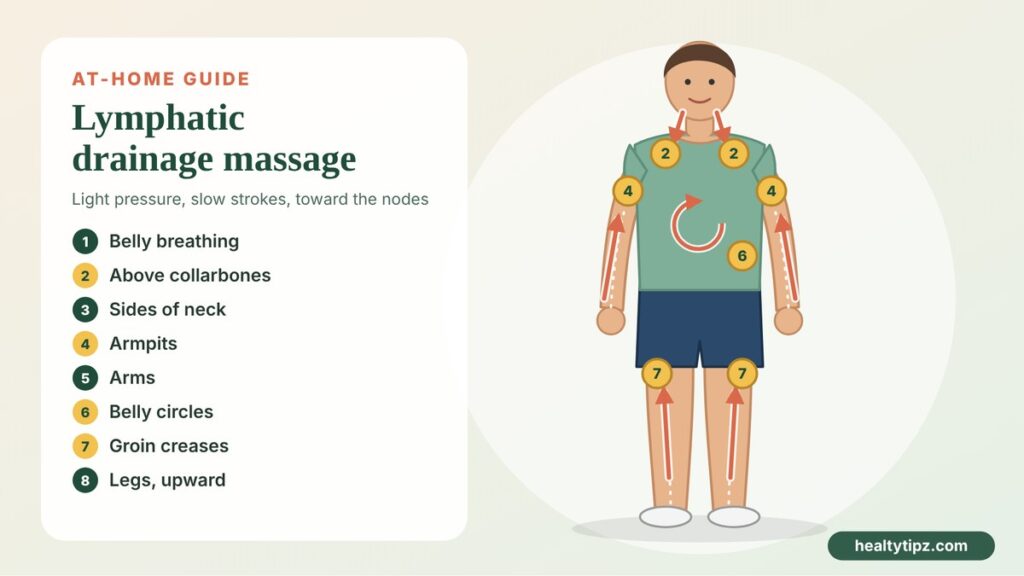
Lie on your back with your knees supported. Go slowly. If you only have three minutes, do steps 1 to 4, since they matter most.
Step 1: Belly breathing (5 breaths)
Place both hands on your belly. Breathe in slowly through your nose so your belly rises into your hands, then breathe out through your mouth and let it fall. Deep breathing changes the pressure in your chest and helps pull lymph up through the large vessel that runs alongside your spine. It also tells your body to relax, which makes the rest easier.
Step 2: Above the collarbones (10 to 15 times)
Find the soft hollow just above each collarbone. Rest two or three flat fingers there and gently stretch the skin down and in, toward the center of your chest. Release and repeat. This is where lymph rejoins your blood, so you’re opening the main drain.
Step 3: Sides of the neck (10 to 15 times)
Place your flat hands on the sides of your neck, just below your ears. Gently stretch the skin down toward your collarbones and release. Move your hands a little lower each few strokes until you reach the collarbones. Keep it feather-light here.
Step 4: Armpits (10 to 15 times each side)
Raise one arm and rest your hand behind your head. Cup the opposite palm in the armpit and gently scoop upward, into the hollow, then release. Switch sides. The armpit nodes drain your arms, chest and upper back.
Step 5: Arms (5 to 10 passes each arm)
Start at the upper arm. Using a flat palm, stretch the skin from the elbow up toward the armpit. Then do the forearm, stroking from wrist to elbow, and finish by stroking the upper arm again. Always move toward the armpit.
Step 6: Belly (5 to 10 circles)
With flat hands, make slow, gentle circles around your belly button, moving clockwise (up the right side, across, and down the left). Then rest your hands on your belly and take two more deep breaths. Skip this step if you’re pregnant, have had recent abdominal surgery, or it feels uncomfortable.
Step 7: Groin creases (10 to 15 times each side)
Place your flat hand in the crease where your thigh meets your hip. Gently stretch the skin upward and inward toward your belly, then release. These nodes drain your legs, so clear them before you work on the legs themselves.
Step 8: Legs (5 to 10 passes each leg)
Work in sections, always toward the groin:
- Thigh: wrap both hands around the front and side of your thigh and stretch the skin up toward the groin crease.
- Back of the knee: with your knee bent, gently pump the soft area behind it with flat fingers, pointing up the leg.
- Calf and shin: stroke from the ankle up to the knee.
- Ankle and top of the foot: stroke from your toes up around the ankle bones.
- Finish with a few long, light strokes from ankle all the way to the groin.
Step 9: Finish and drink some water
End with three slow belly breaths. Have a glass of water if you’re thirsty. It won’t “flush toxins,” but you might need the bathroom soon after, which is normal, since your kidneys are clearing the extra fluid.
Daily habits that keep lymph moving
Here’s the honest part: ten minutes of massage helps, but what you do with the other 23 hours and 50 minutes matters more. Your muscles are your lymphatic system’s real pump.
Walk more, and break up long sits. Every time your calf muscles contract, they squeeze the lymph and veins in your lower legs upward. A short walk every hour or so is one of the best things you can do for puffy ankles. If you track your steps, our steps to calories calculator shows what your daily total adds up to, which can make that extra lap around the block feel more worth it.
Do ankle pumps when you can’t walk. On a plane, at your desk or in bed, point and flex your feet 20 times. It’s a small version of the same calf pump.
Keep an eye on body fat, not just weight. Excess fat tissue can press on lymph vessels and inflame them. Researchers at Boston Children’s Hospital found that severe obesity can cause lymphedema in the legs on its own, and in a later study the risk climbed sharply once BMI went above 40. You don’t need to be anywhere near that range for weight to matter for everyday swelling, though. Our body fat calculator uses the US Navy tape-measure method to give you a better picture than BMI alone.
Raise your legs at the end of the day. Lie down with your legs up on a few pillows or against a wall for 10 to 15 minutes. Gravity does the work.
Go easy on salt and stay hydrated. Salty meals make your body hold on to water, and being dehydrated can make it hold on even more. Plain water through the day is the simplest fix.
Consider compression socks for long flights or standing jobs. Ask a pharmacist about the right pressure. If you have diabetes, poor circulation in your legs or numb feet, check with your doctor first.
How often to do it and what to expect
For general puffiness, once a day is plenty, and many people like to do it at night before bed or in the morning when their face is puffiest. On days when you’ve been sitting or flying a lot, a quick legs-only session can help.
What you’ll likely notice:
- A calm, sleepy feeling, a bit like after a slow stretch
- Needing to pee within an hour or so
- Ankles or rings that feel a little looser, especially at the end of the day
What you shouldn’t expect: lost inches of fat, a flatter stomach from “debloating” gas, or lasting changes without the movement habits above. If the swelling comes back every day no matter what you do, or it’s in only one limb, that’s a reason to see a doctor rather than massage harder.
Frequently asked questions
How hard should I press during lymphatic drainage massage?
Very lightly. You’re only trying to stretch the skin, not reach the muscle. If it feels like a regular massage, you’re pressing too hard.
Which direction should the strokes go?
Always toward the nearest group of lymph nodes, and eventually toward the collarbones. Arms drain toward the armpits, legs toward the groin, and the head and neck down toward the collarbones.
Can lymphatic drainage massage help you lose weight?
No. It can move some water out of your tissues, so the scale may dip slightly, but it doesn’t touch body fat. Regular movement and diet change are what shift fat.
Is it safe to do every day?
For most healthy people, yes. If you have a heart, kidney or clotting condition, an infection, cancer, or you’ve recently had surgery, check with your doctor first.
Should I do it after liposuction or a tummy tuck?
Many surgeons do recommend lymphatic massage after these procedures, but timing and technique matter. Only start when your surgeon says so, and ideally learn it from a therapist they recommend.
This article is for general information and isn’t a substitute for advice from your own doctor or a certified lymphedema therapist.
Sources
- Ezzo J, et al. Manual lymphatic drainage for lymphedema following breast cancer treatment. Cochrane Database of Systematic Reviews, 2015.
- Cleveland Clinic. Lymphatic drainage massage.
- Cleveland Clinic Health Essentials. How to do lymphatic drainage self-massage.
- East West College of the Healing Arts. Massage modalities: lymphatic drainage massage (how lymph moves, and contraindications).
- Greene AK, Sudduth CL. Lower extremity lymphatic function predicted by body mass index. International Journal of Obesity, 2020.
- Obesity-induced lymphedema (review). PubMed Central, 2022.
- Savetsky IL, et al. Obesity increases inflammation and impairs lymphatic function in a mouse model of lymphedema. PubMed Central.
- Tactile Medical. How to do a lymphatic massage (steps adapted from University Health Network guidance).