In this article
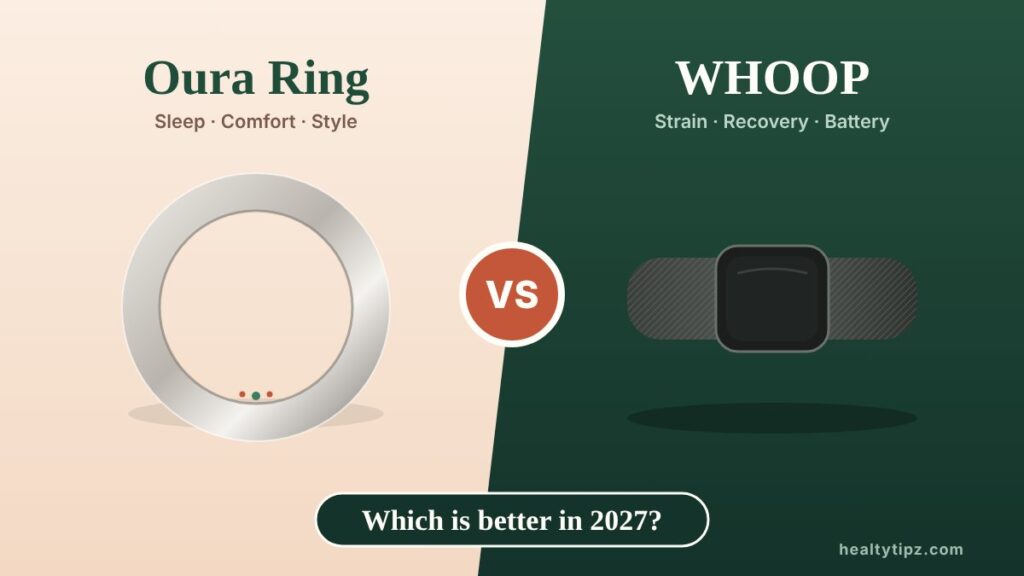
Oura Ring vs WHOOP: Which Is Better in 2027?
Prices and features were checked in early November 2026. Recheck prices before publishing and around Black Friday (November 27, 2026), when both brands often run deals.
Oura and WHOOP both promise the same thing: wear this every day and night, and it will tell you how well you slept, how recovered you are and whether today is a day to push or rest. Both are screenless, both lean heavily on an app, and both cost more than most people expect once you add up the subscription.
The difference is who they’re built for. After going through the current models (Oura Ring 5 and WHOOP 5.0 / MG) and their pricing, here’s the short answer:
- Choose Oura if sleep and general health are your main interest, you want something discreet you’ll forget you’re wearing, and you’d rather pay less over two years.
- Choose WHOOP if you train hard, want detailed strain and recovery coaching, and like the idea of charging once every two weeks.
If you’re still on the fence, the sections below go through each area one at a time.
Oura Ring vs WHOOP at a glance
| Oura Ring 5 | WHOOP (5.0 or MG) | |
|---|---|---|
| What you wear | Smart ring, sizes 6 to 13 | Screenless band on the wrist or upper arm |
| Upfront price | $399 (Silver, Black) or $499 (other finishes) | $0, device included with membership |
| Subscription | $5.99/month or $69.99/year | $199, $239 or $359 a year (One, Peak, Life) |
| Battery | 6 to 9 days | 14+ days |
| Best at | Sleep, readiness, everyday health | Strain, recovery, training load |
| ECG | No | Yes, with WHOOP MG on the Life plan |
| Blood pressure | Overnight “Blood Pressure Signals” patterns | Daily estimates with WHOOP MG (wellness feature) |
Prices are US list prices from TechCrunch and WHOOP’s launch announcement. The older Oura Ring 4 is still sold from $349 with the same app and membership.
Design and comfort
This is where most people make their decision, often without realizing it.
The Oura Ring 5 is the smallest Oura yet. According to TechCrunch, it’s about 40% smaller than the Ring 4, roughly 2 mm narrower and 30% thinner, and it comes in six finishes. It looks like a regular ring, so nobody at work will ask what it is. The trade-offs are that rings can get scratched, they can be uncomfortable when lifting weights or doing pull-ups, and you need the right size. The Ring 5 only comes in sizes 6 to 13 so far, so very small or very large fingers may need the Ring 4.
WHOOP is a small sensor pod on a fabric band. There’s no screen at all, which some people love and others find odd at first. You can wear it on your wrist or, with different bands and clothing, on your bicep, which many lifters and fighters prefer. WHOOP says the 5.0 and MG are 7% smaller than the previous model. It’s less discreet than a ring, but it doesn’t get in the way of gripping a barbell.
The winner is Oura for everyday comfort and style, and WHOOP if you do a lot of grip-heavy training.
Sleep tracking
Both devices track total sleep, sleep stages (light, deep and REM), heart rate, heart rate variability (HRV), breathing rate and skin temperature overnight, and turn it into a morning score. Oura calls it Readiness. WHOOP calls it Recovery.
Oura has the stronger track record here. Sleep is the product it was built around, and the finger is a good spot for picking up a clean pulse signal at night. In a 2024 study published in Sensors, researchers at Brigham and Women’s Hospital compared the Oura Ring, Apple Watch and Fitbit Sense against a lab sleep test (polysomnography) in 35 adults. Oura was the most accurate of the three at sorting sleep into four stages, with the best detection of deep sleep (Oura’s summary of the study). Two things to keep in mind: Oura funded that study, although Brigham researchers designed and ran it, and WHOOP wasn’t part of it.
WHOOP’s sleep tracking is solid and useful, especially its Sleep Coach, which suggests how much sleep you need tonight based on how hard you pushed today. It also has a haptic alarm that buzzes your wrist instead of waking your partner.
Whichever you choose, remember that a tracker can only measure your sleep. Habits are what change it. If your scores keep telling you that you’re falling asleep too late, start with your mornings: here’s how morning light resets your circadian rhythm, and why it’s one of the easiest fixes for a schedule that keeps drifting later.
The winner is Oura, narrowly.
Fitness, strain and recovery
This is WHOOP’s home ground. Its whole system revolves around two numbers: Strain, which measures how much load you put on your body during the day, and Recovery, which tells you how ready you are to take on more. Over time it learns how your body responds to training, poor sleep, alcohol and stress, and suggests a target strain for the day. Even the cheapest WHOOP One plan includes VO2 max estimates and heart rate zones. If you’re the kind of person who wants to know whether today should be a hard session or a rest day, WHOOP answers that question better than anything else on the market.
Oura has caught up a lot. The Ring 5 added live fitness tracking with real-time pace and distance for running and cycling, better automatic detection for low-motion workouts like Pilates, and support for third-party heart rate chest straps. It’s good for most casual exercisers. But a ring is still not ideal during weightlifting, and Oura’s activity scoring is broader and less training-focused than WHOOP’s.
Neither device has a screen or built-in GPS, so serious runners and cyclists may still want a sports watch alongside either one.
The winner is WHOOP for anyone who trains seriously, and it’s close to a tie for casual exercise.
Health features
Both companies are pushing beyond fitness into broader health, and this is where WHOOP’s tiers start to matter.
WHOOP Peak ($239 a year) adds Healthspan, a “WHOOP Age” that estimates your pace of aging, a real-time stress monitor and health alerts. WHOOP Life ($359 a year) swaps the standard band for the WHOOP MG, which adds an on-demand ECG and heart screener for signs of atrial fibrillation, plus daily blood pressure estimates. WHOOP describes the ECG as FDA-cleared. The blood pressure feature had a bumpier road: the FDA sent WHOOP a warning letter about it in July 2025, then closed that letter in June 2026 after WHOOP changed the feature and its labeling. It’s now presented as a wellness estimate calibrated with cuff readings, not a medical measurement. WHOOP also offers Hormonal Insights for menstrual cycle tracking.
Oura’s Ring 5 launched with Health Radar, including Blood Pressure Signals, which look for overnight patterns that may suggest cardiovascular strain, rather than giving you a daily number. It also added a 30-day view of breathing patterns during sleep, tools for tracking GLP-1 medication and weight, and the option to import US health records. Oura is also adding a paid service with Counsel Health that lets members ask health questions and connect with licensed US doctors (TechCrunch). Oura has long offered menstrual cycle tracking and period predictions too.
A word of caution for both: these features can flag trends worth discussing with your doctor, but neither device diagnoses anything. Don’t change medication or ignore symptoms based on a wearable reading.
The winner is WHOOP Life if you specifically want an ECG. Otherwise it’s a tie.
Battery and charging
WHOOP wins clearly. The 5.0 and MG last 14+ days per charge, and you charge it with a battery pack that slides onto the band, so you never have to take it off. Peak and Life come with a wireless PowerPack; One uses a wired pack.
The Oura Ring 5 lasts 6 to 9 days, up from 5 to 8 on the Ring 4. That’s still excellent for a ring, but you do have to take it off to charge, which means a gap in your data.
What it really costs over two years
This is the part most comparisons gloss over. Oura charges for the ring up front plus a small subscription. WHOOP charges nothing up front but a larger yearly fee. Here’s what two years looks like at US list prices, paying yearly:
| Option | Year 1 | Year 2 | Two-year total |
|---|---|---|---|
| Oura Ring 5 (Silver or Black) | $468.99 | $69.99 | about $539 |
| Oura Ring 4 | $418.99 | $69.99 | about $489 |
| WHOOP One | $199 | $199 | $398 |
| WHOOP Peak | $239 | $239 | $478 |
| WHOOP Life | $359 | $359 | $718 |
Oura’s ring price is from TechCrunch and the $69.99 annual membership from Lifestack’s pricing guide. Oura’s first month of membership is free, so the real figure is slightly lower. WHOOP prices are from its launch announcement.
Two things change the math. First, the longer you keep it, the better Oura looks, because you only buy the ring once. By year three, Oura Ring 5 is around $609 total and WHOOP Peak is $717. Second, both lose most of their value if you stop paying. Without a membership, Oura shows only basic scores, and WHOOP stops producing new scores altogether.
The Oura ring, its charger and the membership are FSA- and HSA-eligible in the US, which can soften the cost if you have one of those accounts.
The winner is WHOOP One for the cheapest two years, and Oura for the best long-term value if you’ll keep it for three years or more.
Who should buy which?
Buy the Oura Ring if
- Better sleep is your main goal.
- You want something discreet that looks like jewelry, not a gadget.
- You do moderate exercise like walking, yoga, Pilates or the occasional run.
- You plan to keep it for three years or more, where it becomes the cheaper option.
- You don’t like wearing anything on your wrist at night.
Buy WHOOP if
- You train most days and want to know when to push and when to rest.
- You lift weights, do CrossFit or play contact sports where a ring gets in the way.
- You’d rather not spend $400 up front.
- You want the longest battery life, or an ECG (on the Life plan).
- You’re happy to commit to a yearly membership.
Our pick heading into 2027
For most people reading a wellness site, the Oura Ring 5 is the better buy. It’s more comfortable, it’s the stronger sleep tracker, and over a typical three-year life it costs less than WHOOP Peak. If you’re on a tighter budget, the Ring 4 at $349 runs on the same app and membership.
For athletes and anyone who lives by their training plan, WHOOP Peak is worth it. The coaching around strain and recovery is still the best in the business, and two weeks between charges is hard to give up once you’re used to it.
Whichever you pick, use the first few weeks to learn your normal numbers before reacting to any single score. A wearable is most useful when it nudges better habits, not when it becomes one more thing to worry about.
Frequently asked questions
Is Oura or WHOOP more accurate?
For sleep stages, Oura has the stronger published evidence, including a 2024 study where it beat the Apple Watch and Fitbit against a lab sleep test. WHOOP wasn’t part of that study, so a fair head-to-head doesn’t exist. During workouts, a ring can shift around when you grip weights or bars, which is one reason many athletes lean toward a band like WHOOP.
Can you use Oura without a subscription?
Yes, but only partly. Without the $5.99 monthly membership you get basic scores, and most of the trends and insights are locked. Every new ring comes with one free month of membership.
Does WHOOP work if you cancel the membership?
Not in any useful way. The band can keep recording, but the app stops giving you new scores once your membership ends.
Can I wear Oura and WHOOP together?
You can, and some people do to compare them, but you’d be paying two subscriptions for overlapping data. For most people one is plenty.
Which is better for women?
Both track menstrual cycles. Oura’s ring form and smaller Ring 5 suit people who don’t want a band, while WHOOP’s Hormonal Insights tie your cycle to training and recovery. Pick based on whether sleep or training matters more to you.
Is the Oura Ring 4 still worth buying?
Yes, if you want to save $50 or need a size outside the Ring 5’s 6 to 13 range. It uses the same app and membership; the Ring 5 is mainly smaller with slightly longer battery life.
Sources
- TechCrunch: Oura unveils its Ring 5 with a thinner, lighter design starting at $399 (May 28, 2026)
- Forbes Vetted: Oura Ring 5 launch (May 28, 2026)
- Lifestack: Oura Ring membership cost and pricing in 2026
- WHOOP via Business Wire: WHOOP unveils WHOOP 5.0 and WHOOP MG (May 8, 2025)
- Open Vital: How much does WHOOP cost in 2026?
- MassDevice: FDA closes warning letter over WHOOP blood pressure insights (June 24, 2026)
- Oura: 2024 Sensors validation study summary (study funded by Oura, run by Brigham and Women’s Hospital)