In this article
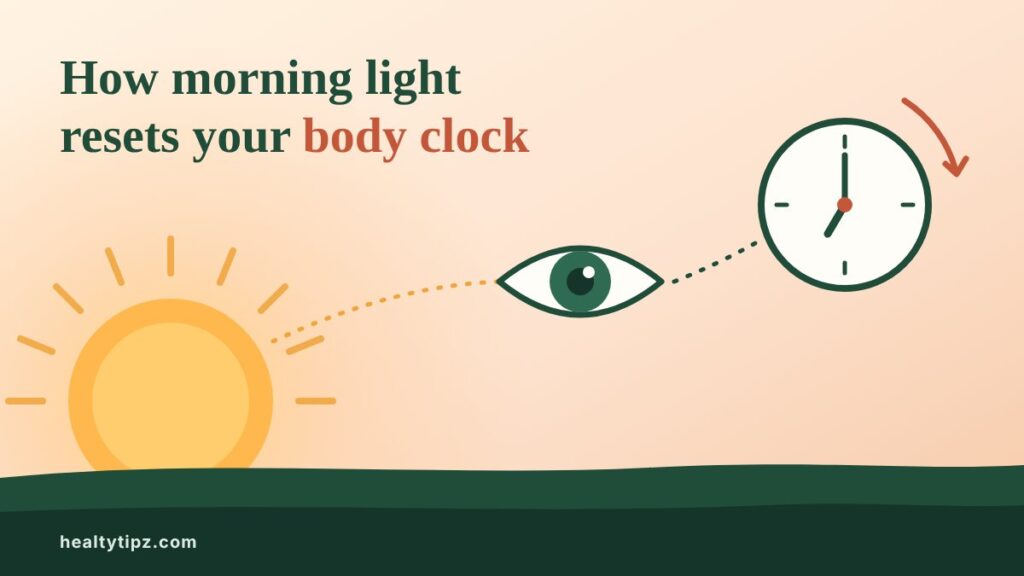
How Morning Light Resets Your Circadian Rhythm
Most sleep advice is about the night: darker rooms, fewer screens, better pillows. But one of the most effective things you can do for your sleep happens hours earlier, in the first hour after you wake up.
Morning light is the main signal your body clock uses to work out what time it is. Get bright light soon after waking and your clock shifts a little earlier, so you feel sleepy at a sensible time that night and wake more easily the next morning. Miss it, spend your evenings under bright screens, and your clock slowly drifts later.
This guide explains what is actually happening inside your body, how much light you need, and a simple routine you can start tomorrow.
What your circadian rhythm is
Your circadian rhythm is the roughly 24-hour cycle that tells your body when to be alert and when to wind down. It affects far more than sleep. According to the US National Institute of General Medical Sciences, these rhythms also shape hormone release, body temperature and other bodily functions.
The timing is run by a tiny cluster of nerve cells in the brain called the suprachiasmatic nucleus, usually shortened to the SCN. Think of it as the master clock that keeps every other clock in your body in step.
Why your clock drifts later
Here’s the catch: your internal clock doesn’t run on exactly 24 hours. A well-known Harvard study measured it at an average of 24 hours and 11 minutes in both younger and older adults. That sounds close enough, but those extra minutes add up. Without a daily reset, your body would want to go to bed and wake up a little later each day.
Light is what does the resetting. Every morning, bright light pulls your clock back into line with the actual time. When people spend their days indoors and their evenings under bright lamps and screens, that reset is weak, and the drift wins. It’s one reason so many people end up as accidental night owls.
How morning light resets your clock
The process starts in your eyes, but not with the cells you use to see. Your retina also contains special light-sensing cells that contain a pigment called melanopsin. These cells care about how bright it is, not what you’re looking at, and they send that information straight to the SCN through a dedicated nerve pathway (Ramkisoensing & Meijer, 2015).
Once the master clock gets the message, a few things happen:
- Melatonin switches off. Melatonin is the hormone that makes you drowsy at night. Bright morning light tells your body to stop making it, so you feel more awake.
- Your clock shifts earlier. Light in the morning moves your body clock forward, while bright light late in the evening pushes it back. This timing effect has been shown in controlled lab studies (Duffy et al., 1996).
- A countdown to bedtime starts. Because your clock now knows when “morning” was, it can time the evening rise in melatonin to match. As NIGMS puts it, when there is less light at night, the SCN tells the brain to make more melatonin so you get drowsy.
What the research shows
In a well-known University of Colorado Boulder study, eight adults spent a week camping in the Rocky Mountains with only sunlight and a campfire for light. Before the trip, living with normal electric lighting, their biological night started about two hours later than it did after a week outdoors. The night owls in the group shifted the most.
A much larger survey of 1,762 adults in Brazil, published in BMC Public Health, found a similar pattern in everyday life. Each extra 30 minutes of sunlight before 10 a.m. was linked to a sleep midpoint about 23 minutes earlier, and morning sun was the only time of day linked to better reported sleep quality. It was an observational study, so it shows a link rather than proof, but it fits neatly with the lab research.
How much light you need, and when
Brightness is measured in lux. Your eyes are very good at adjusting, so a well-lit room feels bright enough, but to your body clock it is far dimmer than outdoors.
| Setting | Roughly how bright |
|---|---|
| Public stairwell | about 200 lux |
| Typical office | about 500 lux |
| Supermarket | about 750 lux |
| Outdoors on an overcast day | about 1,000 lux and up |
| Outdoors in direct sun | many times brighter again |
These everyday figures come from Inverse’s summary of a 2022 expert consensus published in PLOS Biology. That consensus recommends good daytime light levels indoors and keeping light very low in the three hours before bed (Brown et al., 2022).
The practical takeaway is simple: even a cloudy morning outside gives your clock a stronger signal than a bright kitchen.
Timing
- Aim to get outside within about an hour of waking.
- 10 to 30 minutes is a good starting point. Go longer on grey days, since the light is weaker.
- Earlier in the morning is better for shifting your clock earlier. The Brazilian study above found the clearest link with sun before 10 a.m.
Does light through a window count?
Some, but much less. Glass cuts brightness, and sitting a few feet back from a window drops it further. Sitting right next to a big window is better than nothing. Stepping outside is much better.
Never look directly at the sun. You don’t need to. Just being outdoors with your eyes open, facing the general direction of the sky, does the job.
A simple morning light routine
You don’t need a special lamp or an hour-long ritual. Try this for a week:
- Wake up at the same time every day, weekends included. A steady wake time gives your clock a fixed point to reset from.
- Within an hour of waking, spend 10 to 30 minutes outdoors. Walk to the shop, have your coffee on the balcony, walk the dog, or get off the bus a stop early.
- Keep your days bright. Work near a window if you can, and take breaks outside.
- Dim the evening. In the last two to three hours before bed, switch to lamps, turn screen brightness down and avoid bright overhead lights. Evening light pushes your clock the wrong way.
- Sleep in the dark. Blackout curtains or an eye mask help, especially in summer.
If your schedule is badly off, pair this with our step-by-step guide on how to fix your sleep schedule in 3 days, which builds the light routine into a short reset plan.
Check how much sleep you’re missing
Morning light helps you fall asleep earlier, but you still need enough hours in bed. Our sleep debt calculator adds up the sleep you’ve missed over the past week and gives you a realistic catch-up plan.
Using it for kids and teens
Children respond to light in the same way, and morning outdoor time before school can make bedtime battles easier. Teenagers’ clocks naturally shift later during puberty, so morning light and a dimmer evening matter even more for them. Use the bedtime by age calculator to find the right amount of sleep and a bedtime for each age.
Cloudy days, winter and shift work
On cloudy days, go outside anyway and stay a little longer. Overcast daylight is still brighter than most indoor lighting.
In winter, when it’s still dark at your wake time, get outside as soon as it’s light, even if that’s mid-morning, and keep your home bright in the early hours. Some people use a light therapy box in winter. If you’re thinking about one, especially for low mood in the darker months, talk to your doctor first, as it isn’t right for everyone, including people with certain eye conditions or bipolar disorder.
If you work night shifts, the usual rules flip, because your “morning” may be in the evening. That needs a tailored plan, ideally with advice from your occupational health team or a doctor.
When to see a doctor
Morning light is a helpful habit, not a treatment for sleep disorders. See a doctor if:
- You can’t fall asleep until very late, or can’t wake up, even after weeks of a steady routine.
- You have trouble sleeping most nights for more than a few weeks.
- You snore loudly, gasp or stop breathing during sleep.
- You feel very sleepy during the day despite a full night in bed.
- Your low mood gets worse in winter.
Frequently asked questions
How long does it take morning light to reset your circadian rhythm?
Most people notice a difference within a few days to a week of getting light at the same time each morning. In the University of Colorado camping study, one week outdoors was enough to line people’s body clocks up with sunrise and sunset.
Is 10 minutes of morning sun enough?
Ten minutes on a bright morning is a good start. On cloudy days, or if you’re trying to shift your schedule by more than an hour, aim for 20 to 30 minutes.
Do I need to look at the sun?
No, and you shouldn’t. Being outside with your eyes open is enough, because daylight comes from the whole sky, not just the sun.
Do sunglasses block the benefit?
Sunglasses reduce how much light reaches your eyes. If it’s safe and comfortable, skip them for the first few minutes of your morning walk. Never stare at the sun with or without them.
Can morning light help with jet lag?
It can, but the timing depends on which direction you flew and how many time zones you crossed. Getting light at the wrong time can push your clock the wrong way, so plan it for your specific trip.
This article is for general information and isn’t a substitute for advice from a doctor.
Sources
- National Institute of General Medical Sciences (NIH): Circadian Rhythms fact sheet
- Harvard Gazette: Human biological clock set back an hour (on Czeisler et al., Science, 1999)
- Ramkisoensing A, Meijer JH: Synchronization of biological clock neurons by light and peripheral feedback systems promotes circadian rhythms and health (2015)
- Duffy JF, Kronauer RE, Czeisler CA: Phase-shifting human circadian rhythms: influence of sleep timing, social contact and light exposure (Journal of Physiology, 1996)
- University of Colorado Boulder: A week’s worth of camping synchs internal clock to sunrise and sunset (on Wright et al., Current Biology, 2013)
- PsyPost: Morning sunlight exposure is linked to earlier sleep schedules (on Menezes-Júnior et al., BMC Public Health)
- Brown TM et al.: Recommendations for daytime, evening, and nighttime indoor light exposure (PLOS Biology, 2022)
- Inverse: New guidelines on light exposure and circadian rhythm