In this article
How to Fix Your Sleep Schedule in 3 Days
It starts innocently. One late night finishing a show, a weekend lie-in, a Sunday nap that runs a bit long. A week later you’re wide awake at 1 AM and dragging yourself out of bed at 7, wondering how your body forgot what time it is.
The good news is that your body clock can be nudged back faster than most people think. You don’t need supplements or a gadget. You need a fixed wake-up time, the right light at the right time, and three days of not undoing your own progress.
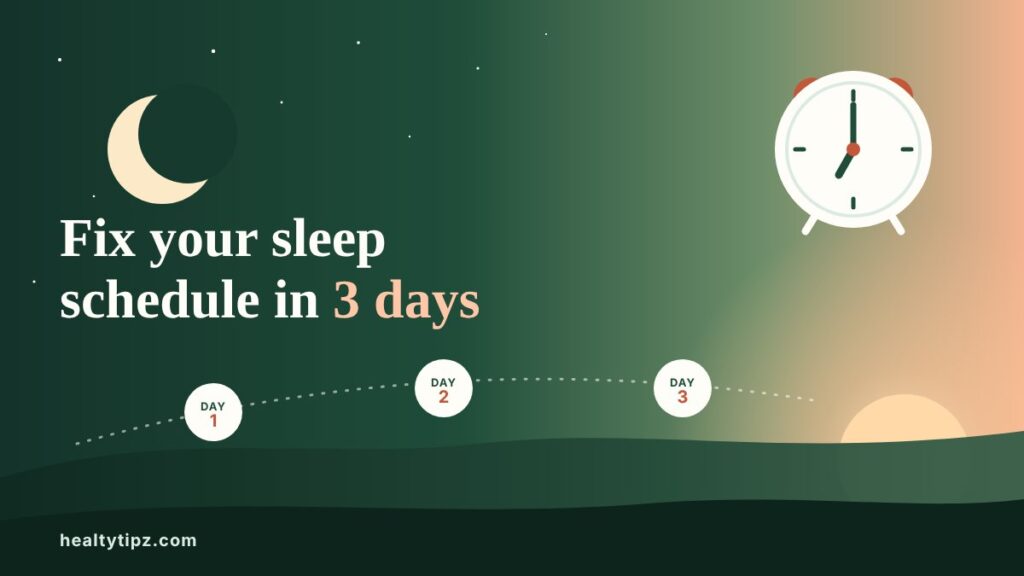
Here’s the short version of the plan:
- Day 1: Get up at the same time no matter how badly you slept, and get outside light within an hour of waking.
- Day 2: Cut caffeine early, keep any nap to 20 minutes, and dim your evenings.
- Day 3: Set a real bedtime based on your wake time and repeat everything.
The rest of this guide walks through each day, why it works and what to do when it doesn’t.
Before you start: pick your wake-up time
Everything in this plan hangs off one number: the time you’ll get up every day. Choose the time your life actually needs, like when you have to leave for work or get the kids to school, not an ideal time you’ll abandon by Thursday.
Next, work out how much sleep you need. The American Academy of Sleep Medicine recommends 7 or more hours for adults, 8 to 10 hours for teens and 9 to 12 hours for children aged 6 to 12. If you’re fixing a child’s or teenager’s schedule, our bedtime by age calculator shows the right hours and bedtime for each age group.
Then count backwards. If you need to be up at 7:00 AM, you want to be asleep somewhere between 10:00 and 11:30 PM. Sleep runs in cycles of roughly 90 minutes, so waking at the end of a cycle usually feels easier than waking in the middle of one. Our sleep calculator does that math for you and gives you a few bedtimes to choose from.
Write your wake time and target bedtime somewhere you’ll see them. A sticky note on the bathroom mirror works fine.
Day 1: Anchor your wake-up time
Day 1 is the hardest, so it’s worth knowing in advance that you’ll probably feel rough. That’s fine. Feeling a little tired tonight is what makes falling asleep earlier possible.
- Get up at your chosen time, even if you fell asleep at 3 AM. No snooze, no “just ten more minutes”. Your wake time sets your body clock far more reliably than your bedtime does.
- Get bright light within the first hour. Open the curtains, have your coffee by a window, or better still, take a 10 to 15 minute walk outside. In lab studies, bright light in the morning moved people’s body clocks earlier, while light late in the evening pushed them later (Duffy et al., 1996).
- Eat breakfast at a normal time. Regular meals give your body another cue about what time of day it is.
- Don’t nap today if you can help it. You want to arrive at bedtime properly sleepy.
- Go to bed when you feel sleepy, not at a time you’ve forced on yourself. If that’s still later than your target, that’s normal for the first night.
The one rule that matters most on Day 1 is the morning alarm. If you only manage that and the light, you’ve done the important part.
Day 2: Fix your caffeine, naps and evenings
Same wake time as yesterday, same morning light. Today you start removing the things that keep pushing your bedtime later.
Stop caffeine at least 6 hours before bed
This one surprises people. In a study published by the American Academy of Sleep Medicine, a large dose of caffeine taken six hours before bed still cut total sleep by more than an hour, and most participants didn’t notice (AASM, 2013). If you go to bed at 11 PM, make your last coffee, tea, cola or energy drink no later than about 5 PM. Earlier is better if you’re sensitive to it.
If you must nap, keep it to 20 minutes
After a short night, the afternoon slump can be brutal. A nap is allowed on Day 2, but keep it short and early. Harvard Health suggests about 20 minutes in the early afternoon, which is long enough to take the edge off without wrecking your night. Our nap calculator tells you exactly when to set the alarm, so you wake from light sleep instead of the groggy middle of a deep one.
Skip naps after about 3 PM altogether. A late nap takes away the sleepiness you’ve been building up for bedtime.
Dim the last hour of your evening
Evening light is the main thing working against you. Around an hour before your target bedtime:
- Switch to lamps instead of bright overhead lights.
- Put your phone on the charger across the room, or at least turn the brightness right down.
- Do something calm and boring: a shower, a paper book, stretching, tidying up for tomorrow.
Researchers who reset volunteers’ body clocks with a week of camping concluded that dimmer evenings plus more morning light could be enough to help many people who fall asleep too late (ScienceAlert).
Day 3: Set a real bedtime and lock it in
By now you’ve had two mornings at the same time and two dimmer evenings, and you’ll probably feel sleepy earlier than you did when you started. Day 3 is about turning that into a routine.
- Keep the same wake time and morning light. Yes, again. This is the habit that holds everything else together.
- Use your target bedtime from the sleep calculator. Start your wind-down an hour before it and be in bed with the lights off at that time.
- If you’re still wide awake after what feels like 20 minutes, get up. Sit somewhere dim and do something quiet until you feel sleepy, then go back. Lying there checking the clock tends to make it worse.
- Plan your weekend now. The fastest way to undo three days of work is sleeping until 11 on Saturday. Try to keep your weekend wake time within about an hour of your weekday one. The AASM notes that relying heavily on weekend catch-up sleep can throw off your internal clock.
What to expect after 3 days
If your schedule was off by an hour or two, three days is often enough to feel the difference: easier mornings and getting sleepy at a sensible time. If you’re trying to move your sleep by several hours, for example after shift work or a long holiday of late nights, think of these three days as the start. Keep the same routine and give it a week or two.
Common mistakes that keep you stuck
- Moving your bedtime earlier but keeping a lazy wake time. Your body won’t feel sleepy earlier until mornings start earlier.
- Long afternoon naps. A two-hour nap at 4 PM will feel great and cost you your night.
- “Catching up” all weekend. One long lie-in resets much of the progress you made during the week.
- The all-nighter reset. Staying up all night to force an early bedtime usually leaves you exhausted, napping in the afternoon and back where you started.
- Your phone in bed. Scrolling keeps your brain busy and your eyes full of bright light right when you need the opposite.
When to talk to a doctor
A messy schedule is common and usually fixable at home. See a doctor if:
- You struggle to fall or stay asleep most nights for more than a few weeks, even with a regular routine.
- Someone tells you that you snore loudly, gasp or stop breathing in your sleep.
- You feel very sleepy during the day even after a full night in bed, or you nod off while driving or at work.
- Low mood, anxiety or racing thoughts are what keep you awake.
These can be signs of insomnia, sleep apnea or another condition that a routine alone won’t fix.
Frequently asked questions
Can you fix your sleep schedule in one day?
You can make a good start in one day by getting up on time and getting morning light, but your body clock moves gradually. Most people need a few days of the same routine before falling asleep earlier feels natural.
Should I pull an all-nighter to reset my sleep?
It’s tempting, but it rarely works. You end up badly sleep deprived, which makes a long afternoon nap or an early crash likely, and that throws the schedule off again. Moving your wake time and keeping it steady is slower but sticks.
How much sleep should I aim for each night?
Most adults need at least 7 hours, teens 8 to 10 and school-age children 9 to 12, according to the American Academy of Sleep Medicine. Use the bedtime by age calculator to turn that into a bedtime for anyone in your family.
Is it OK to nap while fixing my sleep schedule?
A short nap of about 20 minutes before 3 PM is fine for most people. Avoid longer or later naps until your new schedule feels settled. The nap calculator shows when to set your alarm.
This article is for general information and isn’t a substitute for advice from a doctor.
Sources
- American Academy of Sleep Medicine, Sleep Education: How much sleep do I really need?
- American Academy of Sleep Medicine: Late afternoon and early evening caffeine can disrupt sleep at night (Drake et al., Journal of Clinical Sleep Medicine, 2013)
- Duffy JF, Kronauer RE, Czeisler CA: Phase-shifting human circadian rhythms: influence of sleep timing, social contact and light exposure (Journal of Physiology, 1996)
- ScienceAlert: How a week of camping resets the body clock (on Wright et al., Current Biology, 2013)
- Harvard Health Publishing: How long should one nap?