In this article
- 12 Healthy Aging Habits to Start in Your 50s
- 1. Get 150 minutes of movement a week
- 2. Lift something heavy twice a week
- 3. Count your steps, and pick the right target
- 4. Train your balance before you need it
- 5. Protect seven hours of sleep
- 6. Eat more protein (and more plants) than you think
- 7. Rethink your drinking
- 8. Track recovery, not just effort
- 9. Book the screenings and shots that start around 50
- 10. Get your hearing and eyes checked
- 11. Keep your brain busy and your blood vessels healthy
- 12. Treat friendship as a health habit
- Your first month: a simple starter plan
- Frequently asked questions
- Sources
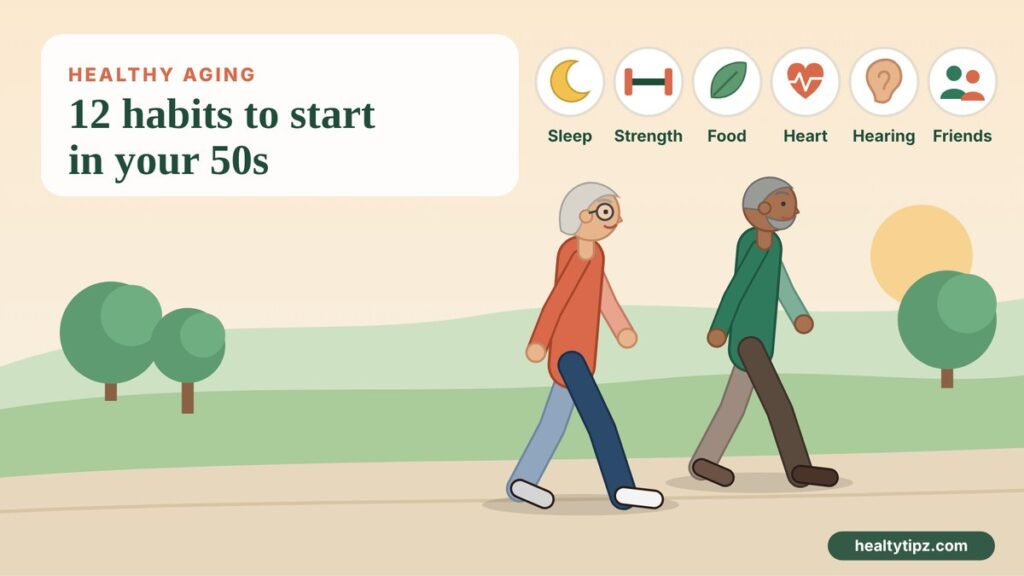
12 Healthy Aging Habits to Start in Your 50s
Turning 50 comes with a strange mix of news. Friends start comparing colonoscopy stories. Your knees develop opinions about stairs. And at some point it sinks in that the habits you have now are probably the ones you’ll carry into your 70s and 80s.
That sounds heavy, but it’s actually good timing. Your body still responds well to training at this age, most chronic problems are either preventable or still early, and anything you change now has decades to pay off. The 2024 Lancet Commission on dementia, for example, estimated that nearly half of dementia cases could in theory be prevented or delayed by tackling 14 risk factors, and several of those factors matter most in midlife.
Below are 12 habits worth starting in your 50s. You don’t need all of them by Monday. Pick two or three, let them settle in, and then add more. There’s a simple four-week plan near the end if you’d like a place to start.
1. Get 150 minutes of movement a week
The CDC’s guidance for older adults starts with at least 150 minutes a week of moderate-intensity activity, which works out to 30 minutes on five days. Brisk walking counts. So do cycling, swimming, dancing and pushing a lawn mower.
“Moderate” just means you’re breathing harder but can still talk in full sentences. If you can sing, speed up a little. If you can’t get a sentence out, slow down. You can also split the time into chunks. Three 10-minute walks after meals add up the same way one 30-minute walk does, and the after-dinner walk is a nice way to help your blood sugar too.
2. Lift something heavy twice a week
This is the habit most people in their 50s skip, and it’s the one that matters more every year. Harvard Health notes that people who don’t train can lose roughly 3% to 5% of their muscle mass each decade after 30. That loss shows up later as trouble getting out of a low chair, carrying groceries or catching yourself when you trip.
The CDC recommends muscle-strengthening work on at least two days a week that covers the major muscle groups: legs, hips, back, abdomen, chest, shoulders and arms. You don’t need a gym. A good starter routine:
- Sit-to-stands from a kitchen chair
- Wall or countertop push-ups
- Resistance band rows
- Glute bridges on the floor
- Carrying two heavy shopping bags around the house
Aim for 8 to 12 slow reps of each. When 12 starts to feel easy, make it harder with a heavier band, a lower chair or a backpack with a few books in it.
3. Count your steps, and pick the right target
The famous 10,000-step goal has surprisingly little research behind it. Some of the best data we have now comes from a 2022 meta-analysis in The Lancet Public Health that pooled 15 cohorts and about 47,000 adults. For people under 60, the risk of dying during follow-up kept falling until about 8,000 to 10,000 steps a day. For people 60 and over, it leveled off between 6,000 and 8,000.
In your 50s you sit in the younger group, so somewhere around 8,000 steps is a sensible goal. If you’re at 3,000 today, don’t jump straight there. Add about 1,000 steps a day each week until you reach it.
Seeing what your steps add up to can be surprisingly motivating. Plug your daily average into our steps to calories calculator and you’ll get a rough idea of the energy you burn, adjusted for your height and weight.
4. Train your balance before you need it
Balance fades quietly. You don’t notice it going until the day you miss a curb. The CDC lists balance work as its own part of the activity guidelines for older adults, with simple examples like walking heel to toe or standing up from a seated position.
The easiest way to fit it in is to attach it to something you already do. Stand on one foot while you brush your teeth, then switch at the halfway mark. Once that’s easy, try it with your eyes closed (near a counter). Tai chi and yoga classes are also great options if you prefer a group setting.
5. Protect seven hours of sleep
Most adults need at least seven hours a night, and that doesn’t drop just because you’ve hit 50. What does change is how easily sleep breaks. Hot flashes, a fuller bladder, aches and a later glass of wine all chip away at it.
The fix is boring but it works. Keep the same wake-up time every day, weekends included, and count back seven and a half hours to find your bedtime. Get outside for some daylight in the morning. Keep the bedroom cool and dark.
One thing worth flagging: if your partner says you snore loudly or stop breathing at night, or you wake up tired no matter how long you sleep, ask your doctor about sleep apnea. It becomes more common with age and it’s very treatable.
6. Eat more protein (and more plants) than you think
As you age, your muscles get less responsive to the protein you eat. An international expert group known as PROT-AGE reviewed the evidence and recommended that older adults get at least 1.0 to 1.2 grams of protein per kilogram of body weight a day, and 1.2 grams or more if they’re active. That’s well above the standard 0.8 g/kg most labels are built on.
For a 75 kg (165 lb) person, that’s roughly 75 to 90 grams a day. The trick is spreading it out. Most people eat a small breakfast and a huge dinner, so aim for about 25 to 30 grams at each meal instead. Two eggs with Greek yogurt, a chicken salad at lunch and a piece of fish with lentils at dinner gets you there.
Keep the rest of the plate full of vegetables, fruit, beans and whole grains. The fiber helps your gut, your cholesterol and your blood sugar, which all start to need a bit more attention in this decade.
Kidney note: if you have chronic kidney disease, talk with your doctor before raising your protein intake.
7. Rethink your drinking
Alcohol advice has shifted a lot recently. The 2025-2030 Dietary Guidelines for Americans, released in January 2026, dropped the old limit of two drinks a day for men and one for women and now simply tell people to drink less. The CDC’s own site still uses those older numbers as the definition of moderate drinking.
Whichever line you go by, the direction is the same. The American Heart Association says alcohol doesn’t protect your heart and links it to higher blood pressure, irregular heart rhythms and a greater risk of stroke. The Lancet dementia commission also lists heavy drinking as one of its 14 modifiable risk factors.
You don’t have to quit to benefit. Try alcohol-free weekdays, switch every second drink to sparkling water, or skip the nightcap and see what it does to your sleep. Many people are surprised by how much better they feel at 3 a.m.
8. Track recovery, not just effort
In your 20s you could train hard on four hours of sleep and bounce back. In your 50s, recovery takes longer, and pushing through fatigue is how injuries happen.
Heart rate variability (HRV) is one of the most useful signals here. It measures the tiny changes in time between heartbeats, and it tends to be higher when your body is rested and lower when you’re stressed, sick or under-recovered. HRV naturally declines with age, so comparing yourself with a 30-year-old isn’t helpful. What matters is your own trend. We explain how to read it, and what’s normal at your age, in our guide: What is HRV? Good HRV by age.
If your HRV is well below your usual range for a few days in a row, treat that as a cue to take an easy day, go for a walk instead of a hard workout, and get to bed earlier.
9. Book the screenings and shots that start around 50
A few preventive steps kick in right around this age, and they’re easy to put off because nothing hurts yet.
- Colorectal cancer screening. The US Preventive Services Task Force now recommends that adults at average risk start at 45 and continue through 75. A colonoscopy isn’t the only choice. Stool-based tests you do at home also count, so ask which one suits you.
- Shingles vaccine. The CDC recommends two doses of Shingrix, given two to six months apart, for adults 50 and older. You should still get it if you’ve already had shingles.
- Blood pressure and cholesterol. Get both checked at least once a year. The 2024 Lancet Commission added high LDL cholesterol in midlife to its list of dementia risk factors, so these numbers matter for your brain as well as your heart.
Your doctor may add others based on your sex and history, such as mammograms, a prostate conversation or a bone density scan. Bring a list to your next checkup and ask what you’re due for.
10. Get your hearing and eyes checked
This one surprises people. In the 2024 Lancet Commission report, hearing loss was tied for the largest share of dementia cases of any modifiable risk factor, at about 7%. Untreated vision loss was added to the list as a new risk factor in the same report.
Treating it may help. In the ACHIEVE trial, published in The Lancet in 2023, hearing aids and audiologist support didn’t change cognitive decline across the whole group. But in the participants who were already at higher risk, the intervention slowed decline by about 48% over three years. It also improved communication and loneliness in both groups.
Get a baseline hearing test in your 50s, even if you think you hear fine. Hearing loss creeps in so slowly that most people are the last to notice. Keep up with eye exams too, especially if you need new reading glasses every year or so.
11. Keep your brain busy and your blood vessels healthy
A lot of what protects your brain is the same stuff that protects your heart. The Lancet Commission’s list of 14 risk factors includes high blood pressure, diabetes, smoking, physical inactivity, obesity and depression. Every habit above chips away at those.
On top of that, the commission recommends staying cognitively active in midlife. That doesn’t mean daily crosswords forever. The brain responds best to things that are new and a little hard: learning a language, picking up an instrument, taking a class, or taking on a project at work that stretches you. If you’ve been doing the same puzzle for 10 years, it’s probably time for a new one.
And if your mood has been low for weeks, talk to someone. Depression is common in midlife, it’s on the dementia risk list, and it’s treatable.
12. Treat friendship as a health habit
This is the habit that feels least like a health habit, and it may be one of the most important. In 2023 the US Surgeon General issued an advisory calling loneliness and isolation a public health crisis. The report found that loneliness raises the risk of early death by about 26% and social isolation by about 29%, and compared the overall effect of poor social connection with smoking up to 15 cigarettes a day.
In your 50s, social circles often shrink without anyone choosing it. Kids leave home, jobs change and friends move. So it helps to be deliberate:
- Put one standing plan on the calendar each week, like a Saturday walk or a Thursday call.
- Join something that meets regularly: a choir, a walking group, a volunteer shift, a sports league.
- Reach out first. Most people are waiting for someone else to send the text.
Bonus: a weekly walk with a friend also counts toward habit 1.
Your first month: a simple starter plan
Twelve habits at once is a recipe for keeping none of them. Here’s one way to layer them in over four weeks.
| Week | Add this | Small first step |
|---|---|---|
| 1 | Movement and checkups | Walk 20 minutes on five days. Call your doctor’s office and ask which screenings and vaccines you’re due for. |
| 2 | Strength and protein | Do two short strength sessions (sit-to-stands, wall push-ups, band rows). Add a protein source to breakfast. |
| 3 | Balance and sleep | Stand on one foot while brushing your teeth. Set one wake-up time for every day of the week. Try alcohol-free weeknights. |
| 4 | Connection and tracking | Put one weekly social plan on the calendar. Check your average daily steps and your HRV trend, then pick the next habit to add. |
After that, keep the ones that stuck and add one new habit a month. By your next birthday, most of this list can be on autopilot.
Frequently asked questions
Is it too late to start exercising at 50?
No. Muscles, heart and lungs all respond to training at 50, 60 and beyond. Start with walking and two short strength sessions a week, then build up slowly. If you have a heart condition, joint problems or haven’t been active in years, check in with your doctor first.
How many steps a day should a 50-year-old aim for?
The 2022 Lancet Public Health meta-analysis found that, for adults under 60, the benefit kept growing up to about 8,000 to 10,000 steps a day. Any increase from where you are now helps, though, so start by adding 1,000 steps a day.
How much protein do I need after 50?
Expert groups suggest about 1.0 to 1.2 grams per kilogram of body weight a day for older adults, and a bit more if you exercise regularly. Spread it over your meals, about 25 to 30 grams at each one.
Which vaccines should I get at 50?
The CDC recommends the two-dose Shingrix shingles vaccine for adults 50 and older, along with a yearly flu shot. Ask your doctor whether you’re due for others based on your age and health.
What is the most important healthy aging habit?
If you could only pick one, regular movement that includes strength training probably does the most, since it helps your heart, muscles, bones, mood and brain at the same time. But the best habit is the one you’ll actually keep.
This article is for general information and isn’t a substitute for advice from your own doctor.
Sources
- CDC. Older adult activity: an overview.
- Paluch AE, et al. Daily steps and all-cause mortality: a meta-analysis of 15 international cohorts. The Lancet Public Health, 2022.
- Harvard Health Publishing. Preserve your muscle mass.
- Bauer J, et al. Evidence-based recommendations for optimal dietary protein intake in older people (PROT-AGE). Journal of the American Medical Directors Association, 2013.
- ABC News. New US dietary guidelines include changes to alcohol guidance. January 2026.
- Cancer Support Community. New guidelines recommend colorectal cancer screening start at age 45 (summary of the USPSTF 2021 recommendation).
- CDC. Shingles vaccine recommendations.
- Livingston G, et al. Dementia prevention, intervention, and care: 2024 report of the Lancet standing Commission. The Lancet, 2024. See also the UCL summary.
- Lin FR, et al. Hearing intervention versus health education control to reduce cognitive decline (ACHIEVE). The Lancet, 2023.
- AHRQ. Surgeon General advisory on the epidemic of loneliness and isolation. 2023.
- Chief Healthcare Executive. Loneliness leads to early death, Surgeon General warns. 2023.