In this article
What Is HRV? Good HRV by Age
If you’ve started wearing a smart ring or fitness band, you’ve probably noticed a number called HRV sitting next to your sleep score. It goes up, it goes down, and it’s not obvious whether 35 is good or worrying.
Here’s the short answer. HRV, or heart rate variability, measures the tiny differences in time between your heartbeats. In general, a higher HRV means your body is relaxed and recovering well, and a lower HRV means it’s under some kind of stress. HRV also falls naturally with age, so a “good” number at 25 looks very different from a good number at 60.
Most importantly, your own trend matters far more than how you compare to anyone else. Below you’ll find what HRV is, typical values by age for men and women, what pushes it up or down, and how to improve yours.
What is HRV?
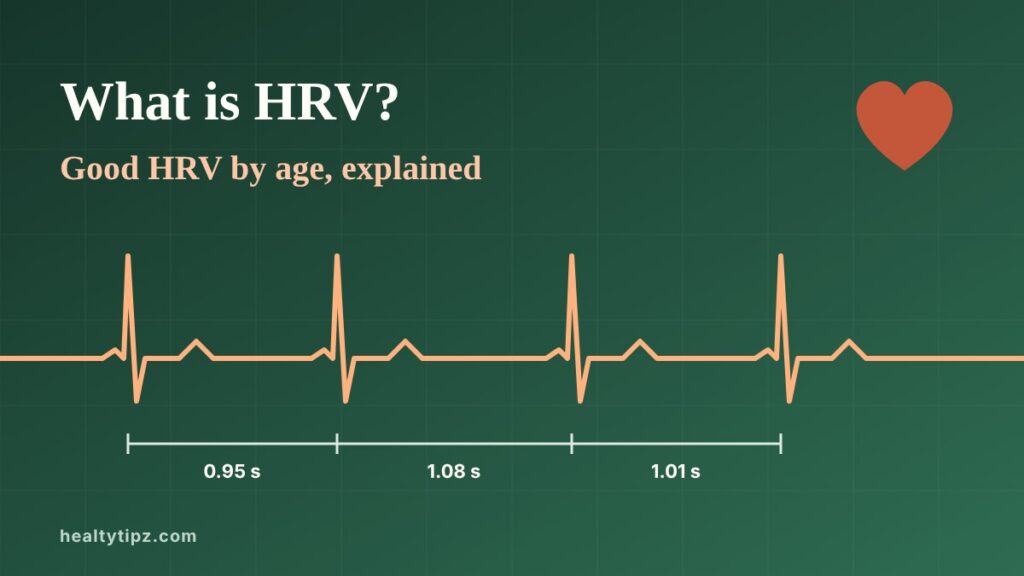
Your heart doesn’t beat like a metronome. Even at a steady 60 beats per minute, the gaps between beats aren’t exactly one second each. One might be 0.95 seconds, the next 1.08, the next 1.01. Heart rate variability is the measure of that variation, usually in milliseconds (ms). As one widely cited review puts it, “a healthy heart is not a metronome”.
Those small changes are controlled by your autonomic nervous system, the part that runs automatically in the background. It has two branches that pull in opposite directions:
- The sympathetic branch is your “fight or flight” system. It speeds the heart up and makes the rhythm more regular, so HRV drops.
- The parasympathetic branch is your “rest and digest” system. It slows the heart and lets the gaps between beats vary more, so HRV rises.
So when you’re well rested and calm, HRV tends to be higher. When you’re stressed, ill, short on sleep, hungover or worn out from hard training, it tends to be lower. Cleveland Clinic describes a high HRV as a sign that your body can adapt to changes easily, while a low HRV can be linked to health problems including heart conditions, anxiety and depression.
What the number on your app means
Most wearables, including Oura, WHOOP, Garmin and Apple Watch, report a version of HRV called RMSSD (root mean square of successive differences). You don’t need the math. It focuses on beat-to-beat changes, which mostly reflect your parasympathetic “rest and digest” activity. Most devices measure it while you sleep, when outside noise like movement, coffee and conversation is lowest.
Good HRV by age
HRV falls steadily from your teens to your sixties, then levels off. That’s normal aging, not a sign that anything is wrong.
The table below comes from the Lifelines Cohort Study in the Netherlands, one of the largest HRV reference studies, which measured 84,772 people aged 13 to 91. The numbers are medians, so half of healthy people in each group were higher and half were lower. The “healthy range” column shows the 2nd to 98th percentile, meaning almost everyone in that age group fell inside it.
| Age | Women: median RMSSD | Men: median RMSSD | Healthy range (women / men) |
|---|---|---|---|
| 20–24 | 52 ms | 48 ms | 11–206 / 10–174 ms |
| 25–29 | 48 ms | 42 ms | 12–181 / 10–173 ms |
| 30–34 | 42 ms | 37 ms | 12–161 / 10–141 ms |
| 35–39 | 38 ms | 33 ms | 11–142 / 9–124 ms |
| 40–44 | 34 ms | 29 ms | 10–124 / 8–106 ms |
| 45–49 | 29 ms | 26 ms | 8–110 / 7–96 ms |
| 50–54 | 27 ms | 24 ms | 8–96 / 7–88 ms |
| 55–59 | 23 ms | 21 ms | 7–84 / 6–90 ms |
| 60–64 | 21 ms | 19 ms | 6–79 / 5–87 ms |
| 65–69 | 18 ms | 18 ms | 5–83 / 5–111 ms |
| 70–74 | 18 ms | 16 ms | 5–116 / 5–162 ms |
| 75+ | 16 ms | 15 ms | 4–106 / 4–130 ms |
Values from Tegegne et al., European Journal of Preventive Cardiology, 2020, as tabulated by Longevity Germany.
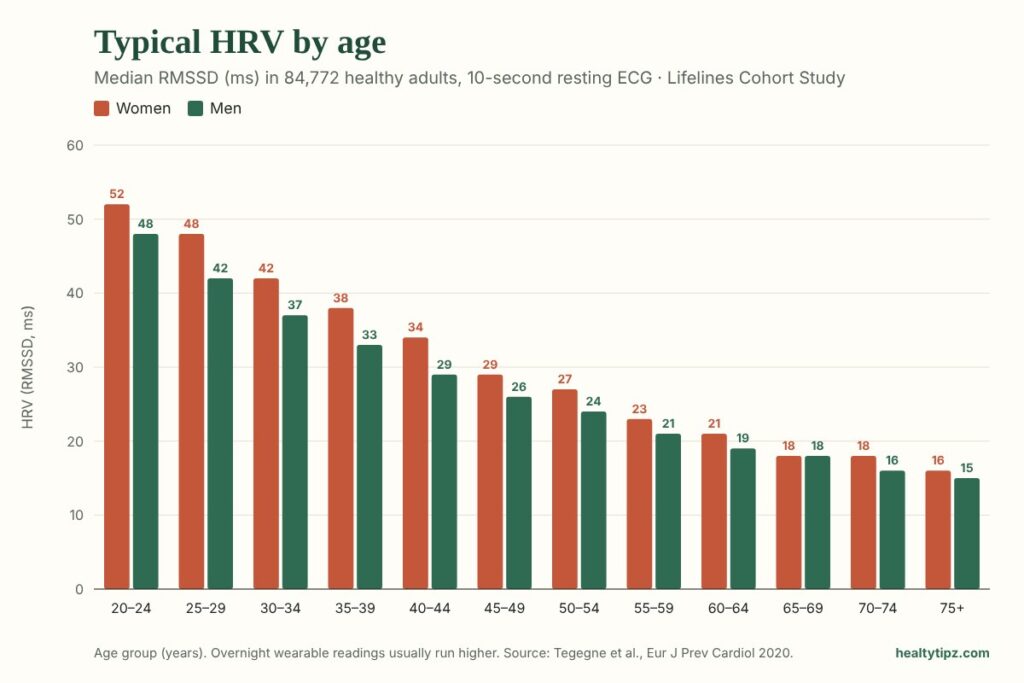
Two things stand out. First, the healthy range is enormous, so a number well below the median isn’t automatically a problem. Second, women in this study had slightly higher HRV than men from age 20 to about 60, by around 5 ms on average in their twenties to mid-forties. After 60 the difference disappeared.
Why your wearable shows higher numbers
The study above used 10-second resting ECGs taken at a clinic visit. Wearables measure overnight, when HRV is usually at its highest, so their numbers tend to run higher. WHOOP, which publishes data from its members, reports an average HRV of 65 ms for men and 62 ms for women, and says a range of roughly 50 to 100 ms is common for a 25-year-old and 35 to 60 ms for a 45-year-old.
So if your ring says 55 and you’re 40, you’re not off the charts. Compare yourself with numbers from the same type of device, and above all with your own baseline.
What counts as a “good” HRV?
A good HRV is one that is stable or rising over time and sits around your usual range. A useful rule of thumb:
- A reading near your 30-day average means you’re about where you normally are.
- A noticeably higher reading usually means you’re well recovered.
- A drop well below your average for a few days in a row is a signal to look at your sleep, stress, alcohol, training or whether you’re coming down with something.
What affects your HRV
Age and sex explain a surprisingly large share of the differences between people. In the Lifelines research, age and sex alone accounted for almost one fifth of the differences in HRV, while lifestyle and stress factors added only a little more on top. Genetics play a big part too. That’s why comparing your number with a friend’s tells you very little.
Day to day, though, plenty of things move your own HRV up or down:
| Usually lowers HRV | Usually raises HRV |
|---|---|
| Short or poor sleep | Consistent, good-quality sleep |
| Alcohol, especially in the evening | Regular aerobic exercise |
| Hard training without enough rest | Rest days after hard sessions |
| Illness, even before symptoms start | Slow, relaxed breathing |
| Mental stress, anxiety or depression | Lower stress and good mental health |
| Late, heavy meals | Staying hydrated |
| Dehydration and heat | A healthy body weight |
Cleveland Clinic lists aging, stress, poor sleep and a higher BMI among the factors that lower HRV.
How to measure HRV
The most accurate measurement is an ECG at a clinic, but for tracking trends at home, a wearable worn overnight is the practical choice. Because it measures you at the same time and in the same state every night, the trend is far more meaningful than any single reading.
Smart rings and fitness bands are the most popular options for overnight HRV. If you’re deciding between the two big names, our Oura Ring vs WHOOP comparison covers how each tracks sleep and recovery, battery life and the real two-year cost.
A few tips for useful readings:
- Wear your device every night, so it can learn your baseline. Most need one to two weeks.
- Stick to one device. Different brands calculate HRV slightly differently, so switching makes the numbers jump.
- Look at the weekly average, not today’s figure.
How to improve your HRV
You can’t stop the age-related decline, but you can move your own baseline up and stop it dipping unnecessarily. None of this is glamorous, and that’s the point.
- Protect your sleep. Aim for 7 to 9 hours with a steady bedtime and wake time. Sleep is the single biggest daily lever for most people.
- Build your aerobic fitness. Regular, mostly easy cardio is one of the most reliable ways to raise HRV over months. The key word is easy: most of your sessions should be at a pace where you could hold a conversation. Our heart rate zone calculator shows exactly which heart rates count as easy (zones 1 and 2) for your age.
- Balance hard training with rest. Hard sessions lower HRV for a day or two, which is normal. Problems start when you stack them without recovering. If your HRV stays low for several days, swap the next hard session for an easy one.
- Cut back on alcohol. Even a couple of drinks in the evening often shows up as a lower HRV the next morning.
- Breathe slowly. A few minutes a day of slow breathing, around six breaths a minute, can help shift your body toward “rest and digest”.
- Manage stress. Walks outside, time with people you like, and getting help for anxiety or low mood all count. Cleveland Clinic notes that managing stress, anxiety and depression can improve HRV.
- Keep the basics steady. Regular meal times, enough water and not eating a big meal right before bed all help your overnight numbers.
Give changes a few weeks before judging them. HRV is noisy from night to night, and the real improvements show up in the monthly trend.
When low HRV is worth a doctor’s visit
A low number by itself is rarely a reason to worry, especially if you’re older or it’s normal for you. Talk to a doctor if:
- Your HRV drops sharply and stays low for weeks with no obvious reason like illness, travel or a hard training block.
- A low HRV comes with symptoms such as chest pain, shortness of breath, dizziness, fainting or a racing or irregular heartbeat.
- Your device flags an irregular rhythm.
- You’re dealing with ongoing stress, anxiety or low mood. HRV can reflect it, but the person matters more than the number.
Very high or erratic HRV readings can also mean something is off. One review points out that higher HRV is not always better, because heart rhythm problems such as atrial fibrillation can make HRV look artificially high. Wearables are wellness tools, not medical devices, so let a doctor interpret anything unusual.
Frequently asked questions
What is a normal HRV for a 40-year-old?
In the Lifelines study, healthy 40 to 44-year-olds had a median RMSSD of about 34 ms for women and 29 ms for men on a short resting ECG. Overnight wearable readings usually run higher, and WHOOP reports 35 to 60 ms as common around age 45.
Is an HRV of 20 bad?
Not necessarily. A reading around 20 ms is about the median for healthy adults in their early sixties on a resting ECG. If you’re 25 and consistently around 20 on a wearable, it’s worth looking at your sleep, stress and fitness, and mentioning it to your doctor.
Is higher HRV always better?
Within your own normal range, a higher reading usually means better recovery. But comparing high numbers between people is pointless, and unusually high or jumpy readings can come from irregular heart rhythms.
Why is my HRV lower than my friend’s?
Age, sex and genetics make a big difference, and different devices calculate HRV slightly differently. Two healthy people of the same age can have HRVs that differ by 50 ms or more.
How long does it take to improve HRV?
Short-term changes, like a better night’s sleep or skipping alcohol, can show up the next morning. Changes in your baseline from better fitness usually take several weeks to a few months.
This article is for general information and isn’t a substitute for advice from a doctor.
Sources
- Shaffer F, Ginsberg JP: An overview of heart rate variability metrics and norms (Frontiers in Public Health, 2017)
- Cleveland Clinic: Heart Rate Variability (HRV) (medically reviewed, 2026)
- Tegegne BS et al.: Reference values of heart rate variability from 10-second resting electrocardiograms: the Lifelines Cohort Study (European Journal of Preventive Cardiology, 2020)
- Lifelines: Study summary and results
- Lifelines: Determinants of heart rate variability in the general population (Heart Rhythm, 2018)
- Longevity Germany: HRV normal range by age (table of the Lifelines medians)
- WHOOP: Normal HRV range by age and gender