In this article
How Much Water Should You Drink a Day? (By Weight)
“Drink eight glasses of water a day” might be the most repeated health tip in the world. It’s also not based on much. When researchers went looking for the science behind it, they couldn’t find any.
The truth is less tidy and more useful: how much water you need depends mostly on your size, how active you are, and how hot it is where you live. A 50 kg office worker in a cool climate and a 95 kg builder working outdoors in summer need very different amounts.
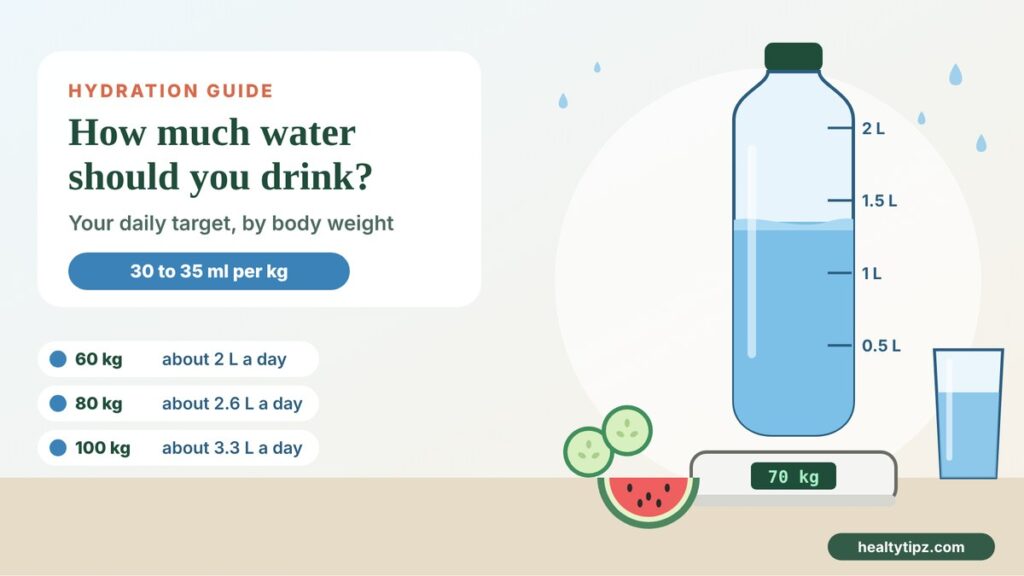
The quick answer: a common starting point is 30 to 35 ml of water per kilogram of body weight a day (about half an ounce per pound). That covers water from drinks and food. For a 70 kg (154 lb) adult, that’s roughly 2.1 to 2.5 liters in total, of which about 1.7 to 2 liters would come from drinks.
Below you’ll find a chart by weight, the official guidelines, when to drink more, and the signs that tell you whether you’ve got it right.
What the official guidelines say
The most quoted numbers come from the US National Academies of Sciences, Engineering, and Medicine. For healthy adults in a temperate climate, they set an adequate daily intake of:
- Men: about 3.7 liters (15.5 cups) of total water a day
- Women: about 2.7 liters (11.5 cups) of total water a day
Two things get lost when people repeat those figures. First, they include all water, from plain water, coffee, tea, milk and the water in your food. Mayo Clinic notes that about 20% of daily fluid typically comes from food. So the drinking part works out closer to 3 liters for men and 2.2 liters for women.
Second, they’re based on what healthy people normally take in, not a hard minimum. If you’re a bit under and feel fine, you’re very likely fine.
A large 2022 study in Science backs this up. Researchers tracked how much water moved through the bodies of more than 5,600 people in 26 countries using labeled water. Daily turnover ranged from about 1 liter to 6 liters, depending mostly on physical activity, then sex, age and climate. One of the researchers said the eight-glasses rule simply isn’t supported by objective evidence.
How much water to drink by weight
The weight-based rule used by many dietitians and clinics is simple:
Body weight (kg) × 30 to 35 ml = total daily water
Or in pounds: body weight (lb) × 0.5 = ounces of water a day
That total includes water from food. If you want to know how much to drink, take about 80% of it.
| Body weight | Total water per day | About this much from drinks |
|---|---|---|
| 50 kg (110 lb) | 1.5 to 1.75 L (51 to 59 oz) | 1.2 to 1.4 L |
| 60 kg (132 lb) | 1.8 to 2.1 L (61 to 71 oz) | 1.4 to 1.7 L |
| 70 kg (154 lb) | 2.1 to 2.45 L (71 to 83 oz) | 1.7 to 2.0 L |
| 80 kg (176 lb) | 2.4 to 2.8 L (81 to 95 oz) | 1.9 to 2.2 L |
| 90 kg (198 lb) | 2.7 to 3.15 L (91 to 106 oz) | 2.2 to 2.5 L |
| 100 kg (220 lb) | 3.0 to 3.5 L (101 to 118 oz) | 2.4 to 2.8 L |
| 110 kg (243 lb) | 3.3 to 3.85 L (112 to 130 oz) | 2.6 to 3.1 L |
These are for a fairly inactive day in mild weather. Add more for exercise and heat (see the next section).
If you’d rather not do the math, our water intake calculator works it out for you in a few seconds, starting from your weight and how active you are.
Why body composition matters too
Weight is a good starting point, but it’s not the whole story. Muscle holds far more water than fat does. That’s why two people who weigh the same can have quite different needs, and why the 2022 Science study found that people with less body fat tended to turn over more water.
In practice, if you carry a lot of muscle, aim toward the top of your range. If a bigger share of your weight is fat, the middle or lower end may be enough. Not sure where you stand? Our body fat calculator uses a few tape-measure readings to estimate your body fat percentage, which gives you a better picture than the scale alone.
When you need more (or less)
Your baseline moves around from day to day. These are the most common reasons to adjust it:
- Exercise. Add roughly 350 to 500 ml for every 30 minutes of activity, more if you sweat heavily. For sessions over an hour, especially in the heat, a drink with electrolytes can help.
- Hot or humid weather. Sweat losses climb quickly. You may need an extra 500 ml to 1 liter on very hot days, even without exercise.
- High altitude. You lose more water through breathing up high.
- Pregnancy and breastfeeding. The National Academies’ figures rise to about 3 liters of total water a day in pregnancy and 3.8 liters while breastfeeding.
- Fever, vomiting or diarrhea. These drain fluid fast. Sip often, and consider an oral rehydration solution.
- Older age. The sense of thirst gets weaker as we age, so older adults can get dehydrated without feeling thirsty. Regular drinks with meals help.
And a few situations call for less, or at least for medical guidance. People with heart failure, advanced kidney disease or some liver conditions are sometimes told to limit fluids. If your doctor has given you a fluid limit, follow it over any chart.
How to tell if you’re drinking the right amount
You don’t need an app to check your hydration. Two signals are surprisingly reliable for healthy adults: thirst and urine color. Mayo Clinic puts it simply: if you’re not thirsty and your urine is pale yellow, you’re likely getting enough.
| Urine color | What it usually means |
|---|---|
| Clear, like water, all day | You may be drinking more than you need |
| Pale straw or light yellow | Well hydrated |
| Dark yellow or amber | Drink more |
| Brown, red or cola-colored | Not a hydration issue. See a doctor |
B vitamins and some medicines can turn urine bright yellow, so judge it over a whole day, not one trip to the bathroom.
Signs of dehydration
- Thirst and a dry mouth
- Dark urine, or peeing much less than usual
- Headache, tiredness or trouble concentrating
- Dizziness when you stand up
Mild dehydration usually improves within an hour or two of drinking. If you feel very unwell, are confused, can’t keep fluids down, or haven’t peed in 8 hours or more, get medical help.
Yes, you can drink too much
It’s rare, but drinking a lot of water in a short time can dilute the sodium in your blood, a condition called hyponatremia. According to Mayo Clinic, symptoms include nausea, vomiting, headache, confusion and fatigue, and severe cases can be life-threatening. It’s most common in endurance athletes who drink well beyond their sweat losses, people in “water challenges,” and people on certain medicines such as some diuretics.
The tricky part is that headache, fatigue and nausea can come from too little water or too much. If you’re not sure what’s behind your symptoms, our symptom checker can help you sort through the possibilities and decide whether it’s time to see a doctor. It doesn’t replace medical advice, but it’s a good first step.
Easy ways to drink enough without thinking about it
Most people don’t need to track every sip. A few habits do the work for you:
- Start the day with a glass. You wake up after 7 or 8 hours without a drink.
- Drink with every meal. A glass with breakfast, lunch and dinner already covers a big chunk of your day.
- Keep a bottle where you can see it. On your desk, in the car, by the sofa. If you know your bottle holds 750 ml, you only need to refill it two or three times.
- Eat your water. Cucumber, lettuce, watermelon, strawberries, oranges, yogurt and soups are mostly water and all count.
- Count your coffee and tea. The idea that caffeine “cancels out” the water in coffee is a myth for regular drinkers. They count toward your total.
- Flavor it if plain water bores you. Add lemon, mint, cucumber slices or a splash of juice.
- Drink before, during and after exercise, not just when you’re done.
Frequently asked questions
How much water should I drink a day for my weight?
A common guide is 30 to 35 ml per kilogram of body weight, or about half an ounce per pound. A 70 kg (154 lb) person would aim for about 2.1 to 2.5 liters of total water a day, including food.
Is the “half your body weight in ounces” rule accurate?
It’s a reasonable starting point for a fairly inactive adult in mild weather, and it lines up with the 30 to 35 ml/kg range. Adjust it up for exercise, heat and pregnancy.
Is 2 liters of water a day enough?
For many adults, yes, once you add the water from food. Larger, very active people or anyone in a hot climate may need more.
Is a gallon of water a day too much?
A US gallon is about 3.8 liters. That’s more than most people need on a normal day, though it may be fine for a large, active person in hot weather. Spread it out, and stop if you feel bloated, nauseous or have a headache.
Does drinking more water help you lose weight?
Water has no calories, so swapping it for sugary drinks helps. Drinking a glass before meals may also make you feel fuller. But water alone won’t burn fat.
Do I need to drink water if I’m not thirsty?
For most healthy adults, thirst is a good guide. The exceptions are older adults, people exercising hard in the heat, and anyone who is ill, since thirst can lag behind what the body needs.
This article is for general information and isn’t a substitute for advice from your own doctor, especially if you have heart, kidney or liver disease.
Sources
- Mayo Clinic. Water: how much should you drink every day? (National Academies adequate intakes).
- Yamada Y, et al. Variation in human water turnover associated with environmental and lifestyle factors. Science, 2022.
- University of Wisconsin-Madison. Stop counting cups: there’s an ocean of difference in our water needs. 2022.
- ScienceAlert. Do you need to drink eight glasses of water a day? It’s complicated.
- Mayo Clinic. Hyponatremia: symptoms and causes.
- OncoLink. Determining fluid requirements (30 to 35 ml/kg method).