In this article
Health Insurance for 1099 Contractors With Fluctuating Income (2027)
When you’re a 1099 contractor, “annual income” is more of a guess than a number. One month you land three projects. The next month the phone is quiet. That’s fine for your business, but it makes buying health insurance tricky, because the marketplace wants you to predict a whole year of earnings before it starts.
Get the estimate right and you could save thousands. Get it badly wrong and you might owe the IRS a painful amount in April. Here’s how to handle it in 2027.
Why fluctuating income matters more in 2027
Most freelancers buy coverage through HealthCare.gov or their state’s exchange. Your premium tax credit, the discount that lowers your monthly bill, is based on the income you expect for the year. When you file taxes, the IRS compares that guess with what you actually earned.
Two changes make that comparison riskier than it used to be:
- No more repayment cap. In the past, lower- and middle-income people who underestimated only had to pay back a limited amount of extra credit. The One Big Beautiful Bill Act removed those caps starting with the 2026 tax year. If you got more credit than you qualified for, you now repay all of it (Healthcare Insider).
- The subsidy cliff is back. The enhanced subsidies expired at the end of 2025. If your household income ends up above 400% of the federal poverty level, you get no premium tax credit at all (KFF).
Put those together and one great quarter can flip you from “subsidized” to “pay back everything.”
How to estimate income when it goes up and down
The marketplace counts your net self-employment income, meaning profit after business expenses, plus other household income. Here’s a simple method:
- Start with the last 12 to 24 months. Add up your 1099-NEC and 1099-K income and average it.
- Subtract your real business expenses: software, equipment, a home office, mileage, and half of your self-employment tax.
- Subtract retirement contributions to a SEP-IRA or Solo 401(k). These lower the income figure the marketplace uses.
- Adjust for what you already know, such as signed contracts, a client you lost, or a planned slow season.
- Lean slightly high if you’re near the cliff. Underestimating now costs more than it used to.
Example: Maya is a freelance designer. She grossed $78,000 last year and expects about the same in 2027. After $11,000 in expenses and a $9,000 SEP-IRA contribution, her estimate is closer to $58,000. That number, not $78,000, goes on her application.
Update your income as the year goes on
Your estimate isn’t locked in. Log in to your marketplace account and report the change whenever your income moves a lot:
- Big contract signed? Report it right away so your monthly credit shrinks now rather than becoming a tax bill later.
- Slow quarter? Update it, and your credit may go up for the rest of the year.
A lot of freelancers set a calendar reminder to review their income every three months. It takes ten minutes.
Other ways to protect yourself
- Take less credit upfront. You can choose to use only part of your premium tax credit each month and claim the rest when you file. It’s a cushion against surprise income.
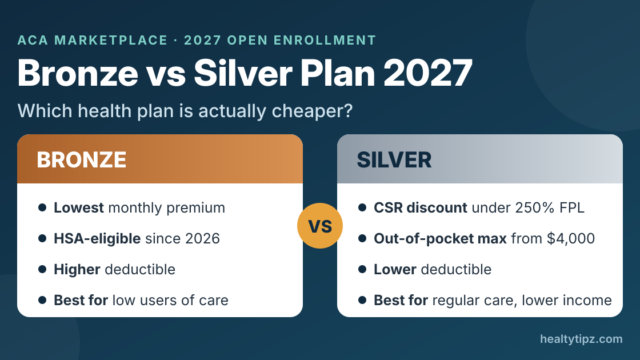
- Consider a bronze plan with an HSA. Since January 1, 2026, bronze and catastrophic marketplace plans are HSA-eligible (IRS). In 2027 you can put up to $4,500 a year (self-only) into an HSA, and contributions reduce your taxable income.
- Deduct your premiums. If you’re self-employed and not eligible for a spouse’s employer plan, you can usually deduct premiums you pay yourself using IRS Form 7206.
- Watch for Medicaid. If your income drops sharply, you may qualify for Medicaid for those months. Medicaid looks at current monthly income, not the yearly total.
Quick FAQ
Do I have to pay back the premium tax credit if I earn more than I estimated? Yes. Starting with 2026 coverage, you repay the full extra amount when you file your return.
What if I earn less than I estimated? You get the difference back as a bigger refund or a smaller tax bill.
What’s the best health insurance for freelancers with irregular income? For most people it’s a marketplace plan with income updated often. A bronze plan paired with an HSA works well if you’re healthy and want lower premiums.
When can I enroll? Open enrollment for 2027 coverage runs November 1, 2026 to January 15, 2027 in most states. Sign up by December 15 for coverage starting January 1.
This article is general information, not tax or insurance advice. Talk with a tax professional or licensed agent about your situation.
Sources: Healthcare Insider: repaying the premium tax credit · KFF: 2027 open enrollment · IRS: HSA changes · IRS: Form 7206 · HealthCare.gov