In this article
Health Insurance for College Students Over 26
The average graduate student isn’t 22 anymore. Plenty of people go back to school at 28, 35 or 45, and plenty of grad students are still in class after their 26th birthday. That birthday matters, because it’s the day most people get dropped from a parent’s health plan.
If you’re a student over 26, or about to be, here’s how to stay covered without overpaying.
What happens to your coverage at 26
Under the Affordable Care Act, you can stay on a parent’s plan until you turn 26, whether or not you’re a student. After that you usually have to find your own coverage. If the plan is through a parent’s job, coverage often ends at the end of the month you turn 26.
The good news: losing that coverage is a qualifying life event. You get a special enrollment period that runs from 60 days before to 60 days after your coverage ends (HealthCare.gov). You don’t have to wait for open enrollment.
A handful of states let young adults stay on a parent’s plan longer, up to age 29, 30 or even 31 in some cases, usually only if you’re unmarried and have no other coverage (ValuePenguin). Ask your parent’s insurer whether your state’s extension applies.
Your 4 main options
| Option | Good for | Cost picture |
|---|---|---|
| Student health insurance plan (SHIP) | Full-time students who use campus health services | Set by your school; often paid per semester and added to your bill |
| ACA marketplace plan | Part-time students, students with some income, anyone who wants year-round coverage | Depends on income; tax credits can lower it a lot |
| Medicaid | Students with very low income in expansion states | Little or no cost |
| Job-based plan | Students working as TAs, RAs or employees | Usually the employer pays most of the premium |
1. Your school’s student health plan
Most universities offer a student health insurance plan, and most have no upper age limit. Many grad schools automatically enroll you and add the fee to your bill unless you prove you have other coverage. These plans usually cover the campus clinic, mental health services and local hospitals, and run on the academic year.
Watch out for: coverage gaps in summer if you’re not enrolled, and narrow networks if you live off campus or take online classes. You also can’t get a tax credit to help pay for a SHIP.
2. A marketplace plan
A marketplace plan through HealthCare.gov or your state’s exchange is often cheaper than a student plan if you have modest income. Your premium tax credit depends on your estimated income for the year. Student loans don’t count as income, but stipends and fellowship pay often do.
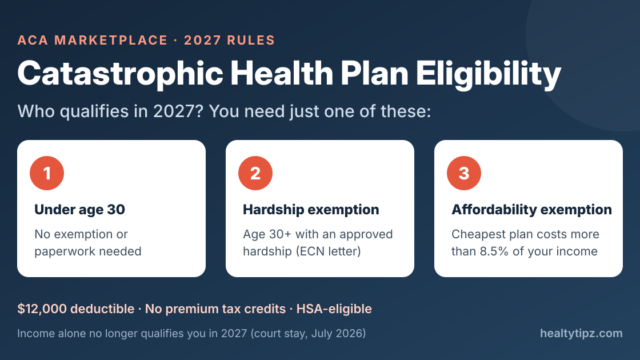
If you’re under 30, you can also look at a catastrophic plan: a low-premium plan that mainly protects you from huge bills. Since 2026, catastrophic and bronze plans can be paired with an HSA (IRS).
3. Medicaid
If your income is very low and your state expanded Medicaid, you may qualify. Starting January 1, 2027, many adults in expansion states must report 80 hours a month of work or other qualifying activity to keep Medicaid (CMS). Going to school at least half-time generally counts, so keep your enrollment records handy.
4. Coverage through work
If you’re a teaching or research assistant, check whether your position comes with health benefits. Many universities provide coverage to graduate employees and pay most or all of the premium.
How to pick
- You use the campus clinic a lot and don’t have much income: compare the SHIP with a subsidized marketplace plan. The marketplace plan often wins.
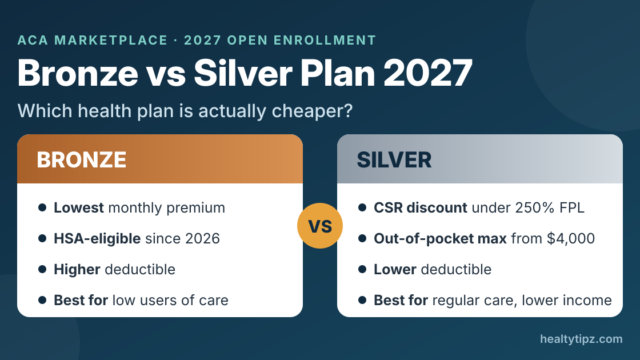
- You’re healthy and want the lowest premium: a bronze or catastrophic plan with an HSA.
- You’re studying online or part-time from another state: a marketplace plan with local doctors in its network.
- Your income is close to zero: apply for Medicaid first.
FAQ
Can I get health insurance as a student over 26? Yes. Your choices are your school’s student plan, a marketplace plan, Medicaid, or a job-based plan.
Do I have to wait for open enrollment after I turn 26? No. Turning 26 triggers a special enrollment period of 60 days before and after you lose coverage.
Is student health insurance worth it? It can be if you rely on campus health services, but compare it with a subsidized marketplace plan first.
When is open enrollment for 2027? November 1, 2026 to January 15, 2027 in most states. Enroll by December 15 for coverage starting January 1.
General information, not insurance advice. Check your school’s plan documents and your state’s exchange for details.
Sources: HealthCare.gov: young adults · ValuePenguin: state rules after 26 · IRS: HSA changes · CMS: Medicaid community engagement · Healthcare Insider: options for students aging off a parent’s plan