In this article
Health Insurance for Uber & DoorDash Drivers (2027 Guide)
If you drive for Uber or deliver for DoorDash, you already know the deal: you’re your own boss. That means nobody hands you a benefits packet. No HR department, no company health plan, no one quietly paying half your premium in the background.
The good news is that you have more options than most drivers realize. And right now is the best time of year to sort it out. Open enrollment for 2027 coverage runs from November 1, 2026 to January 15, 2027 on HealthCare.gov. If you want your plan to start on January 1, sign up by December 15.
This guide walks through what Uber and DoorDash actually offer, where to find a plan, how to report gig income that changes every week, and how to get some of that money back at tax time.
Do Uber and DoorDash offer health insurance?
No. Because drivers are independent contractors, neither company offers a traditional health plan. They do offer a few kinds of help, and many drivers never hear about them:
- Stride Health access. Uber has partnered with Stride Health to help drivers compare marketplace plans and enroll, usually in about 15 minutes from a phone. Stride works with DoorDash, Instacart, Amazon and other gig apps as well.
- California’s Prop 22 stipend. In California, drivers who average 15 to 25 “engaged” hours a week over a quarter get a stipend of 41% of the average Covered California premium. At 25+ hours it rises to 82% (KFF Health News). Engaged time only counts while you’re on a trip or delivery, not while you wait. Hours from different apps can’t be combined.
- DoorDash portable benefits pilots. DoorDash has tested benefits savings accounts in Pennsylvania, Georgia and Maryland. Eligible Dashers could put the money toward health, dental or vision insurance.
- Massachusetts. Uber and Lyft drivers in Massachusetts can earn health insurance stipends through a state portable benefits fund run by Stride.
Check the Driver or Dasher app for what’s available in your state. Treat any stipend as help with the bill, not a full plan. You still need to buy coverage yourself.
Your health insurance options as a gig driver
For most Uber and DoorDash drivers, the best value is an ACA marketplace plan, especially if your income qualifies you for a premium tax credit. Here’s how the main options compare:
| Option | Best for | Watch out for |
|---|---|---|
| ACA marketplace plan (HealthCare.gov or your state’s exchange) | Most full-time and part-time drivers | You need to estimate your income for the year |
| Medicaid | Drivers with low net income | Work requirements start Jan 1, 2027 in many states |
| A spouse’s or partner’s job-based plan | Drivers whose partner has a W-2 job | Family premiums can be high |
| A parent’s plan | Drivers under 26 | Coverage ends when you turn 26 |
| Short-term health insurance | A gap of a few months | Can deny pre-existing conditions; doesn’t cover the ACA’s essential benefits |
| Health sharing ministry | People who accept the trade-offs | Not insurance, and there’s no guarantee bills get paid |
A few notes on each:
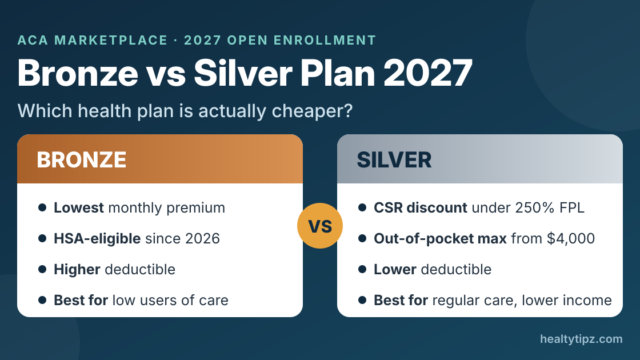
Marketplace plans can’t turn you down for a pre-existing condition, and they cover doctor visits, prescriptions, ER care and preventive care. Plans come in bronze, silver, gold and platinum tiers. Bronze has the lowest premium and the highest deductible. Silver can come with extra cost-sharing help if your income is modest.
Medicaid rules depend on your state. In states that expanded Medicaid, single adults with very low income usually qualify. Starting January 1, 2027, many expansion adults aged 19 to 64 will need to show 80 hours a month of work or other qualifying activity (CMS). Gig hours generally count, so keep good records from your app.
Short-term plans are cheaper for a reason. They’re fine for bridging a month or two between jobs, but they aren’t a good long-term plan for someone spending eight hours a day on the road (healthinsurance.org).
How to estimate your income when it changes every week
The marketplace bases your premium tax credit on your expected net self-employment income for 2027. That’s not the total payout shown in the app. It’s what’s left after business expenses. This is the part that trips up most drivers.
To get a realistic number:
- Pull your 1099-K or 1099-NEC totals and weekly earnings from the last 12 months.
- Subtract business expenses: the mileage deduction (or actual car costs), phone, car washes, insulated bags, tolls and parking.
- Adjust for anything you expect to change next year, such as driving more hours or adding a second app.
- Add any other household income, such as a partner’s wages.
For example, a DoorDash driver who grosses $42,000 but writes off $14,000 in mileage and expenses reports about $28,000. That driver may qualify for a much bigger tax credit than the gross number suggests.
Update your application during the year if your income changes. If you earn more than you estimated, you may have to pay back part of the credit at tax time. If you earn less, you’ll get the difference back.
What changed for 2027
The extra “enhanced” subsidies that kept premiums low from 2021 through 2025 expired on December 31, 2025. The House passed an extension in January 2026, but the Senate hasn’t acted (KFF). As a result:
- The subsidy cliff is back. If your household income is above 400% of the federal poverty level, you get no tax credit at all. Even $1 over the line can cost you thousands of dollars a year. This is one more reason to report net income, not gross.
- Premiums are rising. Benchmark silver premiums go up about 13% on average for 2027, according to KFF.
- Bronze plans now work with an HSA. Since January 1, 2026, bronze and catastrophic marketplace plans count as HSA-compatible (IRS). For 2027 you can put up to $4,500 a year into an HSA for yourself, or $9,000 for a family, before taxes.
Is self-employed health insurance tax deductible?
Yes, and it’s one of the best write-offs a driver has. If you have a profit from driving and you aren’t eligible for a spouse’s employer plan, you can usually deduct the premiums you pay for yourself, your spouse and your dependents. You figure the amount on IRS Form 7206 and report it on Schedule 1. You don’t have to itemize to claim it.
The deduction can’t be more than your net profit from self-employment. It also doesn’t lower your self-employment tax, only your income tax. A tax preparer who works with gig workers can help you get it right.
How to sign up, step by step
- Gather your numbers: last year’s tax return, your 1099s, and your mileage log.
- Go to HealthCare.gov or your state’s exchange (Covered California, Pennie, Get Covered NJ and others). Stride Health is a free alternative that guides you through it.
- Enter your estimated 2027 net income using the method above.
- Compare plans by total yearly cost, not just the monthly premium. Add the premium times 12 plus the deductible you’d realistically hit.
- Check that your doctors and prescriptions are covered.
- Enroll by December 15, 2026 for coverage starting January 1. The final deadline in most states is January 15, 2027.
- If you’re in California, keep proof of enrollment so you can claim your Prop 22 stipend each quarter.
FAQ
Does Uber give drivers health insurance? No. Uber offers enrollment help through Stride Health, and California drivers can earn a Prop 22 stipend. You still need to buy a plan.
Does DoorDash give Dashers health insurance? Not directly. Dashers in California get the Prop 22 stipend, and DoorDash has run portable benefits pilots in a few states.
What happens if I miss open enrollment? You’ll need a qualifying life event, such as losing other coverage, moving or having a baby, to enroll later. A big income change can also qualify in some cases.
Can I deduct health insurance as an Uber driver? Usually yes, through the self-employed health insurance deduction on Form 7206.
What’s the cheapest health insurance for gig workers? For most drivers it’s a subsidized bronze or silver marketplace plan. Drivers with low income may qualify for Medicaid at little or no cost.
This article is for general information and isn’t tax, legal or insurance advice. Rules vary by state. For your situation, talk with a licensed health insurance agent or a tax professional.
Sources
- Uber Newsroom: Momentum rewards and Stride Health
- Stride: Massachusetts portable health benefit fund
- DoorDash: Pennsylvania portable benefits pilot
- DoorDash: Georgia portable benefits pilot
- KFF Health News: Prop 22 health stipends
- KFF: 9 things to watch for 2027 open enrollment
- healthinsurance.org: open enrollment deadlines
- CMS: Medicaid community engagement requirement
- IRS: HSA changes under the One Big Beautiful Bill
- IRS: Instructions for Form 7206