In this article
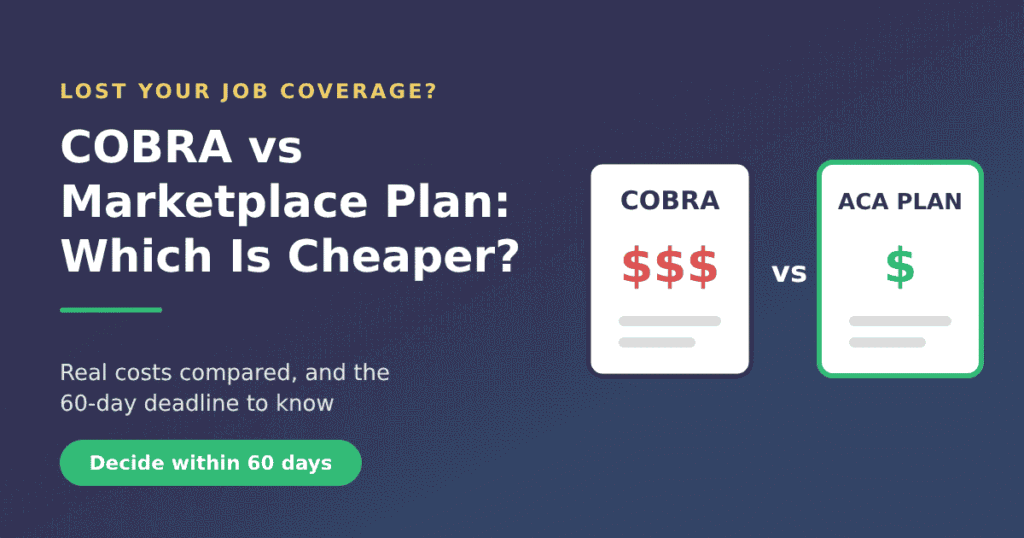
COBRA vs Marketplace Plan: Which Is Cheaper?
You just left a job, maybe by choice, maybe not. A few days later a thick envelope arrives offering COBRA. You open it, see the monthly price, and your heart sinks a little.
Before you sign anything, know this: COBRA is rarely the cheapest option. But there are a few cases where it’s the smart one. Here’s how to tell the difference.
What COBRA actually costs
COBRA lets you keep the exact plan you had at work, usually for up to 18 months. The catch is that your employer stops paying its share. You pay the full premium plus a 2% admin fee, so 102% of the total cost.
That’s a shock because most workers only ever see their own slice. In 2025, the average employer plan cost $9,325 a year for single coverage and $26,993 for family coverage, and workers paid only about 16% and 26% of that (KFF).
So on an average plan, COBRA works out to roughly $790 a month for one person and about $2,300 a month for a family.
What a marketplace plan might cost
A marketplace plan through HealthCare.gov or your state exchange is priced by age, location and plan level. The big difference is the premium tax credit, which is based on your expected household income for the year.
Losing a job often means your income for the year drops, and that can mean a bigger credit. Many people coming off a job pay far less for a marketplace plan than for COBRA, and some with very low income qualify for Medicaid instead.
The flip side: if your household income for the year will be above 400% of the federal poverty level, you get no credit in 2027, and an unsubsidized marketplace plan may cost about as much as COBRA (KFF).
Side-by-side comparison
| COBRA | Marketplace plan | |
|---|---|---|
| Monthly cost | Full premium + 2% | Based on income; tax credits may lower it a lot |
| Same doctors and plan | Yes | Depends on the plan you choose |
| Deductible | What you’ve already paid this year still counts | Starts over at $0 |
| How long it lasts | Usually up to 18 months | As long as you keep paying |
| Tax credit eligible | No | Yes, if you qualify |
When COBRA is worth it
- You’ve already met most of your deductible this year and you have big bills coming, such as surgery or ongoing treatment. Switching plans resets your deductible and out-of-pocket max.
- You’re in the middle of treatment with doctors who aren’t in any marketplace network near you.
- You need only a month or two of coverage before a new job’s plan starts.
- Your old employer is paying for COBRA as part of a severance package.
When the marketplace usually wins
- Your income for the year will be modest, so you qualify for a tax credit.
- You’re healthy and haven’t used much of this year’s deductible.
- You need coverage for longer than a few months.
The 60-day deadline that catches people
Losing job-based coverage gives you a 60-day special enrollment period to pick a marketplace plan. You also have at least 60 days to elect COBRA, and COBRA can be applied retroactively.
The trap is what comes later. If you voluntarily drop COBRA or stop paying outside open enrollment, that doesn’t qualify you for a special enrollment period, so you could end up with no coverage until the next open enrollment (KFF).
There are two exits: during open enrollment (November 1 to January 15 in most states) you can switch from COBRA to a marketplace plan, and when COBRA runs out you get a new special enrollment period.
How to decide in 15 minutes
- Find your COBRA monthly price in the election notice.
- Estimate your household income for the whole year, including the months you were working and any severance.
- Use HealthCare.gov’s “see plans and prices” tool to check marketplace prices with your estimate.
- Add up what each option would cost for the rest of the year, including deductibles you’d have to meet again.
- Pick one before your 60 days run out.
FAQ
Is COBRA cheaper than a marketplace plan? Usually not. COBRA charges the full premium, while marketplace plans often come with income-based tax credits.
Can I drop COBRA for a marketplace plan? Yes, within your 60-day window after losing job coverage, during open enrollment, or when COBRA runs out. Not at other times.
How much does COBRA cost per month? On an average plan, roughly $790 for one person and about $2,300 for a family, based on KFF’s 2025 survey.
General information, not insurance advice. Check your COBRA notice and get real quotes before deciding.
Sources: KFF: 2025 Employer Health Benefits Survey · KFF: dropping COBRA · KFF: 2027 open enrollment · HealthCare.gov: COBRA coverage