In this article
Health Insurance for a Small Business With 2 Employees
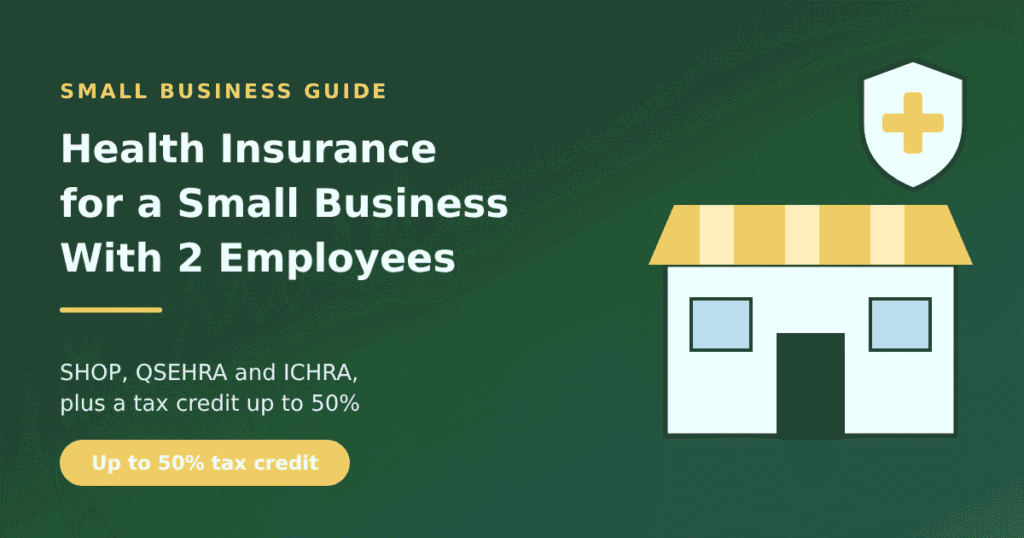
When your whole team fits around one table, offering health insurance can feel like something only “real” companies do. It isn’t. A business with two employees has more options than ever, and some come with tax breaks that make them surprisingly affordable.
Here are the four main paths, what they cost, and how to pick one.
First: who counts as an employee?
This trips up a lot of owners. For most group health plans, insurers want at least one W-2 employee who isn’t the owner or the owner’s spouse. If your “two employees” are you and your spouse, a group plan usually isn’t an option, and you’d look at individual marketplace coverage instead.
If you do have one or two non-owner employees, read on.
Option 1: A small group plan (including SHOP)
This is traditional job-based insurance. You pick a plan from an insurer, pay part of the premium, and your employees join.
You can buy a group plan through a broker or directly from an insurer, or through the SHOP Marketplace, the ACA’s small business exchange. SHOP matters because it’s generally the only way to claim the Small Business Health Care Tax Credit (HealthCare.gov). To qualify:
- You have fewer than 25 full-time equivalent employees.
- Average pay is about $65,000 a year or less.
- You pay at least 50% of employees’ self-only premiums.
- You offer coverage to all full-time employees.
The credit can be worth up to 50% of what you pay toward premiums (35% for nonprofits), and you can claim it for two years in a row. It’s largest for the smallest, lowest-wage employers, so a two-person business can come out well ahead. You claim it on IRS Form 8941.
Watch out for: minimum participation rules (often around 70% of eligible employees must enroll) and the fact that everyone is on the same plan options.
Option 2: QSEHRA
A Qualified Small Employer Health Reimbursement Arrangement lets you give employees a tax-free monthly allowance. They buy their own individual plan and you reimburse them up to the limit.
- Only for employers with fewer than 50 full-time equivalent employees that don’t offer a group plan.
- For 2026, the maximum is $6,450 a year for self-only coverage and $13,100 for family coverage (Blake Insurance Group). The IRS updates these limits each year.
- You choose the amount, as long as you treat employees in the same way.
Good for: owners who want a fixed, predictable cost and minimal paperwork.
Option 3: ICHRA
An Individual Coverage HRA works a lot like a QSEHRA, but with no upper dollar limit and no size cap. You can also set different amounts for different classes of workers, such as full-time and part-time.
Good for: businesses that plan to grow, or owners who want to give a bigger allowance than a QSEHRA allows.
One thing to know about both HRAs: if the allowance makes the coverage “affordable” under IRS rules, your employee can’t also get a premium tax credit on the marketplace. Run the numbers before you choose an amount.
Option 4: Help employees buy their own marketplace plan
You can offer nothing formal and simply point employees to HealthCare.gov. Depending on their income, they may qualify for premium tax credits. A raise may help them pay the premium, but it’s taxable.
This is the cheapest option for you, but also the least attractive when you’re trying to hire or keep good people.
Quick comparison
| Option | Your cost | Tax break | Best for |
|---|---|---|---|
| SHOP group plan | At least 50% of employee premium | Up to 50% credit for 2 years | Owners who want a classic benefit |
| QSEHRA | Fixed allowance you choose, up to the IRS cap | Tax-free to employees, deductible to you | Tiny teams wanting simplicity |
| ICHRA | Fixed allowance, no cap | Tax-free to employees, deductible to you | Growing teams |
| No plan | $0 | None | Bare-bones budgets |
What about you, the owner?
If you’re self-employed and buy your own plan, you can usually deduct those premiums with IRS Form 7206. If you set up a group plan, you can generally join it too.
FAQ
Can a business with 2 employees get group health insurance? Yes, in most states, as long as at least one employee is not the owner or the owner’s spouse.
Is the small business health care tax credit worth it? For very small employers with modest wages, it can return up to half of your premium costs for two years.
ICHRA vs QSEHRA: which is better for a small business? QSEHRA is simpler and capped; ICHRA has no cap and more flexibility. Most two-person businesses start with a QSEHRA.
General information, not tax or legal advice. Talk with a licensed broker or tax professional before you choose.
Sources: HealthCare.gov: SHOP basics · IRS: Small Business Health Care Tax Credit · Blake Insurance Group: small business health insurance · healthinsurance.org: employer tax credits · IRS: Form 7206